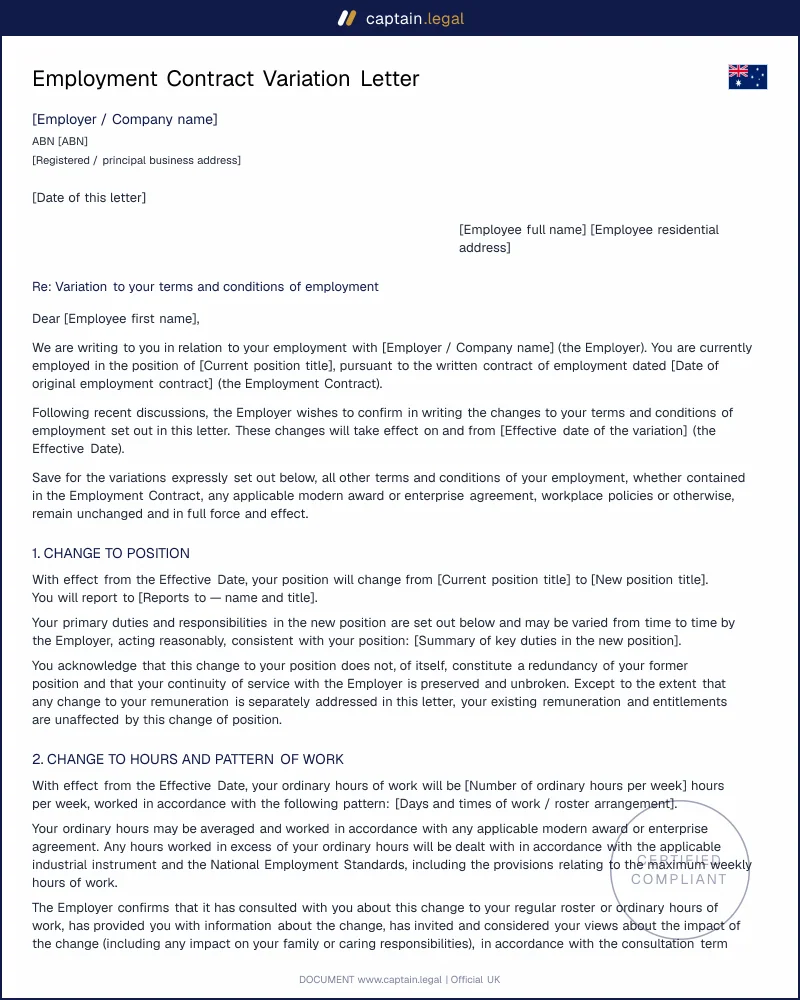
An Employment Contract Variation Letter records a change to an existing Australian employment agreement without tearing up the whole contract. It sits on top of the original document, amending only the clauses you name (role, hours, pay, location, or a shift from casual to permanent) while every other term stays in force. Employers and HR managers use it when a verbal "we'll sort the details later" promise needs to become something enforceable. The value of this contract variation letter is simple: it converts a loose conversation into a signed record that payroll, the employee, and (if it ever comes to that) the Fair Work Commission can all read the same way.
In Australia you cannot vary a contract by decision alone. Variations require genuine agreement from both sides, which is exactly why the letter format matters: it captures consent in writing, dates the change, and closes the door on the "that's not what we agreed" argument six months down the track.
Compliant
2026 Legislation
50,000+ clients
trust us
Affordable
From $4.90 / doc
Secure payment
Instant download
Employment Contract Variation Letter | Fair Work Act
Secure payment
What is an employment contract variation letter?
An employment contract variation letter is a short written instrument that alters one or more terms of an existing contract of employment. It does not replace the original agreement. Instead, it identifies the specific clause being changed, sets out the exact new wording, states an effective date, and confirms that all remaining terms continue unchanged. Lawyers sometimes call the more formal version a deed of variation, but for most everyday changes a signed letter is enough.
The distinction that trips people up is variation versus a fresh contract. A variation adjusts an existing relationship: you bump a salary, add a bonus scheme, or move someone from four days to five. A new contract starts the relationship over, which can reset probation, accrued entitlements framing, and continuity of service. There is a threshold in the case law, too. Where the change to duties or remuneration is profound and the original contract never contemplated it, a court may treat the old contract as discharged and replaced, as discussed in Federated Mutual Insurance Co of Australia Ltd v Sabine and applied in later authority. If you are promoting someone into a genuinely different job, a variation letter may not be the right tool, and a new contract is the cleaner path. For adjustments within the same broad role, a variation is precisely what you want. If you are still finalising the underlying agreement, the Australian employment contract template built to the Fair Work Act 2009 gives you the base document this letter then amends.
Legal framework
Employment terms in Australia sit across four layers: the individual contract, any applicable modern award or enterprise agreement, the National Employment Standards under the Fair Work Act 2009 (Cth), and the common law of contract. A variation letter has to respect all four at once. The starting principle from the Fair Work Act and confirmed repeatedly by practitioners is that an employer cannot unilaterally change a fundamental term such as position, hours, pay, or location. Genuine agreement from the employee is required, and any change that reduces an entitlement below the NES floor or below an applicable award is void to that extent. You can always improve on the minimum. You cannot contract underneath it.
The common law adds a requirement that surprises many employers: consideration. A variation is a contractual change, and at common law each side generally must give something of value for the new promise to bind. Where only one party gains (a pay cut with nothing flowing back to the employee, for instance), the variation can fail for want of consideration unless it is executed as a deed of variation, which is enforceable without consideration provided the execution formalities are met. Australian courts have softened this in places, recognising in Musumeci v Winadell Pty Ltd and later in Hill v Forteng Pty Ltd [2019] FCAFC 105 that a "practical benefit" can amount to sufficient consideration, but you should not build a variation around that safety net. Where value is unclear, use a deed.
Awards and enterprise agreements bring their own overlay. Many awards set minimum notice for roster or shift changes and impose consultation obligations before major changes to hours. If your employee is award-covered, check that instrument before you finalise the letter. The Fair Work Ombudsman publishes the official Fair Work guidance on changing to permanent employment, which is the authoritative reference for the casual conversion pathway discussed below.
When do you need this document?
The most common trigger is a pay change: a salary increase, a new commission or bonus structure, or a shift in allowances. Documenting it protects both sides, because a verbal promise of "an extra ten grand from July" is worth very little when the manager who made it has moved on. The second frequent scenario is a change of hours, whether increasing a part-timer's ordinary hours, reducing them, or rearranging the days worked. Here you have to watch award notice rules for roster changes, which can require days of advance notice you did not plan for.
Role changes sit in the middle of the risk spectrum. Expanding someone's duties, adding a team-lead responsibility, or updating a position title all warrant a variation letter, provided the change stays within the same broad job. A casual-to-permanent conversion is the fourth major use, now governed by the employee choice pathway and often paired with a variation letter that spells out the new full-time or part-time hours. Location changes round out the list: moving an employee to a new site, or formalising a hybrid or remote arrangement.
Two edge cases deserve a flag. First, a probation extension is a variation and needs genuine agreement, not a manager's say-so. Second, a "temporary" change that quietly becomes permanent can create a new implied term you never intended, so put an end date in the letter if the change is genuinely time-limited. When the variation touches confidentiality or restraint terms, consider whether the Australian NDA and confidentiality template should be updated alongside it.
Key clauses included in our template
- The identification of the parties and original contract opens the letter with the employer's full legal entity name and the employee's name, then references the original employment contract by date and position. This anchors the variation to a specific agreement so there is no ambiguity about which document is being amended.
- The clause-by-clause statement of what changes names each term being varied (for example, "Clause 5 Remuneration" or "Schedule 1 Hours of Work") and sets out the exact replacement wording. Vague drafting like "hours will change as discussed" is replaced with the precise new figure, day pattern, or salary, because a variation that cannot be read on its face invites the dispute it was meant to prevent.
- The effective date fixes when the change takes operational effect, which matters for payroll cut-off, leave accrual, and any award notice period that applies to the change.
- The consideration or deed clause records what each side gives in exchange, satisfying the common law requirement, or converts the instrument into a deed of variation where consideration is unclear. This is the clause that keeps a one-sided change enforceable.
- The preservation clause confirms that every term not expressly varied continues in full force, so the parties do not accidentally reopen the entire contract.
- The signature and acknowledgement block captures dated signatures from both parties, evidencing the genuine agreement that Australian law requires for any valid variation.
State and territory considerations
Because the Fair Work Act 2009 (Cth) operates nationally through the national workplace relations system, the core rules on variation apply consistently across every state and territory for employees of constitutional corporations, which covers the vast majority of private-sector workplaces. That said, a few local layers still bite.
New South Wales, Victoria, and Queensland employers should pay close attention to modern award coverage, since most award-covered roles carry consultation and roster-notice obligations that a variation to hours will trigger regardless of state. Western Australia is the notable structural exception: sole traders, partnerships, and other unincorporated employers there fall under the state industrial relations system rather than the national one, so a variation for those employers is governed by WA state instruments and the Industrial Relations Act 1979 (WA) rather than the Fair Work Act. Getting the jurisdiction wrong at the outset means applying the wrong minimum standards to the change. For small business employers across all states, note that the casual conversion employee choice pathway only became available from 26 August 2025, later than the 26 February 2025 date that applied to larger employers, which affects the timing of any casual-to-permanent variation. Public-sector and local-government employment can sit under separate state frameworks again, so confirm the applicable instrument before drafting. Where the variation is one part of a broader restructure, the Australian termination letter pack drafted to s.119 covers the redundancy scenarios a variation cannot.
How to fill out this variation letter
You start by selecting the type of change you are making, since role, hours, pay, location, and casual conversion each pull in slightly different wording and, for hours, different award notice considerations. From there, you enter the employer's full legal entity name and the employee's details, then reference the original contract by its date and the position it created. The template then asks you to identify the specific clause being varied and to type the exact new term, whether that is a salary figure, a revised day pattern, or a new position title. You nominate an effective date, which the letter uses to frame payroll and accrual timing. If the change is one-sided or the consideration is unclear, you select the deed of variation option so the document executes without needing fresh consideration. The letter closes with a preservation statement and a dual signature block. Once both parties sign, you download a clean Word file for editing and a print-ready PDF for the personnel file. If the underlying agreement itself needs work first, the full library of Australian employment documents sits one click away.
Common mistakes to avoid
The costliest error is treating a variation as something the employer can impose. Australian law is clear that fundamental terms cannot be changed unilaterally, and pushing a pay cut or a significant hours reduction through without genuine agreement risks claims of breach of contract, adverse action, or constructive dismissal. A close second is forgetting consideration entirely: a beautifully drafted letter that gives the employee nothing in return can be unenforceable at common law unless it is executed as a deed, and many DIY variations miss this completely. The third recurring trap is vague language. "Duties will be adjusted as required" or "hours to be confirmed" defeats the whole purpose, because a variation the parties cannot read on its face is a variation waiting to be litigated.
Employers also stumble on award and agreement overlay. Skipping the consultation or roster-notice obligations in an applicable modern award can make an otherwise valid variation non-compliant, and those obligations apply on top of the individual contract, not instead of it. Finally, people confuse a variation with a fresh contract. If the change is profound enough to discharge the original contract, dressing it up as a minor amendment can leave you exposed. When in doubt about whether you are varying or replacing, the safer choice is to issue a new agreement. For businesses formalising the entity behind these arrangements, the Australian company constitution template under s.136 rounds out the governance paperwork.
Frequently Asked Questions
21 verified reviews · 50 000+ downloads
- Immediate access to the document
- PDF + Word download
- Compliant with 2026 legislation
- Reviewed by lawyers
You might also like