Create my document
Login

Choose country

AustraliaAustraliaChoose country
Family & Divorce

Limited Child Support Agreement | Child Support Act 1989

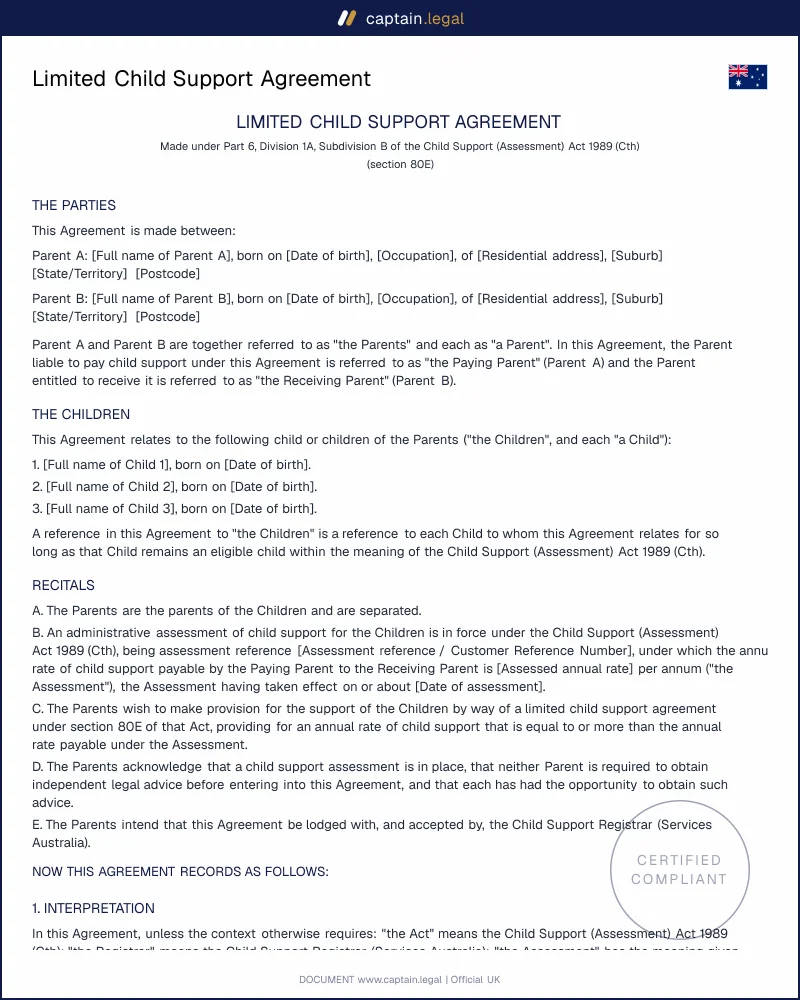
Draft a limited child support agreement under the Child Support (Assessment) Act 1989. Registrable with Services Australia, above the assessment. Word and PDF.
4.8/523 reviews50 000+ downloadsInstant download
Share

A Child Support Private Agreement (Limited Agreement) lets separated parents lock in the amount, indexation and extra costs of raising their children, then register it with Services Australia (Child Support) so it carries real legal weight. Under the Child Support (Assessment) Act 1989 (Cth), a limited child support agreement sits between an informal handshake and a full binding agreement: it must be in writing, signed by both parents, and it needs an existing child support assessment as its floor. This template is built for Australian parents who already have an assessment in place and want to formalise periodic payments, indexation, and extraordinary expenses like private school fees, orthodontics and health cover, without paying for two sets of lawyers.

Most parents reach for this document when the standard formula assessment does not quite fit their life. Maybe one parent earns irregular income, maybe the kids are in private school, maybe you simply want certainty for the next few years. A limited agreement gives you that structure while keeping a sensible exit built in.

Compliant

2026 Legislation

50,000+ clients

trust us

Affordable

From $4.90 / doc

Secure payment

Instant download

Limited Child Support Agreement | Child Support Act 1989

Secure payment

Fill in the template

What is a child support private agreement (limited agreement)?

A limited child support agreement is a formal written arrangement between two parents or carers about the financial support of their children, registered with the Child Support Registrar under the Child Support (Assessment) Act 1989 (Cth). It is one of two private agreement types Australian law recognises. The other is the binding child support agreement, which requires each parent to obtain independent legal advice and can be made for any amount, even below the formula. A limited agreement takes the opposite trade-off: no lawyer sign-off is required, but the annual rate you agree must be equal to or more than the amount payable under the current assessment.

That single constraint shapes everything. Because the agreed figure cannot dip below the formula, Services Australia treats a limited agreement as a way to add certainty and extras on top of the baseline, not a way to reduce a paying parent's obligation. People often confuse this with a purely private handshake arrangement, which involves no registration and no enforcement machinery at all. A registered limited agreement is different: once accepted, the Registrar gives effect to it, and unpaid amounts can be collected through the child support system. If you want flexibility without the cost and permanence of a binding agreement, and you already hold an assessment, this is usually the right instrument. Our family law document templates for Australia are drafted around exactly this distinction so you pick the correct category from the start.

2

When do you need this document?

The most common trigger is a wish for predictable payments over a fixed horizon. Parents who have separated amicably often want to know precisely what lands each fortnight for the next few years, rather than watching the figure move every time an income estimate changes. A limited agreement freezes the arrangement while preserving a clean three-year exit, which suits parents who expect their circumstances to settle but not vanish.

Extraordinary expenses drive a second wave of these agreements. The formula assessment covers day-to-day costs, but it says nothing about private school fees, braces, elite sporting programs, or the gap between Medicare and a specialist's actual invoice. When one child is in private education and another is not, parents frequently want those costs carved out and shared on a defined percentage, and a limited agreement is the natural home for that detail. Recording who pays what, and when, stops the quarterly argument before it starts.

Irregular or seasonal income is a third scenario. A tradesperson, a commission earner or a small business owner may find the formula whipsaws their liability, so a stable agreed figure at or above the assessment brings sanity to both households. One edge case worth flagging: if either parent expects to fall below 35% care, the entitlement to child support under the agreement can drop away entirely, so build in what happens if care percentages shift. Parents blending finances after a new relationship also use these documents alongside a broader separation record. If your situation reaches into property or superannuation, our separation and financial agreement resources sit next to this one in the same category.

3

Key clauses included in our template

  • The identification of the parents and children names each parent by full legal name and lists every child the agreement covers, with dates of birth, because section 87 lets one agreement span multiple children and the Registrar needs each child clearly identified. Vague references to "the kids" have no place in a document the Registrar must accept.
  • The periodic child support amount states the annual or fortnightly figure in words and numbers, expressly confirmed to be equal to or more than the current administrative assessment. This is the clause the Registrar scrutinises first, so it references the assessment it sits on top of.
  • The indexation clause sets how the periodic amount adjusts over the life of the agreement, typically by reference to a published index or a fixed annual percentage, so payments keep pace without a fresh negotiation each year. Leaving this out is how a fair figure in year one becomes an unfair one by year three.
  • The extraordinary expenses clause defines which costs sit outside the periodic amount, private school fees, orthodontic and dental work, private health insurance premiums, and major extracurricular costs, and fixes the sharing ratio and the approval process before a large bill is incurred.
  • The duration and review clause records the start date, confirms the three-year minimum before unilateral termination, and sets an optional review point so both parents revisit the numbers deliberately rather than by accident.
  • The termination and dispute clause spells out the statutory exit routes, including the three-year notification and the 15% notional assessment shift, and points parents to family dispute resolution before any court step.
4

State and territory considerations

Child support is Commonwealth law, so the core of a limited agreement is uniform across Australia. The Child Support (Assessment) Act 1989 (Cth) applies identically whether you live in Sydney or Darwin, and Services Australia administers acceptance nationally. What changes between jurisdictions is the surrounding machinery: the courts that hear disputes, the family dispute resolution landscape, and the state or territory rules on private school enrolment and health that shape your extraordinary expenses.

New South Wales parents deal with the Federal Circuit and Family Court of Australia registries in Sydney, Parramatta and Newcastle for any related property or parenting matters, and NSW has a dense network of accredited family dispute resolution practitioners whose section 60I certificates matter if a dispute escalates. Documenting private school fee obligations carefully is worth the effort given Sydney's private education costs.

Victoria operates a strong Family Relationship Centre network, and Victorian parents often pair a limited agreement with a parenting plan lodged through those services. Where a child attends an independent Victorian school, the enrolment contract usually binds the enrolling parent personally, so your extraordinary expenses clause should mirror who signed the school agreement.

Queensland parents, spread across a large decentralised state, frequently build travel and contact costs into their thinking because changeover distances are real. While those costs are more a change of assessment matter than an agreement term, a well-drafted limited agreement still acknowledges how significant travel interacts with the shared expenses you record.

Western Australia is the important outlier. WA is the only state that did not refer its ex-nuptial family law powers to the Commonwealth, so parenting matters for unmarried parents run through the Family Court of Western Australia. Child support assessment and limited agreements, however, still operate under the Commonwealth scheme, so a WA limited agreement is accepted by Services Australia the same way, even though related parenting orders follow the WA pathway.

5

How to fill out this child support private agreement

You begin by confirming the one precondition that cannot be skipped: an administrative assessment must already be in place, because our form asks for the assessed annual rate that your agreed figure has to meet or beat. From there you enter each parent's full legal details and list every child the agreement will cover, which the template uses to structure the payment and expense clauses correctly. Next you set the periodic amount and choose your indexation method, and the document confirms in plain words that the figure is equal to or more than the assessment so the Registrar has no reason to hesitate.

You then define the extraordinary expenses, ticking the categories that apply, private schooling, medical and dental gaps, health insurance, extracurricular costs, and setting the sharing ratio and the approval step for large outlays. The final stage covers duration, the three-year exit and dispute resolution, after which both parents sign. Once you download in Word and PDF, you lodge the signed agreement with Services Australia using the Child Support Agreement form so the Registrar can accept it. If you also need to record living and financial arrangements, our Australian separation agreement templates complement this one.

6

Common mistakes to avoid

The single most damaging error is agreeing a figure below the current assessment. A limited agreement whose periodic amount falls short of the assessed annual rate will not be accepted, so parents who negotiate downward simply waste the exercise and often the goodwill that came with it. Close behind is trying to lodge without an assessment in place at all. The assessment is a legal precondition, not a formality, and the Registrar cannot accept the agreement until one exists. A third frequent slip is treating the document as self-executing: an unsigned or unlodged agreement carries none of the enforcement weight parents assume, because a limited agreement only takes effect once the Registrar accepts it.

Vague expense clauses cause the most day-to-day friction. Writing "we will share school costs" without a ratio, a definition of what counts, or an approval process guarantees a fight the first time a large invoice arrives, so name the expenses and fix the percentages. Parents also forget indexation, leaving a sensible year-one figure to erode in real terms, and they overlook the 35% care threshold, which can quietly extinguish an entitlement if care shifts. Finally, many parents do not realise the three-year clock and the 15% notional assessment rule can end the agreement earlier than expected, so plan for those exits rather than being surprised by them. Where employment income drives the numbers, our Australian employment document templates help evidence earnings cleanly.

Key takeaways

Eligibility

You need a current assessment first

A limited child support agreement only works if an administrative child support assessment is already in force when you apply for acceptance. That assessment sets the baseline: the annual rate in your agreement must be equal to or higher than the assessed amount under the Child Support (Assessment) Act 1989 (Cth). It is designed to add certainty and cover extras, not reduce the paying parent’s liability.

Formalities

Written, signed, then accepted to bite

This is not a casual arrangement. The agreement must be in writing and signed by both parents (or eligible carers), whether on one document or identical counterparts. It only takes legal effect once Services Australia (Child Support), acting as the Child Support Registrar, accepts and registers it under Part 6 (including s 80E). Until acceptance, you do not have the same enforceable footing.

Enforcement

Registration unlocks collection and consequences

Once the Registrar accepts the limited agreement, it carries real legal weight through the child support system. Unpaid amounts can be pursued and collected via Services Australia processes, unlike a private handshake deal that relies on goodwill. Use the agreement to lock in practical items like periodic payments, indexation and specific extra costs (for example private school fees or orthodontics) so expectations are clear and arrears are less likely.

Frequently Asked Questions

Signing alone is not enough. A limited child support agreement takes legal effect only when the Child Support Registrar at Services Australia accepts it, and acceptance depends on two conditions: an administrative assessment must be in force, and the agreed annual rate must be equal to or more than that assessment. The document itself must be in writing and signed by both parents, either on one copy or on separate identical copies. Once accepted under the Child Support (Assessment) Act 1989 (Cth), the Registrar gives effect to it and amounts owing can be collected through the child support system, which is what separates a registered agreement from an informal private arrangement that carries no enforcement.

No. This is the defining feature that distinguishes a limited agreement from a binding one. A binding child support agreement requires each parent to obtain independent legal advice and produce a signed statement confirming it, while a limited agreement requires none of that. You can seek legal advice if you want reassurance, and many parents do for complex extraordinary expenses, but it is not a legal precondition to acceptance. The trade-off is that the agreed figure must sit at or above the formula assessment, whereas a binding agreement can be set at any amount. For most amicable separations with an assessment already in place, skipping the lawyer requirement is the practical appeal.

A limited agreement can cover both cash payments and non-cash items on top of the periodic amount. In practice parents include private school fees, uniforms and excursion costs, private health insurance premiums, out-of-pocket medical, dental and orthodontic expenses, and the costs of significant extracurricular or sporting activities. The key is precision: define each category, fix the sharing ratio, whether proportional to income, 50/50, or another split, and set an approval process for large outlays before they are incurred. Section 84 of the Act expressly allows non-periodic and lump sum provisions, so these clauses are well within the recognised scope of a limited agreement.

Yes. Under section 87 of the Child Support (Assessment) Act 1989 (Cth), a single child support agreement can be made in relation to two or more children, which is exactly how most separated families use it. The template lists each child by full name and date of birth so the periodic amount and the extraordinary expenses can be structured correctly across the sibling group. This matters when children have different needs, for example one in private school and one not, because a well-drafted agreement can apportion specific expenses to specific children rather than treating them as a single undifferentiated pool.

A limited agreement has a three-year minimum before either parent can end it unilaterally. After three years, either party may terminate simply by notifying the Child Support Registrar, without needing the other parent's consent. The agreement can also end earlier if a fresh notional assessment shows the child support payable has changed by more than 15% from what a notional assessment produced when you signed. Beyond those routes, both parents can agree to replace it with a new agreement, and a court can set it aside under section 136 in cases of fraud or unconscionable conduct. Building an awareness of these exits into your duration clause avoids nasty surprises.

You download the agreement in both Word and PDF. The Word version lets you refine names, amounts, indexation and the extraordinary expenses clauses before either parent signs, which is useful when you are still finalising the school fee split or the sharing ratios. The PDF is the clean copy for signing and lodgement. Once both parents have signed, you submit it to Services Australia with the Child Support Agreement form so the Registrar can consider acceptance. Keeping an unsigned Word master is sensible, because if you later replace the agreement after the three-year point you already have your starting structure ready to adjust.

Yes, and this catches parents out. Your Family Tax Benefit Part A is generally calculated by reference to a notional assessment, meaning the amount the formula would produce, rather than the higher figure you may have agreed to pay or receive. So agreeing to more than the assessment does not reduce the paying parent's family assistance calculations in the way some expect, and it does not inflate the receiving parent's. The notional assessment is refreshed periodically, and either parent can generally challenge a new notional assessment within a short window. If your household budget leans on family assistance, factor this separation between the agreed figure and the notional figure into your planning.

4.8/5

23 verified reviews · 50 000+ downloads

Limited Child Support Agreement | Child Support Act 1989
  • Immediate access to the document
  • PDF + Word download
  • Compliant with 2026 legislation
  • Reviewed by lawyers
Fill in the template
Secure payment
Updated on July 18, 2026

You might also like

Separation Agreement Australia
Binding Financial Agreement Australia