Create my document
Login

Choose country

AustraliaAustraliaChoose country
Personal

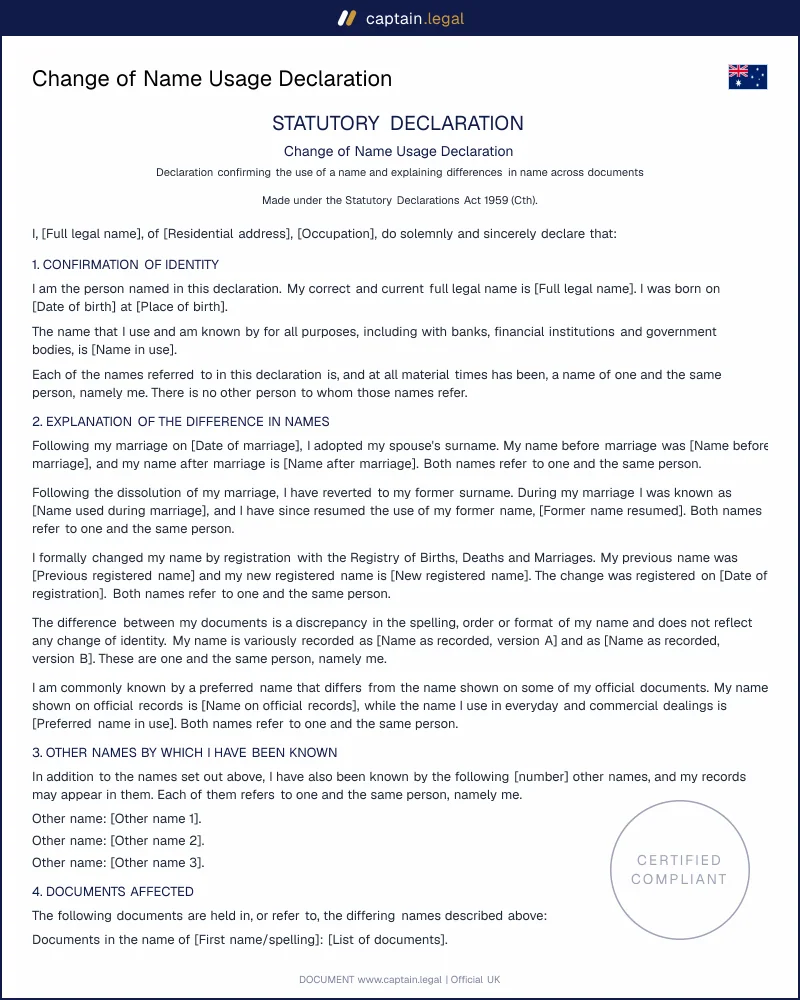
Change of Name Usage Declaration Australia (Cth 1959)

Statutory declaration under the Statutory Declarations Act 1959 confirming one and the same person. State and Commonwealth compliant, editable Word and PDF.
4.7/59 reviews50 000+ downloadsInstant download
Share

A change of name usage declaration is a sworn statement in which you confirm, under law, that the different names appearing across your identity and financial records all belong to one person: you. It is the document banks, superannuation funds, insurers, and government agencies ask for when your birth certificate says one thing, your bank account says another, and a marriage certificate, spelling variation, or informal usage sits somewhere in between. If your driver licence reads "Jennifer" and your bank file reads "Jenny", or a maiden name still lingers on an old policy, this declaration links the records and lets the institution act without freezing your file.

In Australia, this is almost always made as a statutory declaration, a formal instrument governed by legislation and witnessed by an authorised person. Getting the form and the witnessing right is what separates a declaration a bank accepts on sight from one that gets bounced back.

Compliant

2026 Legislation

50,000+ clients

trust us

Affordable

From $4.90 / doc

Secure payment

Instant download

Change of Name Usage Declaration Australia (Cth 1959)

Secure payment

Fill in the template

What is a change of name usage declaration?

A change of name usage declaration is a statutory declaration dealing with one narrow question: it states that two or more names in circulation refer to a single individual, and it explains how that discrepancy arose. It does not change your legal name. That is a separate process handled by the Registry of Births, Deaths and Marriages under state and territory Births, Deaths and Marriages Registration legislation, which issues a change of name certificate. This document does something quieter and more common. It reconciles records that already exist, so an organisation can be satisfied that "John James Smith" on a title and "John Smith" on a transfer are one and the same person.

The distinction matters because people conflate the two constantly. If you formally changed your name by registration, marriage, or divorce, you usually prove that with the certificate itself. The usage declaration steps in when there is no single certificate that bridges the gap: when a name has been misspelled at the source, when you have used a shortened or anglicised version for years, or when a foreign document cannot be linked cleanly to your Australian records. The declaration you make on our platform is drafted to the one and the same person standard that lenders, share registries, and government departments expect, with the operative facts set out in plain, chronological order.

2

When do you need this document?

The classic trigger is a home loan or refinance where the lender's identity check flags a name mismatch. A broker sees "Jane Johnston" on a payslip and "Jane Smith" on the bank statement, and the file stalls until you declare that you married in 2016 and have used your married name since. Share registries are just as fussy: a holding recorded under a former name cannot be sold or transferred until the registry has a declaration confirming the holder and the seller are the same person, often paired with a certified copy of the marriage certificate.

Property settlements produce a steady stream of these. When the name on a certificate of title differs from the name on the memorandum of transfer, the land titles office will not register the dealing until a declaration explains the discrepancy, whether it flows from marriage, a spelling correction, or an error made when the title was first issued. The same logic reaches a residential tenancy agreement where a landlord or tenant is identified inconsistently across the lease and an ownership record.

Then there are the everyday reconciliations: superannuation nominations recorded under a maiden name, insurance policies bought under an anglicised spelling, or a long-standing habit of using a middle name as a first name. One edge case worth flagging is the foreign-issued document, such as an overseas deed poll or marriage certificate, which Australian institutions frequently refuse to link directly, so a usage declaration explaining how the community name diverged from the legal name becomes the practical bridge. A second edge case is the deceased estate, where an executor must show that the name on an asset matches the name in the will.

3

Key clauses included in our template

  • The declarant's identity and legal name opens the document, stating your full legal name as it appears on your birth certificate, citizenship certificate, or change of name certificate, together with your address and date of birth. This anchors the declaration to a single verifiable identity before any other name is introduced.
  • The statement of the names in use lists every variant that appears across your records, each quoted exactly as it is written on the relevant document. Precision here is what makes the declaration usable: a bank matching "J. Smith" to "John James Smith" needs to see both forms spelled out, not summarised.
  • The "one and the same person" clause is the operative heart of the document. It declares in the accepted statutory language that all listed names refer to you, a single individual, and that you are the person named in each of the attached or referenced records.
  • The explanation of how the discrepancy arose sets out the facts in chronological order, whether marriage, divorce, a registered change of name, a spelling error at source, or long usage of a shortened form, with dates. Institutions read this closely because it distinguishes an innocent variation from a red flag.
  • The solemn declaration and witnessing block closes the document with the statutory formula required by the Statutory Declarations Act 1959 or the relevant state Act, followed by the signature, the date, the reference to any supporting certificates annexed, and the authorised witness's details.
4

State and territory considerations

New South Wales governs statutory declarations through the Oaths Act 1900 (NSW), and the declaratory formula ends with words confirming the declaration is made by virtue of that Act. NSW maintains its own list of authorised witnesses, and while remote witnessing by audio-visual link has been embedded following the pandemic-era reforms, the state form still contemplates witnessing by an authorised person rather than a fully unwitnessed digital option. A declaration for a NSW land titles dealing should use the NSW form, not the Commonwealth one.

Victoria replaced its older regime with the Oaths and Affirmations Act 2018 (Vic), in force from 1 March 2019, with the old Evidence (Miscellaneous Provisions) Act 1958 form ceasing to be valid after 1 January 2020. Victoria expressly permits electronic signing and witnessing by audio-visual link, and section 30 of the Act sets out a broad list of authorised witnesses. Using a pre-2020 Victorian form will get your declaration rejected, so the currency of the template matters here more than in most states.

Queensland relies on the Oaths Act 1867 (Qld), one of the oldest instruments still in force, updated by later amendment. The Queensland form carries the "by virtue of the provisions of the Oaths Act 1867" wording, and the state prescribes who may take a declaration, including justices of the peace and commissioners for declarations, a category Queensland uses heavily. For property matters, a Queensland titles office expects the state form aligned to its own registration practice.

Western Australia operates under the Oaths, Affidavits and Statutory Declarations Act 2005 (WA), which consolidated the state's rules into a single modern statute. WA sets its own authorised witness list and declaratory wording, and a WA declaration for a state purpose should follow the WA form rather than the Commonwealth version. Across all jurisdictions the golden rule holds: match the form to the purpose, because an institution acting under state law will often decline a declaration executed under the wrong Act. When employment records are the source of the mismatch, our employment document templates can help you correct the underlying paperwork.

5

How to fill out this change of name usage declaration

You start by choosing whether the declaration is for a Commonwealth purpose, such as a bank, superannuation fund, or share registry, or a state purpose, such as a land titles office or a state court, because that choice sets the correct statutory wording and witness rules. From there you enter your full legal name exactly as it appears on your primary identity document, then your address and date of birth, so the declaration is anchored to a single verifiable person before any variant name is added.

Next you list each name in use, transcribing it letter for letter from the record where it appears, and you set out the reason for the discrepancy in date order. The form prompts you for the operative facts most institutions want, the marriage date, the spelling correction, or the period over which a shortened name was used, and assembles them into the accepted "one and the same person" statement. You then identify any certificates you intend to annex.

Once the wording is complete, you download the document in editable Word and print-ready PDF format. You sign it in front of an authorised witness, either in person or over an audio-visual link where the relevant Act allows, or you use the myGov digital pathway for a Commonwealth declaration if you prefer no witness. If you are reconciling names for a company or director record, our business and company templates cover the related filings.

6

Common mistakes to avoid

The most frequent failure is using the wrong Act for the purpose. People download a Commonwealth stat dec and present it to a state land titles office, or the reverse, and the institution declines it because the declaratory formula does not match its governing law. Just as common is transcribing a name loosely: writing "John Smith" when the record actually reads "John J. Smith" defeats the entire purpose, because the institution is matching character strings, not intentions. A declaration that summarises rather than quotes the disputed names rarely survives a careful reviewer.

Witnessing errors are the next big category. A declaration signed before someone who is not on the authorised list is simply invalid, and you cannot witness your own document even if you are an authorised witness yourself. People also forget to annex the supporting certificate, leaving the reader with an assertion and nothing to check it against, or they sign a Victorian form that predates 2020 and is no longer valid. Some declarants understate the history, giving a single date when the real sequence involved a marriage, a later divorce, and a reversion to a former name. Leave out a step and the institution sees a gap, not a clean chain. For a straightforward authority record rather than a sworn statement, our personal notice and authority templates offer a lighter alternative.

Key takeaways

What it does

Links different names to one person

This statutory declaration is used to confirm that different names across your records refer to you. It is commonly requested by banks, superannuation funds, insurers and government agencies when documents don’t match, such as “Jennifer” on a driver licence but “Jenny” on a bank file, or a maiden name still on an older policy. It lets the organisation update or act without freezing the file.

Not a rename

It does not change your legal name

A change of name usage declaration reconciles existing records; it is not the process for formally changing your name. Legal name changes are handled through your state or territory Registry of Births, Deaths and Marriages under births, deaths and marriages registration legislation, typically producing a change of name certificate. This declaration is mainly for gaps where no single certificate neatly bridges spelling variations, short forms or long-term informal use.

Execution rules

Use the right statutory declaration pathway

The governing law is usually the Statutory Declarations Act 1959 (Cth) for Commonwealth purposes, or the relevant state oath/statutory declaration legislation for state purposes. The form and witnessing need to match the purpose: a bank or share registry often expects a Commonwealth stat dec, while a state land titles office may require a state form. From 1 January 2024, Commonwealth stat decs can be done on paper, electronically with audio-visual witnessing, or digitally via myGov using myGovID (no witness).

Frequently Asked Questions

Yes. When made correctly under the Statutory Declarations Act 1959 (Cth) or the relevant state Act, it is a formal legal instrument, and making a false statement in it is a criminal offence. That is precisely why banks, insurers, and government agencies accept it as evidence that different names belong to one person. The binding force comes from the solemn declaration and the authorised witnessing, or from verified digital execution through myGov. It does not change your legal name. It only confirms that existing records refer to the same individual, so you carry full liability for the accuracy of every fact you declare.

No, and this is the point people most often misunderstand. A usage declaration reconciles records that already exist and confirms that "one and the same person" holds the different names in circulation. Legally changing your name is a separate registration process handled by your state or territory Registry of Births, Deaths and Marriages, which issues a change of name certificate. If you want to adopt a wholly new name going forward, you need that registration. If you simply need a bank or titles office to accept that your maiden name and married name are yours, this declaration is the correct and far quicker instrument.

For a Commonwealth statutory declaration, an approved witness includes legal practitioners, medical practitioners, pharmacists, justices of the peace, police officers, and many other listed occupations connected to Australia. Each state maintains its own authorised list under its own Act, so a Victorian declaration follows section 30 of the Oaths and Affirmations Act 2018 while a Queensland one follows the Oaths Act 1867. You cannot witness your own declaration, even if you are an authorised witness. Since 1 January 2024, a Commonwealth declaration can also be witnessed over an audio-visual link, or made with no witness at all through verified myGov digital execution.

You receive the document in both editable Word and print-ready PDF format. The Word version lets you adjust wording, add annexure references, or correct a detail before signing, which matters because name declarations demand exact transcription. Where a name mismatch stems from marriage or separation, our family and divorce templates address the underlying certificates. For the fully digital myGov pathway you follow that platform's own process, but for in-person or audio-visual witnessing the downloadable file is what you take to your authorised witness.

The declaration itself is effective the moment it is properly signed and witnessed, or digitally executed. There is no waiting period built into the law. The practical timeline depends on the institution's own processing, which usually runs from a few days to a couple of weeks once you submit the declaration with any required certified copies. To avoid delay, make sure the names are transcribed exactly, the correct Act is cited for the purpose, and every supporting certificate is annexed. A declaration that is complete and correctly witnessed is rarely queried, while a defective one restarts the clock.

Often yes, but not always. A single well-drafted declaration confirming that all your names refer to one person can be certified and copied for multiple recipients, and many banks and registries accept a certified copy. Some institutions, particularly land titles offices, insist on an original executed under their own state form. The safest approach is to check whether the recipient requires a Commonwealth or state declaration, because a share registry acting under Commonwealth practice and a state titles office acting under state law may not accept the same document. When in doubt, prepare the declaration for the stricter purpose.

4.7/5

9 verified reviews · 50 000+ downloads

Change of Name Usage Declaration Australia (Cth 1959)
  • Immediate access to the document
  • PDF + Word download
  • Compliant with 2026 legislation
  • Reviewed by lawyers
Fill in the template
Secure payment
Updated on July 21, 2026

You might also like

Enduring Power of Attorney AU
Advance Care Directive Australia