Create my document
Login

Choose country

AustraliaAustraliaChoose country
Personal

Appointment of Enduring Guardian | Guardianship Act 1987

Appointment of enduring guardian drafted to the Guardianship Act 1987 (NSW) and state equivalents. Correct witnessing, functions and acceptance clauses.
4.8/514 reviews50 000+ downloadsInstant download
Share

An appointment of enduring guardian lets you name someone you trust to make decisions about your health, your accommodation, and your daily life if you ever lose the capacity to make those decisions yourself. It is one of the most practical personal legal documents an Australian adult can put in place, and it sits alongside a will and an enduring power of attorney at the core of any sensible estate plan. The appointment only comes into effect if and when you lose decision-making capacity, and it stops short of anything financial. Getting the signing formalities right is what separates a document institutions will accept from one that gets challenged when it matters most.

Most people assume a hospital or an aged care provider will simply listen to the closest relative. In practice they often will not, especially when family members disagree. A properly executed appointment removes that guesswork by putting your chosen person on the record.

Compliant

2026 Legislation

50,000+ clients

trust us

Affordable

From $4.90 / doc

Secure payment

Instant download

Appointment of Enduring Guardian | Guardianship Act 1987

Secure payment

Fill in the template

What is an appointment of enduring guardian?

An appointment of enduring guardian is a written instrument by which a competent adult (the appointor) names one or more people to make personal, lifestyle, and medical decisions on their behalf once they can no longer make those decisions themselves. The word enduring is the important part. A plain guardianship arrangement can lapse or be limited in time, whereas an enduring appointment survives the loss of capacity that would otherwise unravel an ordinary authority. The guardian's role covers where you live, what health care and dental treatment you consent to, what personal services you access, and who you associate with, subject to any limits you write into the document.

It is easy to confuse this document with an enduring power of attorney, and the two are often signed at the same appointment, but they do different jobs. An enduring power of attorney deals with money, property, and legal transactions. An enduring guardian deals with the person, not the wallet. Neither one can do the other's work, which is why anyone building a complete plan usually needs both, together with a valid will. The exact name of the personal-decisions document also shifts depending on where you live, a point that trips up families who move interstate and assume one form covers the whole country.

2

When do you need this document?

The classic trigger is age and life stage. Once you have a mortgage, children, or a blended family, the cost of having no plan starts to outweigh the mild discomfort of thinking about incapacity. Most people sign an appointment of enduring guardian at the same sitting as their will and their financial power of attorney, treating the three as a single planning exercise rather than separate errands. A new diagnosis is another common prompt. Someone in the early stages of dementia still has capacity to appoint, and that window can close faster than families expect, so acting while capacity is clear is far safer than waiting.

Relationship changes matter more than most people realise. A separation, a new partner, or a remarriage can all upend who you would want speaking for you, and in New South Wales an appointment is automatically revoked if you marry after making it, unless you married the very person you appointed. Buying property with a partner, or simply reaching an age where surgery becomes more likely, are both sensible moments to review an existing appointment or make a first one.

There is also an edge case worth flagging for anyone with cross-border ties. If you split your time between two states, or you are likely to be admitted to a hospital interstate, the recognition rules become live. Each jurisdiction recognises out-of-state appointments only to the extent of the powers created under the original law, so a NSW appointment may be honoured in another state but read down to that state's limits. Families managing this alongside a relative's affairs often pair the appointment with the right Australian power of attorney and estate documents so nothing falls through the cracks.

3

Key clauses included in our template

  • The identification of the appointor and guardians names every party in full and confirms each person is over 18. Where you appoint more than one guardian, the clause specifies whether they act jointly (all must agree), severally (any one can act alone), or jointly and severally, because that single choice decides whether an urgent decision can be made when one guardian is unreachable.
  • The statement of functions sets out exactly what the guardian may decide, from accommodation and health care to consenting to medical and dental treatment and accessing personal services. You can authorise the full range or carve it back, for example allowing decisions about treatment but not about where you live.
  • The limitations and directions clause records any conditions you want your guardian to follow, such as a preference to remain at home for as long as is safe, giving your guardian a clear steer rather than a blank cheque.
  • The substitute guardian provision names a backup who steps in if your first choice dies, resigns, or loses capacity, which keeps the appointment alive rather than collapsing it back to a tribunal application.
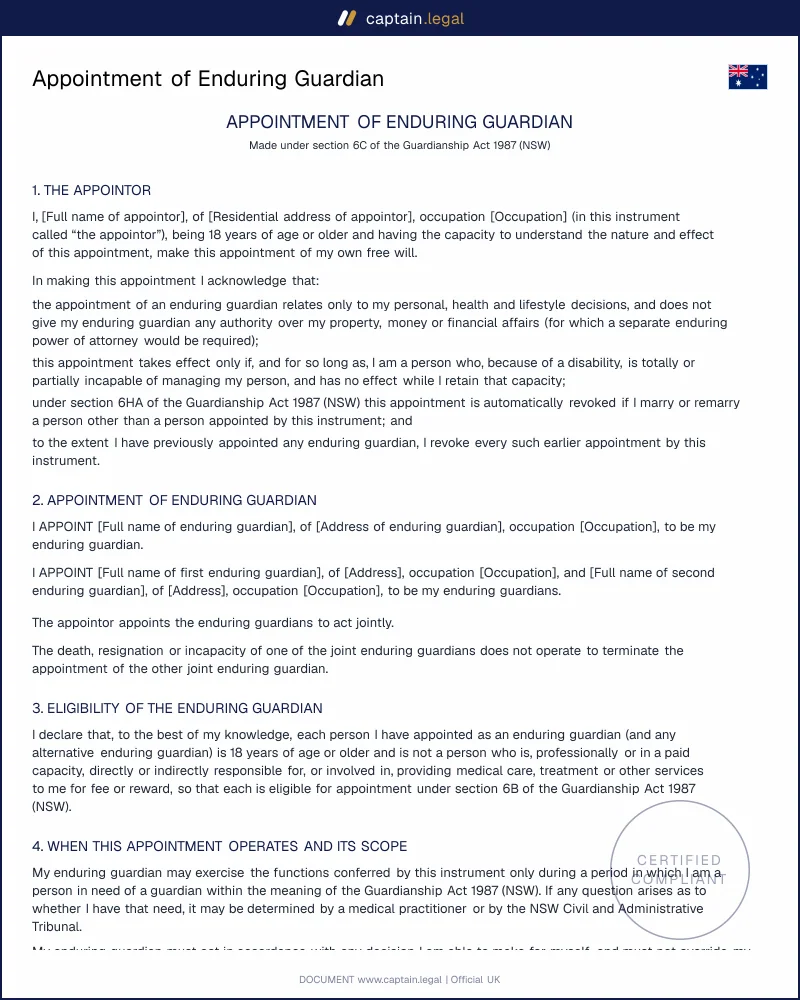
  • The acceptance and witnessing block captures the guardian's signed acceptance and the eligible witness's certification that the document was explained to you, the two formalities most often missed when people use a generic form.
4

State and territory considerations

New South Wales is the home of the classic appointment of enduring guardian under the Guardianship Act 1987 (NSW). The appointment covers personal and medical decisions but never finances, which stay with an enduring power of attorney. The witnessing bar is high: only a lawyer, a Local Court registrar, or an approved employee of the NSW Trustee and Guardian or Public Guardian will do, and that person must explain the document to you first. Keep the original with your will and give copies to your guardian and your GP.

Western Australia uses an enduring power of guardianship under the Guardianship and Administration Act 1990 (WA), appointed under section 110B with formalities in section 110E. Two witnesses are required, present together, and there is no registration system, so where you store the original genuinely matters. WA lets you tailor the guardian's functions tightly, authorising treatment decisions while withholding decisions about accommodation if you prefer.

Victoria no longer offers a standalone enduring guardian. Lifestyle and personal decisions now sit inside an enduring power of attorney under the Powers of Attorney Act 2014 (Vic), while medical treatment runs through a separate medical treatment decision maker under the Medical Treatment Planning and Decisions Act 2016 (Vic). Victorians building a plan therefore need to think in terms of two documents, not one.

Queensland rolls personal, health, and financial authority into a single enduring power of attorney under the Powers of Attorney Act 1998 (Qld), so a separate guardian document is usually unnecessary. Choosing the right instrument for your state before you draft anything is the whole ball game, and it is worth checking your wider Australian legal document categories to line up the matching financial and estate paperwork.

5

How to fill out this appointment of enduring guardian

You start by selecting your state or territory, because that choice sets the correct document name, the statutory language, and the witnessing rules the rest of the form depends on. From there you enter your own details as the appointor and name the person or people you are appointing, confirming each is over 18 and willing to act. If you name more than one guardian, the form asks you to choose how they act together, and it explains the practical effect of jointly versus severally so you are not guessing.

Next you set the scope. You can grant your guardian the full range of personal and health functions or narrow them, and you can add directions that record your values, such as a wish to stay at home or to prioritise certain kinds of care. The form then walks you through the acceptance and witnessing block, prompting the eligible witness certification your state requires. You download the result in editable Word and print-ready PDF, sign it in front of the right witness, and store the original safely. Families often prepare the matching financial authority at the same time from the Australian business and personal legal templates available on the platform.

6

Common mistakes to avoid

The most frequent error is using the wrong document for your state. A Victorian who fills in a NSW-style enduring guardian form has created something their own law no longer recognises, and no amount of careful wording fixes a document made under the wrong Act. Close behind is botched witnessing. In NSW the witness must be a lawyer or Local Court registrar and must explain the effect of the document before you sign, so a form witnessed by a neighbour is simply invalid. People also leave the guardian's acceptance unsigned, forgetting that the appointment is not complete until the person you chose signs on too.

Another quiet trap is appointing two guardians jointly without thinking it through. It sounds fair, but it means every decision needs both signatures, and a single unavailable guardian can freeze an urgent medical choice. Timing is the last big one. An appointment made late, under family pressure, or when capacity is already slipping invites a challenge before NCAT or the equivalent tribunal, which is exactly the dispute the document was meant to prevent. Reviewing your appointment after any major life change, and pairing it with current Australian family and separation documents where relationships shift, keeps the whole plan honest.

Key takeaways

WHAT IT DOES

It only starts if you lose capacity

An appointment of enduring guardian lets you choose who makes personal, lifestyle and medical decisions if you cannot decide for yourself. It covers things like where you live, what health and dental treatment you consent to, and day-to-day services and contact. It does not operate while you still have capacity, and it does not give anyone power over your money or property.

SCOPE

Personal decisions only, not finances

This document is often signed alongside a will and an enduring power of attorney, but they do different jobs. An enduring power of attorney deals with financial and legal transactions. An enduring guardian deals with the person, not the wallet. If you only sign one, gaps appear fast, for example a guardian cannot access bank accounts to pay aged care fees, and an attorney cannot consent to treatment.

FORMALITIES

Witnessing rules decide if it stands up

Getting the signing requirements right is what makes institutions accept the appointment when it matters. In NSW it is made under Part 2 of the Guardianship Act 1987 (NSW) and section 6C requires the appointor to sign in front of an eligible witness. That witness must explain the effect before you sign, and cannot be one of the people you appoint as guardian.

Frequently Asked Questions

Yes, provided it is completed for the correct jurisdiction and executed with the witnessing formalities that state requires. The template mirrors the prescribed structure under the relevant Act, for example Part 2 of the Guardianship Act 1987 (NSW) or the Guardianship and Administration Act 1990 (WA), and it includes the acceptance and witness certification blocks those laws demand. What makes it binding is not the paper alone but the execution: the appointor must have capacity, the eligible witness must explain the document and sign, and each guardian must accept in writing. Follow those steps and institutions will treat it as a valid appointment.

An enduring guardian makes personal and lifestyle decisions, which typically include where you live, what health care and dental treatment you consent to, what personal support services you receive, and who you associate with. You control the breadth of that authority when you sign, so you can grant every function or limit the guardian to specific areas. What a guardian cannot touch is your money. Financial and property matters stay with an enduring power of attorney, which is a separate document. In Queensland and Victoria the personal decisions are instead folded into the enduring power of attorney, which is why confirming your state first is essential.

It takes effect only when you lose the capacity to make personal or lifestyle decisions for yourself, and not a moment before. While you retain capacity, you keep making your own decisions and your guardian has no power at all. The appointment then operates for as long as you lack capacity and ends if you regain it or die. This is the feature that makes it enduring, because an ordinary authority would fail at the very point incapacity begins. If a dispute arises about whether capacity has been lost, a tribunal such as NCAT in NSW can rule on the question.

Yes. Every appointment is generated in editable Word format so you can adjust names, functions, and any directions before signing, and in a clean PDF built for printing and execution. Because these documents must be signed on paper in front of an eligible witness, the print-ready PDF is what you take to that appointment. Keeping the editable Word file is useful if your circumstances change and you later revoke and remake the appointment, which is common after a separation, a remarriage, or a move interstate.

Not necessarily. The law lets any competent adult make an appointment of enduring guardian without engaging a solicitor, and a well-drafted template covers the standard situations most families face. That said, the witnessing rules in some states, notably New South Wales, require a lawyer or Local Court registrar to witness and explain the document, so a legal practitioner is often involved at the signing stage even when you have prepared the form yourself. If your situation is complex, with a contested family background or a guardian overseas, tailored advice is worth the cost.

You can revoke an appointment at any time while you still have the capacity to understand what you are doing. Revocation must be in writing, witnessed in the same way the original was, and delivered to the guardian you previously appointed so they know their authority has ended. Making a fresh appointment does not automatically cancel an old one, so it is safest to sign an express revocation and then a new appointment. In New South Wales, marrying after you made the appointment also revokes it by operation of law, unless you married the person you had already appointed as guardian.

4.8/5

14 verified reviews · 50 000+ downloads

Appointment of Enduring Guardian | Guardianship Act 1987
  • Immediate access to the document
  • PDF + Word download
  • Compliant with 2026 legislation
  • Reviewed by lawyers
Fill in the template
Secure payment
Updated on July 20, 2026

You might also like

Enduring Power of Attorney AU
Advance Care Directive Australia