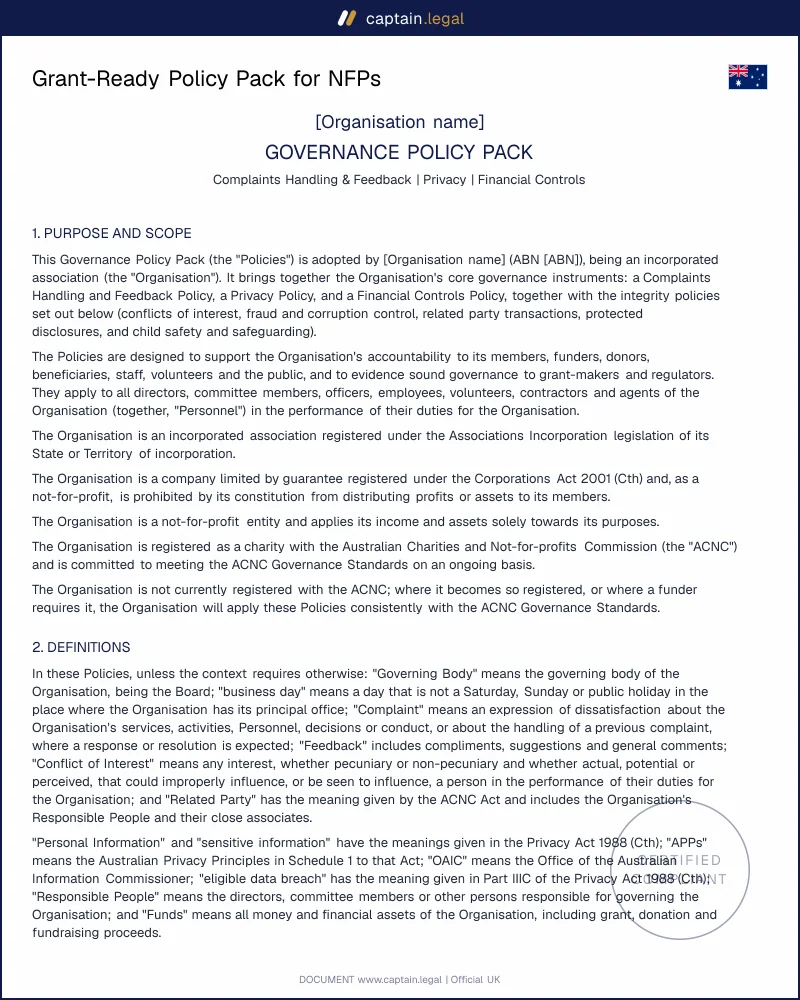
Because incorporated associations are regulated at state and territory level, the financial controls and complaints elements should sit comfortably alongside your specific Associations Incorporation Act rather than contradict it. In New South Wales, associations operate under the Associations Incorporation Act 2009 (NSW), administered by NSW Fair Trading, which sets financial reporting tiers by revenue and expects committee members to manage funds responsibly. A financial controls policy that reflects your tier's audit or review obligations reads as deliberate rather than boilerplate.
In Victoria, the Associations Incorporation Reform Act 2012 (Vic) is administered by Consumer Affairs Victoria and includes model rules that many associations adopt; your complaints and grievance procedure should dovetail with the dispute resolution mechanism in those rules rather than duplicate or override it.
In Queensland, the Associations Incorporation Act 1981 (Qld), overseen by the Office of Fair Trading, sets its own reporting levels and grievance procedure requirements, and the model rules there also address internal dispute handling. If your constitution already contains a dispute clause, your standalone complaints policy must complement it, not conflict with it, or you risk a member arguing the wrong process was followed.
Charities registered with the ACNC face the same Commonwealth Governance Standards regardless of which state they incorporated in, so the privacy and financial elements travel unchanged across borders. What shifts state to state is the incorporating law layer beneath them. If your not-for-profit is a company limited by guarantee, the state Associations Acts fall away entirely and the Corporations Act 2001 (Cth) governs, which changes the reporting and audit context your financial controls policy should reference. Our incorporated association constitution aligned to the state Acts is the document to check your policy pack against before you adopt it.