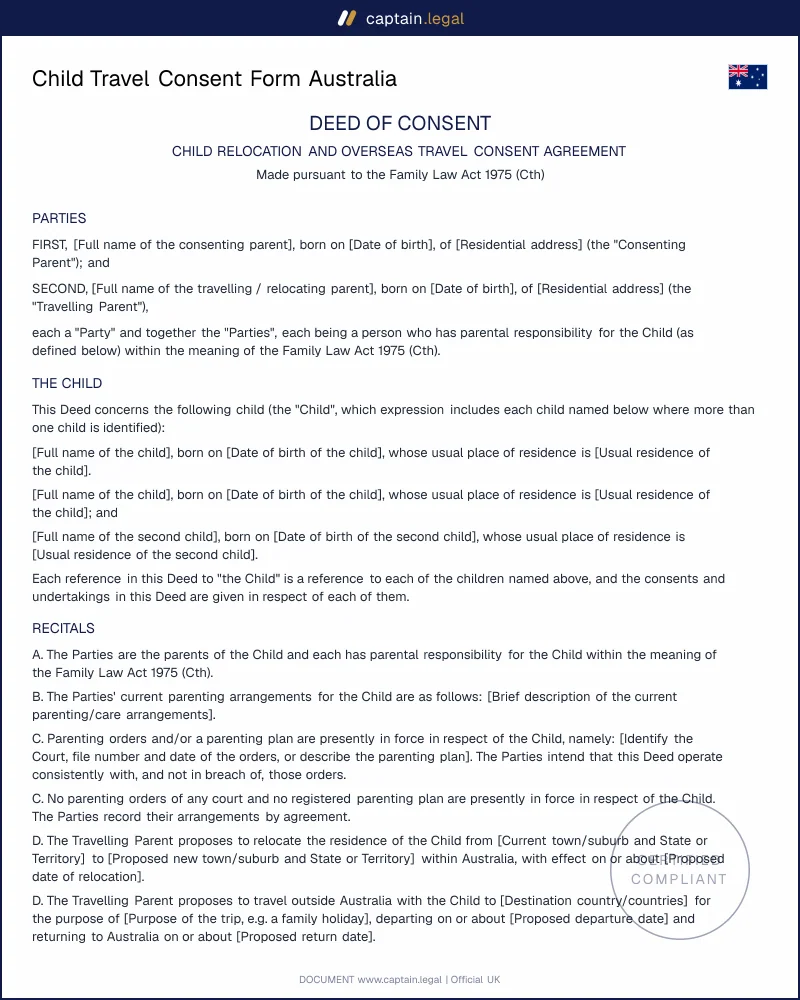
Family law is federal in Australia, so the Family Law Act 1975 (Cth) governs parental responsibility and overseas travel consent uniformly across New South Wales, Victoria, Queensland, South Australia, Tasmania, the Australian Capital Territory and the Northern Territory. A consent agreement drafted to the Act works the same in Brisbane as in Hobart, which is one of the genuine advantages of the national scheme. The practical differences appear in relocation cases, where distance is measured against local realities. A move within greater Sydney rarely counts as a relocation at all, while a move from regional Queensland to Melbourne almost always does, because it collapses the other parent's ability to maintain regular contact.
Western Australia is the standing exception every practitioner learns early. For ex-nuptial children, family law in WA is administered under the state's own Family Court Act 1997 (WA) rather than the Commonwealth Act, though the substantive principles on parental responsibility and travel closely track the federal position. The Australian Passports Act 2005 still applies nationally, so passport consent rules do not change across the border. For married couples, the Commonwealth Act governs even in WA. The upshot is that a consent agreement should reference the correct governing legislation for your family's circumstances, and a WA family dealing with an ex-nuptial child should have the document framed against the state Act. Beyond that single carve-out, the document travels well between states, which is exactly why a nationally drafted template suits most families.