Create my document
Login

Choose country

AustraliaAustraliaChoose country
Employment

Casual Employment Contract: Closing Loopholes Compliant

Drafted to s.15A of the Fair Work Act 2009 as amended by Closing Loopholes No. 2. Casual loading offset, CEIS timing and employee choice pathway included.
4.7/527 reviews50 000+ downloadsInstant download
Share

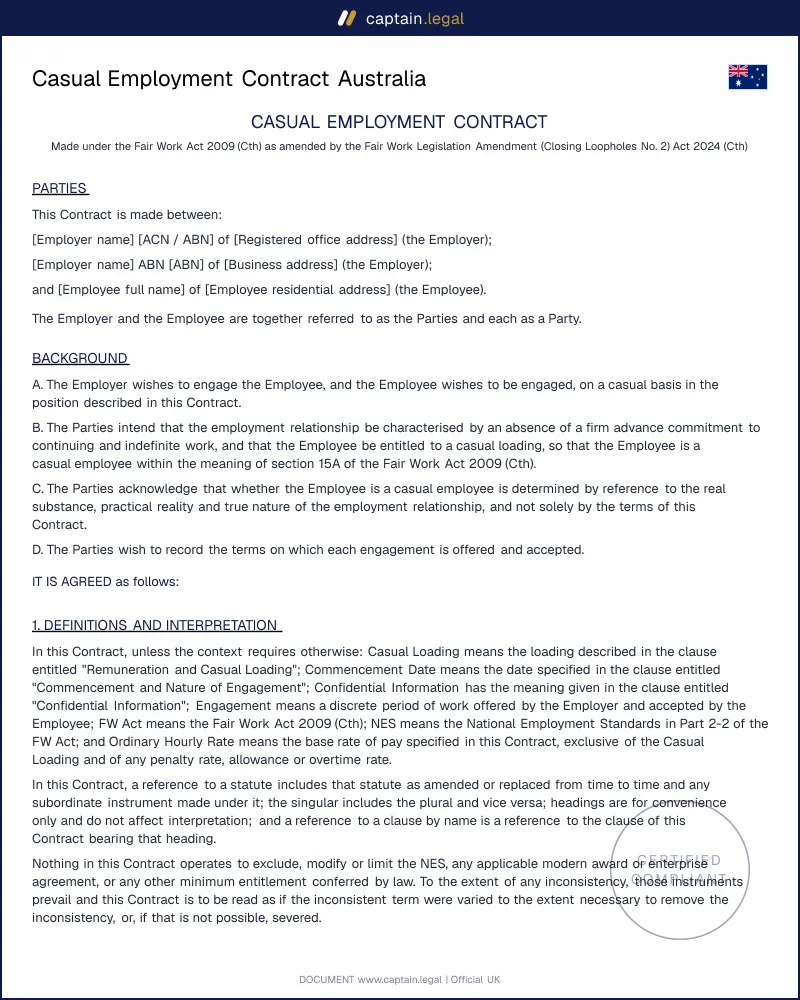
A casual employment contract is the written engagement document you give a worker who has no firm advance commitment to continuing and indefinite work, and who is paid a casual loading instead of paid leave. Since the Closing Loopholes No. 2 reforms rewrote section 15A of the Fair Work Act 2009 (Cth), the contract alone no longer settles whether someone is casual : the Fair Work Commission looks at the real substance of the relationship. This template pairs the contract with the Casual Employment Information Statement obligations that now bite at fixed intervals, and it is built for Australian employers who engage hospitality staff, retail assistants, warehouse hands, tradespeople and administrative support on an irregular basis.

Getting the paperwork right protects the casual loading offset if a misclassification claim ever lands.

Compliant

2026 Legislation

50,000+ clients

trust us

Affordable

From $4.90 / doc

Secure payment

Instant download

Casual Employment Contract: Closing Loopholes Compliant

Secure payment

Fill in the template

What is a casual employment contract in Australia?

A casual employment contract records an offer of work made without any promise that the work will continue, and an acceptance on that same footing. The employee is free to accept or refuse each shift ; the employer is free to stop offering shifts. In exchange for surrendering annual leave, personal leave, notice of termination and redundancy pay, the worker receives a casual loading set by the relevant modern award or enterprise agreement. The standard figure across most awards is 25 per cent on top of the ordinary hourly rate, though a handful of awards and agreements set a different casual rate.

The distinction that trips up employers is the one between a casual and a part-time employee working irregular hours. A part-timer has guaranteed hours written into the contract, accrues leave, and must be given notice before dismissal. A casual has none of that, but also has no roster security. Labelling someone "casual" in the contract does not make them casual if you roster them 38 hours a week for eight months straight and everyone treats the arrangement as ongoing. That is precisely the mischief s.15A was rewritten to stop.

A casual employment contract also differs sharply from an independent contractor agreement built around s.15AA of the Fair Work Act. A contractor runs their own business and invoices you ; a casual is your employee, accrues superannuation, and is covered by the National Employment Standards, minus the entitlements the loading buys out.

2

When do you need this document?

The obvious trigger is a first engagement. You are opening a café, staffing a Saturday retail floor, or covering a seasonal warehouse peak, and you need workers you can roster shift by shift without carrying leave liabilities through the quiet months. Issue the contract before the first shift, and issue the Casual Employment Information Statement at the same time. Both belong in the same onboarding pack.

The less obvious trigger is a repapering exercise. Plenty of Australian businesses are still running casuals on contracts drafted against the pre-2024 definition, which leaned on the "no firm advance commitment as stated in the contract" formulation that s.15A has now displaced. Those contracts are not automatically void, but they misdescribe the legal test and they usually lack the loading offset wording that saves you in a misclassification claim. If your template predates August 2024, it needs replacing.

A third scenario is the conversion refusal. A casual gives you an employee choice notification, you assess it, and you decide the relationship still fits the casual definition. Your ability to defend that refusal rests almost entirely on what the contract says and what your rosters show.

Two edge cases deserve flagging. Casual academics and other higher education staff covered by the relevant awards sit under carve-outs that alter the ordinary analysis. And a casual who takes on a genuinely regular roster over many months while continuing to accept and reject shifts freely may still be casual : regularity alone is not conversion, though it is the single loudest factor an inspector will look at.

3

Key clauses included in our template

  • The nature of engagement clause states in terms that each offer of work is a separate offer, that the employee may accept or decline any shift, and that no ongoing commitment arises from a pattern of acceptance. It is drafted to mirror the s.15A factors rather than to recite the old contractual test, so it reads as evidence of practical reality rather than as a label.
  • The casual loading and offset clause identifies the loading percentage (typically 25 per cent under the applicable modern award), states expressly which entitlements it compensates for, and includes a set-off provision. This clause is the one that saves you money if a court later finds the worker was not casual, because it allows the loading already paid to be offset against the leave entitlements claimed.
  • The applicable industrial instrument clause names the modern award or enterprise agreement and confirms that its terms prevail over any less favourable contract term. Vague drafting here is common and dangerous, because the award drives the loading rate, minimum engagement periods and penalty rates.
  • The minimum engagement clause records the shortest shift you will roster, since most awards impose a floor of two to four hours per engagement. Rostering below the award minimum triggers underpayment exposure even where the employee is happy with the shorter shift.
  • The employee choice pathway acknowledgement confirms that the employee has received the Casual Employment Information Statement and understands the notification mechanism under the National Employment Standards. It records the issue date, which is the fact you will need if the Ombudsman asks.
  • The confidentiality and workplace policy clause binds the casual to the same standards as permanent staff, a point often forgotten. Casuals handle cash, customer data and stock ; the confidentiality protections used in Australian NDAs translate directly into this setting.
4

State and territory considerations

New South Wales, Victoria, Queensland, South Australia and Tasmania all sit within the national workplace relations system for private sector employers, so s.15A and the National Employment Standards apply uniformly. The practical variation comes from long service leave, which remains a state matter. Casuals accrue long service leave under the Long Service Leave Act 1955 (NSW) and its Victorian equivalent, the Long Service Leave Act 2018 (Vic), and continuity of service for casuals is calculated differently in each. Victorian employers should note that continuous employment survives breaks of up to twelve weeks under the state Act, which catches out businesses that assume a summer gap resets the clock.

Western Australia is the outlier that matters. Sole traders, partnerships and unincorporated bodies in WA fall outside the national system and sit under the Industrial Relations Act 1979 (WA) and the state award system. For those employers, s.15A does not apply and the casual definition comes from the relevant WA award instead. Incorporated WA businesses are national system employers and follow the federal rules. Check your entity type before assuming the Fair Work Act governs your WA casuals.

Queensland and the Northern Territory raise a portable long service leave issue in construction and contract cleaning, where industry schemes capture casual service that would otherwise be lost between employers. A casual labourer moving between builders accrues through the scheme rather than through any single employer, so your contract should acknowledge the levy arrangement rather than promise entitlements the scheme actually holds.

The Australian Capital Territory operates portable long service leave across a broader set of industries, including community services, security and hospitality. Casual engagement in those sectors carries a registration obligation that the employment contract itself does not discharge. Employers in the ACT hospitality trade frequently miss this, and the scheme audits.

5

How to fill out this casual employment contract

You start by identifying the employer entity and confirming whether it is a small business employer, meaning fewer than 15 employees counted across associated entities. That single answer drives the Casual Employment Information Statement schedule and the employee choice eligibility period, so the form asks it early. From there you name the modern award or enterprise agreement that covers the role, which sets the loading rate and the minimum engagement the document will carry through.

Next comes the commercial detail : position title, base hourly rate exclusive of loading, the loading percentage, the location, and the reporting line. The form generates the offset wording automatically once the loading figure is entered, so you do not need to draft it yourself. You then set out the shift offer mechanism, choosing between roster publication, direct request, or an app-based system, and the document adjusts the acceptance language accordingly.

The final stage covers the ancillary terms : superannuation fund choice, tax file number declaration reference, workplace policies incorporated by reference, and the confidentiality undertaking. You download the pack in Word and PDF, sign it alongside the Casual Employment Information Statement, and file the issue date. Businesses building out their wider paperwork usually pair this with the range of Australian business formation and governance templates already on the site.

6

Common mistakes to avoid

The most expensive mistake is treating the contract as determinative. Employers write "the employee is engaged on a casual basis with no firm advance commitment", roster the person Monday to Friday for a year, and assume the clause holds. It does not, because s.15A now instructs the decision maker to look past the document at the practical reality. The second mistake follows from the first : omitting or botching the loading offset clause. Without it, a successful misclassification claim delivers the employee both the loading already paid and the leave entitlements never taken, which is the double recovery outcome the offset exists to prevent.

The third is the Casual Employment Information Statement schedule. Issuing it once at hire and forgetting it is non-compliance. A non-small business must reissue at six months, at twelve months, and every twelve months after that ; a small business reissues at twelve months and then annually. Employers also serve stale versions of the statement, when the obligation is to give the version current at the moment of issue.

The fourth is silence on the 21 day response window. When an employee choice notification arrives, you must consult and then respond in writing within 21 days, either accepting or refusing on one of the permitted grounds. Missing the window is a breach of the National Employment Standards, and a refusal with no stated reasons is worthless before the Commission. The fifth, quietly common, is failing to name the award at all, which leaves the loading rate and minimum engagement floating.

Key takeaways

FAIR WORK ACT

Casual status depends on reality, not labels

After the Closing Loopholes No. 2 changes, s.15A of the Fair Work Act 2009 looks past what the contract calls the role and asks how the work runs in practice. If someone is rostered like an ongoing employee (for example, 38 hours a week for months) and treated as continuing, a “casual” label can fail. That is where misclassification claims start.

CASUAL LOADING

Pay the loading, keep the offset protection

A casual arrangement is tied to entitlement to a casual loading or a specific casual rate under the contract or a fair work instrument. Many modern awards use a 25 per cent loading, though some differ. Getting the paperwork and pay settings right is what supports a casual loading offset if the engagement is later challenged and the employee claims leave and other National Employment Standards entitlements.

CEIS

Give the CEIS at the required intervals

This template is designed to pair the contract with Casual Employment Information Statement obligations that apply at fixed intervals. Missing the CEIS timing is an avoidable compliance gap, especially in hospitality, retail and other irregular-shift workplaces. Build it into onboarding and your regular HR calendar so the worker receives the statement when due, not only at the start of the engagement.

Frequently Asked Questions

Yes. It is drafted against the Fair Work Act 2009 (Cth) as amended by the Closing Loopholes No. 2 reforms, and once both parties sign it, it operates as an enforceable contract of employment. What it cannot do is override the National Employment Standards or a modern award : any term less favourable than the applicable instrument is simply of no effect, and the instrument's term applies instead. The template is built to sit under the award rather than against it. The document does not replace advice on a genuinely contested classification, but for a standard casual engagement it is the same instrument an Australian employment practice would issue.

The rate comes from the modern award or enterprise agreement covering the role, not from the Fair Work Act itself. Across the great majority of modern awards the figure is 25 per cent on top of the ordinary hourly rate for the classification. Some instruments set a different casual rate, and a small number express it as a flat casual hourly rate rather than a loading. Under the second limb of s.15A, an entitlement to a loading or a casual rate is a precondition of casual status : pay no loading and the worker is not casual, whatever the contract says. Award-free employees take the loading from the contract itself.

Before the employee starts, or as soon as possible afterwards. Then it depends on your size. A non-small business employer, meaning 15 or more employees, must give it again after six months of employment, again after twelve months, and after every subsequent twelve month period. A small business employer, fewer than 15 employees, gives it again after twelve months and then annually. Always issue the version current on the day you hand it over, since the Fair Work Ombudsman updates the statement periodically. Email, hard copy and a link to the current version all satisfy the delivery requirement provided the employee actually receives it.

Twenty one days from the day the employee gives you the written notice. Within that window you must consult with the employee about what would change, covering whether they would move to full-time or part-time, what their hours would be, and when the change would take effect. Your response must be in writing and must either accept the notification or refuse it on a permitted ground. The grounds are narrow : that the employee still meets the casual definition, that there are fair and reasonable operational grounds, or that acceptance would breach a recruitment or selection process required by law. A refusal must state reasons.

An eligible casual can notify you in writing after six months of employment, or twelve months if you are a small business employer. They must believe they no longer meet the casual employee definition, they must not be in a live dispute with you about the pathway, and they must not have notified you unsuccessfully in the preceding six months. Service before 26 August 2024 does not count towards the qualifying period. The mechanism replaced the old casual conversion model, which put the onus on employers to offer conversion after twelve months. The onus now sits with the employee to ask.

Word and PDF, both included. The Word version is there for the edits every engagement needs, since award names, loading rates and reporting lines vary between roles and you will want a clean master to reuse. The PDF is the signing and filing copy, and it is the one to attach when you send the onboarding pack. Print the Casual Employment Information Statement from the Fair Work Ombudsman site on the day of issue and staple it to the contract, rather than saving an old copy locally.

Not annual leave, not paid personal or carer's leave, and not paid compassionate leave : the loading buys those out. Casuals do get unpaid carer's leave, unpaid compassionate leave, and family and domestic violence leave, which is paid for casuals under the National Employment Standards. Long service leave is a separate question governed by state and territory legislation, and casuals frequently do accrue it. Superannuation is payable on ordinary time earnings regardless of casual status. Casuals engaged regularly and systematically for at least six months, or twelve in a small business, can also access unfair dismissal protections.

Yes, and the shorter the engagement the more the paperwork matters. Without a written contract there is no loading offset clause, no named award, and no documented shift offer mechanism, which means a classification argument later turns entirely on rosters and recollection. A one-page verbal arrangement gives you nothing to point at. The contract also carries the confidentiality and policy terms you need even for a two-shift engagement. If you are also engaging people outside an employment relationship, the Australian legal document catalogue covers the contractor side separately.

4.7/5

27 verified reviews · 50 000+ downloads

Casual Employment Contract: Closing Loopholes Compliant
  • Immediate access to the document
  • PDF + Word download
  • Compliant with 2026 legislation
  • Reviewed by lawyers
Fill in the template
Secure payment
Updated on July 16, 2026

You might also like

Employment Contract Australia
Employee Offer Letter Australia