Create my document
Login

Choose country

AustraliaAustraliaChoose country
Business

NDA Australia: Protect Your Confidential Information Fast

NDA template drafted to Australian breach of confidence law (Coco v AN Clark) and the Corporations Act 2001, with Victorian NDA Act carve-out. Word & PDF.
4.7/522 reviews50 000+ downloadsInstant download
Share

A Non-Disclosure Agreement (NDA) is a contract that binds one or both parties to keep specified information secret and to use it only for an agreed purpose. Australian founders, employers and dealmakers reach for one at the same three moments: before opening the books to a potential buyer or investor, before briefing a contractor or new hire on how the business actually works, and before two companies compare notes on a joint venture. This confidentiality agreement template covers both unilateral disclosure (you talk, they listen) and mutual disclosure (both sides swap sensitive material), drafted for Australian commercial law and the equitable doctrine of breach of confidence that our courts have applied since Moorgate Tobacco Co Ltd v Philip Morris Ltd (No 2) (1984). Download it in Word and PDF, ready to sign.

Compliant

2026 Legislation

50,000+ clients

trust us

Affordable

From $4.90 / doc

Secure payment

Instant download

NDA Australia: Protect Your Confidential Information Fast

Secure payment

Fill in the template

What is a Non-Disclosure Agreement in Australia?

A Non-Disclosure Agreement is a promise, enforceable as a contract, that the recipient of information will not disclose it to third parties or exploit it for their own benefit. Australia has no dedicated trade secrets statute, and that absence explains why the document matters so much here. Protection rests on two pillars: the contract you sign and the equitable obligation of confidence the courts will imply from the circumstances. The equitable route works even without paperwork, but it demands proof of three elements set out in Coco v AN Clark (Engineers) Ltd [1969] RPC 41 and adopted across Australian jurisdictions: the information must carry the necessary quality of confidence, it must have been imparted in circumstances importing an obligation of confidence, and there must be unauthorised use to the discloser's detriment. Proving the second element from a coffee-shop conversation is expensive. A signed NDA converts that argument into a document.

Terminology causes needless confusion. Confidentiality Agreement, Confidentiality Deed and Non-Disclosure Agreement describe the same instrument; the choice is stylistic, not legal, though a deed executed under seal avoids any argument about consideration and attracts a longer limitation period in most states. A unilateral NDA protects one discloser and is standard for investor pitches, contractor briefings and vendor due diligence. A mutual NDA binds both sides and is the honest choice whenever two businesses are genuinely exchanging material, because a one-way agreement in a two-way conversation leaves half the room unprotected. Do not confuse an NDA with a restraint of trade. Confidentiality restricts what a person may say; a restraint restricts where and for whom they may work. They are governed by different rules and courts treat them very differently.

2

When do you need this document?

Capital raising is the most common trigger. A founder who hands over a cap table, customer list and unit economics to a prospective investor without an NDA has published that material, and sophisticated investors know it. The awkward reality is that many venture funds refuse to sign at first meeting, which is why the document is usually deployed at the diligence stage rather than the pitch. Sale of a business is the second scenario, and it is the one where NDAs are most rigorously enforced: a buyer walking away with your supplier pricing and margin structure has taken something worth real money. Engaging contractors, agencies and freelancers ranks third. A developer who sees your codebase, a marketing agency that sees your acquisition funnel, an accountant who sees your ledgers: each needs a written obligation, because the equitable presumption is weaker for arm's length service providers than for employees.

Employment sits slightly apart. Employees owe an implied duty of fidelity during employment and a narrow post-employment duty covering genuine trade secrets, but that implied duty is thin and courts construe it narrowly. An express confidentiality clause, or a standalone NDA signed at onboarding, gives you something to point at. Joint ventures and technical collaborations round out the standard list, and here a mutual NDA is almost always the right instrument.

Two edge cases legitimately catch people out. First, an NDA signed after the information has already been disclosed protects nothing prospectively unless it is drafted to expressly cover prior disclosures; the definition of Confidential Information must reach backwards in time. Second, information that is already in the public domain, or that the recipient independently developed, carries no quality of confidence at all, and an NDA cannot manufacture secrecy where none exists. An overreaching definition that claims everything is confidential often ends up protecting nothing, because a court asked to enforce an unworkably broad clause may decline the injunction outright.

3

Key clauses included in our template

  • The definition of Confidential Information is the clause that decides the outcome of any dispute. Ours works by category rather than by blanket assertion: technical data, financial records, customer and supplier details, pricing, business plans, source code and know-how, whether disclosed orally, in writing or by inspection. It captures information disclosed before signing, which closes the retrospective gap that defeats so many home-made agreements.
  • The permitted purpose clause states exactly why the information is being handed over: to evaluate a proposed investment, to perform services under a contract, to assess a joint venture. Use outside that purpose is a breach regardless of whether anything was disclosed to a third party. This clause does more enforcement work than the non-disclosure obligation itself.
  • The standard exclusions carve out information already public, information already lawfully held by the recipient, information independently developed without reference to the disclosure, and information lawfully received from a third party. Courts expect these carve-outs. An NDA lacking them looks amateurish and invites an argument that it is unreasonably wide.
  • The compelled disclosure clause deals with subpoenas, ASIC notices and statutory demands. The recipient must notify the discloser promptly and give them a chance to seek a protective order, then disclose only what the law requires. Paired with it is the whistleblower and protected disclosure carve-out, which preserves rights under Part 9.4AAA of the Corporations Act 2001 and, where relevant, the Victorian NDA restrictions.
  • The term and survival provisions separate two clocks: the disclosure period (how long you keep sharing) and the confidentiality period (how long the obligation lasts). Genuine trade secrets can run perpetually; ordinary commercial information usually gets three to five years, which is what most Australian courts will comfortably enforce.
  • The return or destruction of materials, no licence granted, injunctive relief acknowledgement, and governing law and jurisdiction clauses complete the deed. The jurisdiction clause names a single State or Territory and its courts, which prevents a forum fight before the substantive dispute even starts.
4

State and territory considerations

New South Wales. Contract and equity apply uniformly, so the real variables are procedural. NSW Supreme Court Practice Note SC Eq 7 governs urgent applications, and the Court expects a discloser seeking an injunction to move within days, not weeks. Execution as a deed is governed by the Conveyancing Act 1919 (NSW), which since the 2022 amendments permits electronic signing and remote witnessing for deeds, a change that materially speeds up cross-border deals. NSW also hosts the largest volume of restraint litigation in the country because section 4 of the Restraints of Trade Act 1976 (NSW) lets a court read down an unreasonable restraint rather than strike it out, an option unavailable elsewhere. That statute does not apply to pure confidentiality obligations, but it explains why NSW contracts routinely bundle the two clauses and why separating them cleanly matters.

Victoria. The Restricting Non-disclosure Agreements (Sexual Harassment at Work) Act 2025 (Vic), in force since 1 July 2026, is the sharpest divergence in Australia. A workplace NDA covering material information about sexual harassment is unenforceable against the complainant unless six preconditions are met, including that the complainant requested it, received the prescribed information statement, and had a 21-day review period. The complainant may terminate the confidentiality obligation twelve months after signing on seven days' written notice. The Act reaches any worker who usually works in Victoria, even where the employer is based interstate. Commercial NDAs are unaffected, but any confidentiality deed with a Victorian workforce should carve the subject matter out explicitly. Disputes go to the Industrial Division of the Magistrates' Court.

Queensland. Unlike NSW, Queensland courts cannot rewrite an overbroad restraint; they either sever it cleanly under the blue-pencil test or refuse enforcement. That discipline flows through to how Queensland practitioners draft confidentiality clauses, favouring narrow categories and defined terms over sweeping language. Execution of deeds is governed by the Property Law Act 2023 (Qld), which permits electronic execution and dispenses with the paper-and-seal formalities that used to catch out interstate parties.

Western Australia. Distance and industry mix shape practice. Resources sector NDAs dominate, typically covering geological data, drill results and tenement information, and they frequently intersect with continuous disclosure obligations under the ASX Listing Rules once a party is listed. WA retains stricter formalities for deeds under the Property Law Act 1969 (WA), so verify execution requirements before assuming an electronic signature carries. Our Australian business document templates include the shareholders' agreements and service agreements these deals sit alongside.

5

How to fill out this Non-Disclosure Agreement

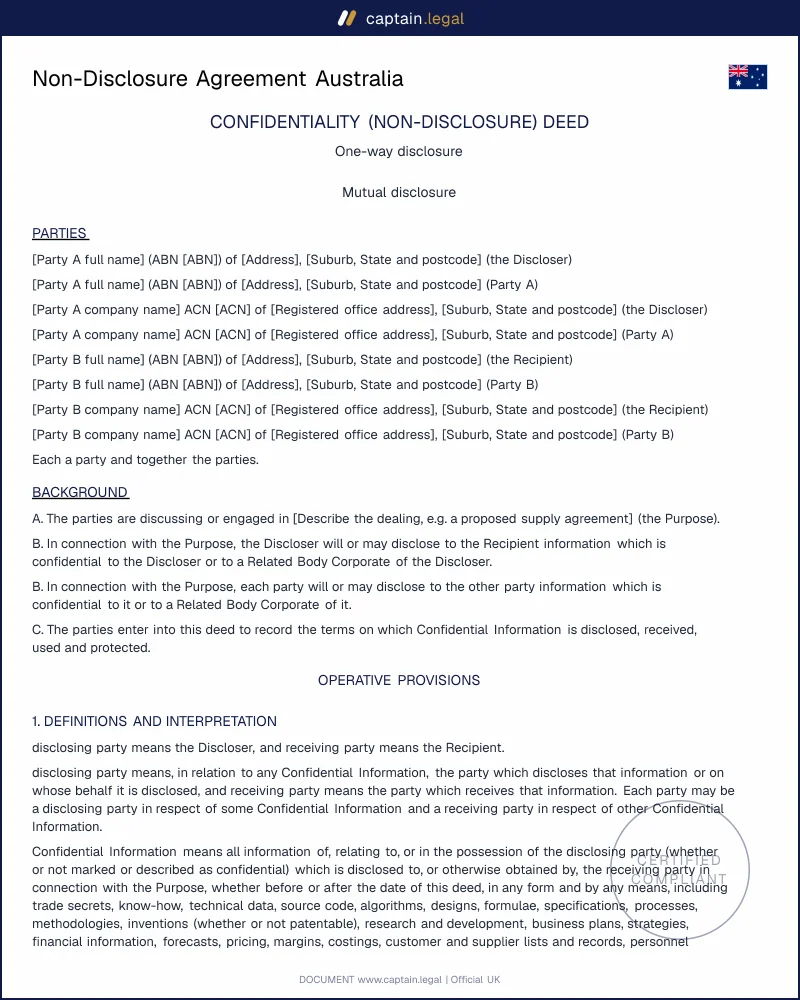
You begin by choosing between unilateral and mutual disclosure, and this choice reshapes the rest of the document. Selecting mutual mirrors every obligation so that both parties carry identical duties. From there you enter the parties: full legal name, ACN or ABN, and registered office for each company, or full name and address for an individual. Get the entity right. Naming a trading name instead of the trustee company is the error that most often sends parties back to the drawing board.

The purpose field comes next, and it deserves a full sentence rather than a phrase. "To evaluate a possible acquisition of the shares in [Company]" beats "business discussions". You then set the confidentiality period, choosing between a fixed term and a perpetual obligation for genuine trade secrets. The form prompts you to nominate the governing State or Territory, which populates the jurisdiction clause and the court naming.

Optional clauses follow: non-solicitation of employees, a non-circumvention obligation for broker and introducer arrangements, and a Victorian sexual harassment carve-out. Once complete, you download in Word and PDF, review with the other side, and execute. Signing as a deed requires the additional attestation the form generates automatically. If the counterparty is an individual rather than a company, our Australian personal legal documents cover the statutory declarations and powers of attorney that sometimes accompany these arrangements.

6

Common mistakes to avoid

The single most damaging error is defining Confidential Information as everything the discloser ever says. Courts read such definitions with scepticism, and a judge asked for an urgent injunction on a clause covering "all information of any kind" will wonder what precisely is being protected and whether the applicant knows either. Narrow, categorised definitions win injunctions; sweeping ones lose them. The second error is silence on the permitted purpose, which leaves a recipient free to argue they never disclosed anything to anyone, they simply used what they learned to build a competing product. That is a defence you have handed them. Third, and specific to Australia, is failing to distinguish confidentiality from restraint of trade. Bolt a two-year non-compete onto a confidentiality deed and you invite the whole instrument to be attacked as an unreasonable restraint, particularly outside NSW where courts lack the power to read the clause down.

Timing errors round out the list. An NDA signed after the pitch meeting is a document about the past that says nothing about the past, unless drafted to reach backwards. Equally common is the unsigned draft: parties negotiate, exchange the material, and never quite get around to execution, leaving only the equitable claim and its evidentiary burden. Finally, watch the counterparty's group structure. An NDA binding a holding company says nothing about its subsidiaries or its consultants, and a recipient's obligation to bind its own representatives must be express. Our Australian family and separation agreements show how the same discipline about naming parties correctly applies well beyond commercial work.

Key takeaways

Purpose

An NDA locks in secrecy and use

An NDA is a contract that limits how the recipient can use and disclose specified information, usually for a defined purpose (for example, an investor pitch, contractor onboarding or vendor due diligence). In Australia, there is no single trade secrets statute, so your protection leans heavily on the document you sign plus the surrounding circumstances. Get it signed before you share anything meaningful.

Legal test

Coco v Clark sets the proof burden

If you end up relying on breach of confidence in equity, you must prove the three Coco v AN Clark elements: the information had the necessary quality of confidence, it was shared in circumstances importing an obligation of confidence, and there was unauthorised use to your detriment. Without a signed NDA, that second element can turn into an expensive argument about what was said and what was understood.

Remedies

Move fast or lose the injunction

The practical remedy that counts is an injunction, because once confidential information is public, money rarely fixes the damage. Courts can grant urgent interlocutory injunctions where there is a serious question to be tried and damages would be inadequate, but delay hurts you. If you sit on a leak for weeks, you weaken the balance of convenience and make urgent relief harder to obtain.

Frequently Asked Questions

Yes, provided it is properly executed and the usual contractual elements are present: agreement between the parties, consideration (or execution as a deed, which removes the need for consideration), sufficient certainty, and an intention to create legal relations. Australia has no registration or stamping requirement for confidentiality agreements, so the document takes effect on signature. Enforcement runs through the State Supreme Courts or the Federal Court, which can grant injunctions, damages, an account of profits and orders for delivery up. The template is drafted to the requirements Australian courts apply, including the Coco v Clark elements that a discloser must establish if the equitable claim is run alongside the contractual one.

A unilateral NDA protects information flowing in one direction only. You disclose, the other party receives, and only they carry obligations. It suits investor diligence, contractor engagements and vendor briefings where the sensitive material is all yours. A mutual NDA imposes identical duties on both parties and is the right instrument whenever both sides will share commercially sensitive material, which is the reality in most joint ventures, merger discussions and technical collaborations. Choosing unilateral in a genuinely two-way conversation is a common misstep: you protect your own position and leave the other side's disclosures unprotected, which becomes an obstacle the moment their lawyers read the draft.

Three to five years is the range Australian courts enforce without argument for ordinary commercial information: pricing, customer lists, business plans, financial data. Genuine trade secrets, meaning information with real commercial value that derives that value from being secret, can be protected indefinitely, and the template supports a perpetual term for that category. The key is proportionality. A perpetual obligation over a routine customer list looks like a restraint dressed up as confidentiality, and a court may decline to enforce it. Note that the equitable duty of confidence survives independently of whatever term you choose, so expiry of the contractual clause is not always the end of the matter.

The document downloads in Microsoft Word (.docx) and PDF. Word suits negotiation, since the other side's lawyers will want to mark up the definition of Confidential Information and the term. PDF suits execution and archiving. Both versions carry identical clause numbering, so cross-references survive conversion. Australian electronic signature legislation, principally the Electronic Transactions Act 1999 (Cth) and its State counterparts, recognises electronic execution for most agreements, and every State and Territory now permits electronic execution of deeds. The Word version is fully editable if your specific deal needs a clause the standard form does not include.

Before, always. An NDA signed after disclosure protects nothing about what was already said unless the definition of Confidential Information expressly extends to information disclosed prior to the date of the agreement. Ours does, which is a deliberate safeguard rather than an invitation to be careless. In practice, disclosers use the document as a gate: no meeting, no data room access, no technical briefing until the deed comes back signed. If you have already disclosed and are now scrambling for paperwork, the equitable claim under Coco v Clark remains available, but you will need evidence of the circumstances importing the obligation.

No. Whistleblower protections under Part 9.4AAA of the Corporations Act 2001 (Cth) override contractual confidentiality, and a clause purporting to prevent a protected disclosure to ASIC, APRA, the ATO or the Australian Federal Police is void to that extent. The template contains an express carve-out preserving those rights, along with a compelled disclosure clause for subpoenas and statutory notices. Since 1 July 2026, Victoria has gone further: the Restricting Non-disclosure Agreements (Sexual Harassment at Work) Act 2025 (Vic) makes NDAs covering workplace sexual harassment unenforceable against a complainant unless six statutory preconditions are met. Any NDA touching a Victorian workforce needs that subject matter carved out.

No, and conflating the two is a drafting error with real consequences. An NDA restricts the use and disclosure of specified information. A restraint of trade restricts a person's ability to work, solicit or compete, and it is presumptively void at common law unless the party seeking to enforce it proves the restriction is reasonable to protect a legitimate business interest. Outside New South Wales, where section 4 of the Restraints of Trade Act 1976 (NSW) allows a court to read down an excessive restraint, courts cannot rewrite the clause; they sever or refuse. Bolting a broad non-compete onto a confidentiality deed risks tainting the whole instrument. Keep them in separate documents.

Move immediately. The primary remedy is an interlocutory injunction restraining further use or disclosure, and the courts weigh delay heavily in the balance of convenience: a discloser who waits a month after learning of a leak has often lost the argument before filing. You send a letter of demand, gather evidence of the disclosure and the loss, and apply to the Supreme Court of the relevant State or the Federal Court depending on the subject matter. Beyond injunctive relief, the courts award damages for contractual breach, equitable compensation, an account of the profits the recipient made from the misuse, and orders for delivery up or destruction of materials.

Only if the agreement says so. A deed signed by a holding company does not automatically bind its subsidiaries, its staff, or the consultants it engages. The template addresses this with an express obligation on the recipient to limit internal access to representatives who need the information for the permitted purpose, to ensure those representatives are bound by equivalent confidentiality duties, and to remain liable for any breach by them. Without that clause, a recipient can spread your material through its group and argue truthfully that it personally disclosed nothing outside the corporate family. Name the group companies explicitly where the deal warrants it.

4.7/5

22 verified reviews · 50 000+ downloads

NDA Australia: Protect Your Confidential Information Fast
  • Immediate access to the document
  • PDF + Word download
  • Compliant with 2026 legislation
  • Reviewed by lawyers
Fill in the template
Secure payment
Updated on July 16, 2026

You might also like

Terms and Conditions Australia
Partnership Agreement AU