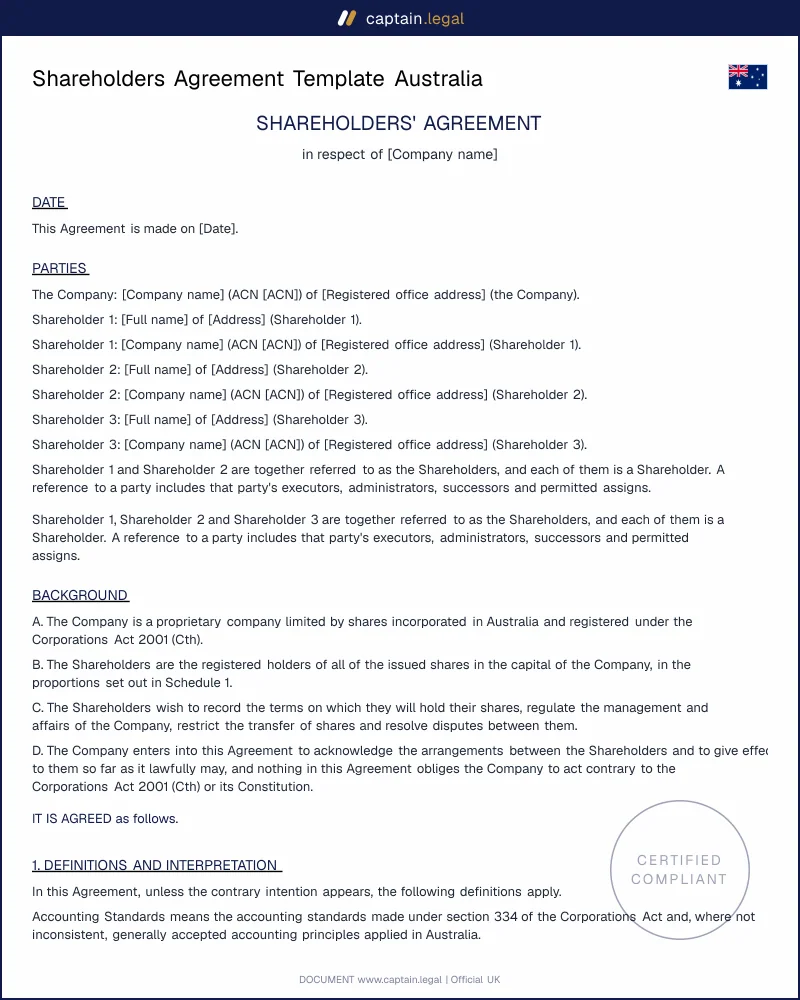
A shareholders' agreement is the private contract that sits alongside a Pty Ltd company's constitution and governs how the owners actually deal with each other: who controls the board, what happens when someone wants out, and how a deadlock gets broken before it reaches the Federal Court. Every Australian proprietary company with two or more shareholders should have one, whether it is a two-person consultancy in Newtown or a family manufacturing business in Dandenong. The Corporations Act 2001 (Cth) supplies a bare statutory skeleton, and the replaceable rules fill almost none of the gaps that matter commercially. This template gives you a drafted agreement covering share capital, voting, drag and tag along rights, exit mechanics and dispute resolution, ready to complete and execute.
Compliant
2026 Legislation
50,000+ clients
trust us
Affordable
From $4.90 / doc
Secure payment
Instant download
Shareholders Agreement (Pty Ltd) | Corporations Act 2001
Secure payment
Legal framework
The Corporations Act 2001 (Cth) is the governing statute for every proprietary company registered in Australia, administered by the Australian Securities and Investments Commission. A Pty Ltd must have at least one shareholder and no more than fifty non-employee shareholders under section 113, and it cannot engage in fundraising that would require a disclosure document. Those two constraints shape how a shareholders' agreement is drafted: transfer restrictions must keep the company under the fifty-member ceiling, and any issue of new shares has to fit within the exemptions in Chapter 6D.
Directors' duties in sections 180 to 184 apply regardless of what the shareholders agree between themselves. A nominee director appointed by a major shareholder still owes duties to the company as a whole, not to their appointor, and no clause in an agreement can contract out of that. Section 187 offers narrow relief for wholly owned subsidiaries only. Practitioners handle this through information rights and reserved matter provisions rather than by attempting to direct nominee votes, which would expose the appointor to shadow director liability under section 9.
The oppression remedy in sections 232 to 234 is the background threat that a well drafted agreement is designed to avoid. A shareholder can apply to the court where the conduct of the company's affairs is contrary to the interests of members as a whole or oppressive, unfairly prejudicial or unfairly discriminatory. The High Court's reasoning in Wayde v New South Wales Rugby League Ltd (1985) sets the objective standard of unfairness that applies. Deadlock, exclusion from management and refusal to pay dividends are the three classic grounds, and each is addressed directly in this template.
Variation of class rights follows sections 246B to 246G, requiring a special resolution of the class or written consent of seventy five per cent of that class. Share buy-backs are regulated by Part 2J.1, which matters for any exit clause funded by the company rather than the continuing shareholders. A buy-back that breaches the solvency requirements in section 257A exposes directors to personal liability, so exit mechanics should always give the shareholders a purchase option before the company steps in. The ASIC guidance on company registers and member records explains the lodgement obligations that follow every transfer.
When do you need this document?
Two founders incorporating a Pty Ltd with a fifty fifty split need this document on day one, not after the first argument. Equal ownership without a casting vote or a deadlock mechanism is the single most common path to a winding up application on the just and equitable ground under section 461(1)(k). The agreement is what converts a stalemate into a process. A family business bringing the second generation onto the register is the next most frequent trigger, because the questions of who can sell, to whom, and at what price become live the moment ownership fragments beyond the original couple.
Bringing in an investor changes the calculus again. An angel or seed investor taking twenty per cent will want reserved matters, pre-emptive rights on new issues to protect against dilution, and tag along protection so they exit alongside the founders in a trade sale. Founders on the other side want drag along rights so that a minority holder cannot block a sale of one hundred per cent of the company to a buyer who insists on clean title. Both sit in the same document and both are negotiated at the same table.
Employee share schemes create a subtler need. Once staff hold shares, even through an employment agreement package that includes equity, the company has multiple small holders whose shares need compulsory transfer provisions on cessation of employment. Without a good leaver and bad leaver framework, a dismissed employee keeps their stake indefinitely and attends every general meeting.
The edge case worth flagging is the shareholder who is also a trustee. Where shares are held by a family trust, the agreement must bind the trustee in its capacity as trustee and address what happens on a change of trustee or an appointment of a new appointor. Many agreements name the trust and stop there, which leaves the beneficial owners free to restructure around the transfer restrictions entirely.
Key clauses included in our template
- The share capital and shareholding schedule records each shareholder, their class of shares and the number held, tied to the company's share register maintained under section 169. It also covers future issues, with a pre-emptive rights mechanism giving existing holders the first opportunity to subscribe pro rata before any third party is approached, which is the primary defence against dilution.
- The board composition and appointment rights provision sets how many directors each shareholder or class may appoint and remove by written notice. It includes the quorum, the chair's role and, where relevant, whether the chair holds a casting vote at board level. In fifty fifty companies the casting vote is usually excluded deliberately and the deadlock clause carries the load instead.
- The reserved matters clause lists the decisions that require unanimous or supermajority shareholder approval regardless of board control: issuing shares, changing the constitution, borrowing above a threshold, related party transactions, and any sale of the business. This is the mechanism that gives a minority holder real protection without giving them day to day control.
- The transfer restrictions and pre-emption on transfer clause requires a departing shareholder to offer their shares to the others before any external sale, at a price fixed by an agreed formula or an independent valuer. It also lists permitted transfers to related entities and family trusts that bypass the offer round.
- The drag along and tag along rights operate as a pair. Drag along lets holders of a specified majority, commonly seventy five per cent, compel the remainder to sell on the same terms to a genuine third party buyer. Tag along lets a minority holder join any sale by a controller, at the same price per share, so that control cannot be sold away without them.
- The compulsory transfer events cover death, bankruptcy, incapacity, cessation of employment and material breach. Each triggers a deemed offer of the affected shares, with the good leaver and bad leaver distinction setting whether the price is fair market value or a discounted issue price.
- The deadlock resolution clause escalates through negotiation between principals, then mediation, then a shotgun or Russian roulette buy-sell if the parties choose that option. Drafted properly it names the mediator body and the timeframe at each stage.
- The restraint of trade and confidentiality provisions bind shareholders during their holding and for a cascading period afterwards, drafted with successive geographic and temporal limbs so a court can sever the widest that fails.
State-specific considerations
New South Wales courts see the largest volume of shareholder disputes in Australia, and the Equity Division of the Supreme Court has developed a body of oppression jurisprudence that rewards precise drafting. The critical local point is restraint of trade. NSW is the only jurisdiction with the Restraints of Trade Act 1976 (NSW), which lets the court read down an unreasonable restraint to the extent it is reasonable, rather than striking it out entirely. A restraint clause drafted for a Sydney company therefore has more room to reach, though the drafting should still cascade. Stamp duty on share transfers was abolished for unlisted companies, but Chapter 4 of the Duties Act 1997 (NSW) still catches landholder acquisitions where the company holds land in NSW above the threshold.
Victoria takes the orthodox common law approach to restraints, meaning an unreasonable clause is severed or fails outright with no judicial rewriting available. Victorian shareholders' agreements consequently use tighter cascading restraints with narrower default limbs. The Supreme Court of Victoria's Commercial Court handles oppression applications through a docket system that pushes parties toward mediation early, which makes a contractual mediation step in the deadlock clause genuinely useful rather than decorative. Landholder duty under the Duties Act 2000 (Vic) applies at a lower land value threshold than several other states, so any share transfer in a company holding Melbourne property needs a duty check before completion.
Queensland applies the general law on restraints in the same way as Victoria. The practical distinction is procedural. Applications under the Corporations Act are heard in the Supreme Court of Queensland's Commercial List, and Queensland practice on interlocutory relief in share transfer disputes is comparatively brisk, which suits a party seeking to enforce a pre-emption clause against a shareholder who has already signed with an outsider. Duty on landholder acquisitions sits in Chapter 3 of the Duties Act 2001 (Qld).
Western Australia shares the orthodox restraint position and has its own landholder duty regime under the Duties Act 2008 (WA), relevant to any company holding Perth or regional land. The bigger WA consideration is distance. Where shareholders are split between Perth and the eastern states, the agreement should specify the governing law and the venue for proceedings expressly, because Corporations Act applications can be commenced in any state Supreme Court or the Federal Court. A jurisdiction clause is not optional in a cross-state shareholder base.
Common mistakes to avoid
The most damaging error is signing an agreement that contradicts the constitution and saying nothing about which one governs. When a transfer dispute reaches a solicitor, the first question is always which document controls, and an agreement without a priority clause turns a two week negotiation into a six month argument. The second recurring failure is a valuation clause that names a mechanism nobody can operate: "fair market value as agreed between the parties" is not a mechanism, it is a deferred disagreement. Name the valuer, name the body that appoints the valuer if the parties cannot agree, and set a deadline. The third mistake is drafting a drag along threshold that the actual cap table can never reach. A seventy five per cent drag in a company where the largest holder owns sixty per cent and the rest are scattered gives you a right that exists only on paper.
Founders also forget to bind future shareholders. An agreement that does not require every new holder to execute a deed of accession leaves the company with two classes of owner: those bound and those free. Every issue and every permitted transfer must carry an accession condition. Finally, restraint clauses get copied from an unrelated precedent and end up unenforceable, either because the geographic reach is national when the business operates in one suburb, or because the period runs for five years when eighteen months reflects the commercial reality. An overreaching restraint outside New South Wales usually fails completely rather than being read down, which leaves the departing shareholder free to compete from the day they sell. The Australian company formation and governance documents catalogue includes the resolutions and deeds that support these provisions.
Frequently Asked Questions
21 verified reviews · 50 000+ downloads
- Immediate access to the document
- PDF + Word download
- Compliant with 2026 legislation
- Reviewed by lawyers
You might also like