Create my document
Login

Choose country

AustraliaAustraliaChoose country
Real Estate

Residential Tenancy Agreement: Prescribed Standard Terms

Lease drafted to the prescribed standard terms of each state: RTA 2010 (NSW), RTA 1997 (Vic), RTRA Act 2008 (Qld). Bond caps and notice periods included.
4.8/518 reviews50 000+ downloadsInstant download
Share

A residential tenancy agreement is the written contract that governs the letting of a dwelling in Australia, setting out the rent, the bond, the term, and the reciprocal obligations of the landlord and the tenant. Every state and territory legislates its own regime, and each imposes a prescribed or approved form that displaces whatever the parties might otherwise have drafted for themselves. This template covers the standard-form lease used for houses, units, apartments, and townhouses let as a principal place of residence, whether on a fixed term or periodically. It suits self-managing landlords, private tenants, property investors moving between jurisdictions, and small agencies who need a compliant rental agreement without waiting on a solicitor.

Get the form wrong and the consequences are not theoretical. A term that contradicts the Act is void by operation of law, and tribunals across the country strike them out routinely.

Compliant

2026 Legislation

50,000+ clients

trust us

Affordable

From $4.90 / doc

Secure payment

Instant download

Residential Tenancy Agreement: Prescribed Standard Terms

Secure payment

Fill in the template

What is a residential tenancy agreement?

A residential tenancy agreement grants a tenant exclusive possession of residential premises for a term, in exchange for rent. Australian law treats it as a hybrid : it is a contract, but it is also a statutory creature, because each jurisdiction imports a set of standard terms into every agreement regardless of what the parties sign. In New South Wales those terms sit in the Residential Tenancies Regulation 2019; in Victoria they flow from the Residential Tenancies Act 1997 and the Residential Tenancies Regulations 2021; in Queensland the General Tenancy Agreement (Form 18a) is prescribed under the Residential Tenancies and Rooming Accommodation Act 2008. You cannot contract out of these terms, and a clause purporting to do so has no effect even where both parties initialled it.

The distinction that trips people up most often is between a residential tenancy agreement and a licence to occupy. A boarder or lodger who shares facilities with the owner and lacks exclusive possession is usually outside the Residential Tenancies legislation altogether, which means no bond lodgement, no tribunal jurisdiction, and no prescribed notice periods. Rooming house and boarding house arrangements sit in their own statutory streams. Holiday lets under a stated short duration are also excluded in most jurisdictions. Terminology varies too : Victoria renamed the instrument a residential rental agreement and the landlord a residential rental provider in 2021, while Queensland uses lessor and tenant. The substance is the same, but using the wrong label on a notice can cost you an application at the tribunal. Landlords assembling a full leasing pack usually pair the agreement with the other Australian real estate documents and tenancy forms they will need at signing.

2

When do you need this document?

The obvious trigger is a new letting, and every jurisdiction now requires the agreement in writing for a residential tenancy. The less obvious triggers are where landlords come unstuck. A fixed term rolling into a periodic tenancy does not require a new agreement, but if you are renegotiating the rent or adding an occupant it is cleaner to execute a fresh one than to paper over an old document with an addendum. A change of tenants also matters : substituting one co-tenant for another is an assignment, and most jurisdictions require the landlord's written consent plus a new bond arrangement, not a handshake.

Investors buying a tenanted property inherit the existing agreement by operation of law. In practice, the sale contract should attach it, and the buyer needs the bond transferred to their name at the relevant authority. Landlords renting to a family member for a nominal amount often assume the Act does not apply. It usually does, and the absence of a written agreement leaves them without any of the termination machinery when the arrangement sours. The same applies to granny flat lettings and secondary dwellings.

Two edge cases repay attention. First, a fixed term of more than three years in NSW must be annexed to the form approved by the Registrar-General for registration under the Real Property Act 1900, which practitioners overlook constantly. Second, a tenancy created for the duration of employment sits at the boundary between the Residential Tenancies legislation and the employment relationship, and terminating it engages both regimes at once. Landlords managing that overlap should read the terms of the Australian employment contracts and termination documents alongside the tenancy paperwork.

3

Key clauses included in our template

  • The identification of the parties and the premises captures every adult who will occupy the dwelling, not merely the person who negotiated the letting. Unnamed occupants create real difficulty at termination because a notice binds only the persons named on it. The template also records agent authority where the landlord is not signing personally.
  • The term and commencement provisions distinguish a fixed term from a periodic agreement and set out what happens at expiry. Under the reformed NSW regime the agreement continues as a periodic tenancy on the same terms unless one party gives notice on a prescribed ground.
  • The rent clause fixes the amount, the frequency, and the payment method, with the mandatory fee-free electronic option that NSW, Victoria, and Queensland all now require. Rent in advance is capped by statute, at two weeks under section 33 of the NSW Act.
  • The rental bond clause records the amount, the payer, and the lodgement pathway with the state authority. Overcharging the bond is an offence, not a drafting slip, and the cap is expressed in weeks of rent as at the date the agreement is entered into.
  • The repairs and maintenance provisions separate urgent from non-urgent repairs, set the notification pathway, and reflect the minimum standards duty that now applies in Victoria, Queensland, and New South Wales.
  • The entry and inspection clause states the statutory notice periods for routine inspections, repairs, valuations, and sale viewings, which differ sharply between jurisdictions.
  • The additional terms section is where a landlord may address pets, smoking, gardening, parking, and subletting, subject to the overriding rule that an additional term inconsistent with the standard terms is void.
4

State and territory considerations

New South Wales is now the most heavily reformed jurisdiction in the country. The prescribed form under the Residential Tenancies Regulation 2019 is compulsory, and the bond cannot exceed four weeks' rent under section 159 of the Residential Tenancies Act 2010 with no exception for high-rent premises and no pet bond. Rent in advance is capped at two weeks. No-grounds terminations were abolished on 19 May 2025, so every termination notice must state a prescribed ground, attach supporting evidence, and be accompanied by the Termination Information Statement. Giving a notice on a ground that is not genuine is an offence. Disputes go to NCAT, which has a bond jurisdiction of thirty thousand dollars.

Victoria renamed the instrument a residential rental agreement and uses the prescribed form under section 26(1) of the Residential Tenancies Act 1997. The bond is capped at one month's rent unless the weekly rent exceeds nine hundred dollars or VCAT sets a higher figure, which makes Victoria the outlier on quantum. The fourteen minimum standards in Schedule 4 of the Residential Tenancies Regulations 2021 must be satisfied before the renter moves in, and a failure during the tenancy is automatically an urgent repair the renter can arrange themselves and recover against the provider. Bonds are lodged with the RTBA within 10 business days. Further reforms commenced on 25 November 2025.

Queensland operates the Form 18a General Tenancy Agreement under the Residential Tenancies and Rooming Accommodation Act 2008, administered by the Residential Tenancies Authority. The bond cap has been four weeks' rent across the board since 30 September 2024, pet bonds are prohibited, and rent may rise only once every 12 months on two months' written notice, with the twelve-month clock attaching to the premises rather than the tenancy. Minimum housing standards apply throughout the tenancy. Terminations run through a Notice to Leave and, if unheeded, QCAT.

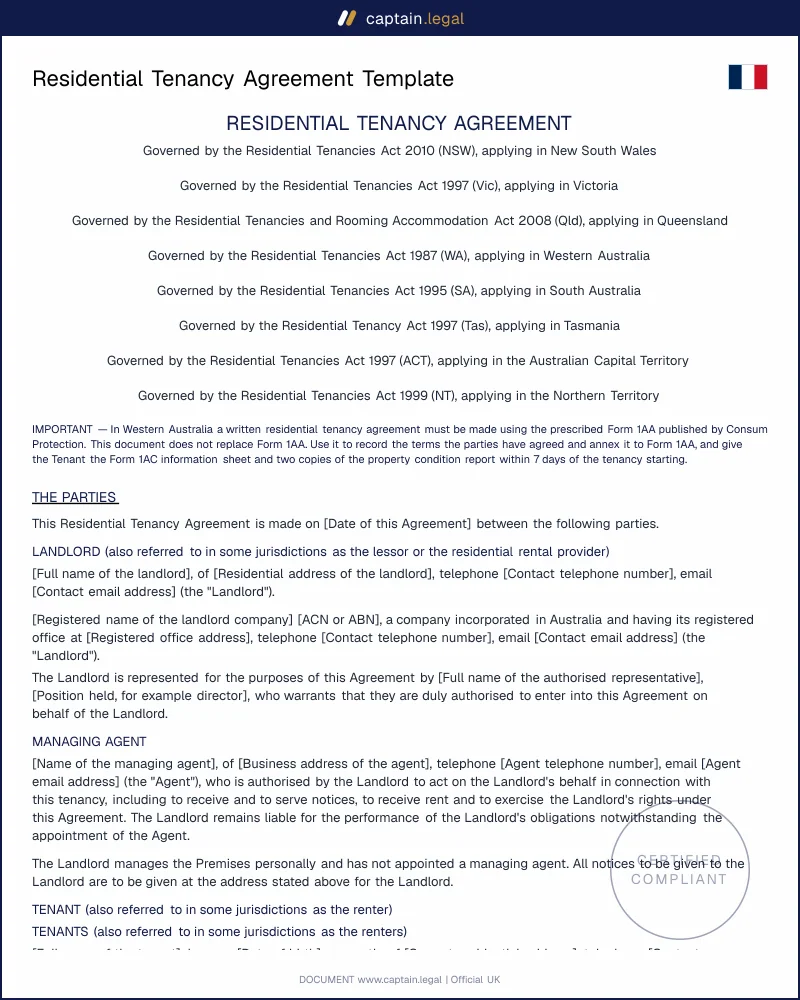
South Australia, Western Australia, Tasmania, the ACT, and the Northern Territory each keep their own form, bond cap, and tribunal. South Australia's reforms removed no-grounds terminations and limited rent increases to one in twelve months. Western Australia still permits a pet bond and remains the least prescriptive on minimum standards. Never reuse an interstate lease : a Victorian agreement served in Queensland is not merely non-compliant, it fails to incorporate the standard terms the tenant is entitled to receive.

5

How to fill out this residential tenancy agreement

You start by selecting the state or territory where the premises are located, and the form adjusts from there : the prescribed terminology, the bond cap, the rent-in-advance limit, the lodgement authority, and the statutory citations all follow that single choice. Next you enter the landlord and agent details, then every tenant who will hold the tenancy, with full legal names as they appear on identification rather than the shortened versions people use day to day. The premises description follows, including the parking space, storage cage, or furniture that forms part of the letting.

From there you set the term, choosing between a fixed period and a periodic arrangement, and the form flags where a long fixed term triggers registration requirements. The rent block asks for the amount, the frequency, the first payment date, and the fee-free payment method the legislation requires you to offer. The bond block calculates the maximum permitted for your jurisdiction from the rent you entered, so you cannot inadvertently exceed the cap. Additional terms come last, with prompts for pets, smoking, gardens, and subletting. You then download in Word or PDF, sign, and give the tenant their copy together with the condition report and the prescribed information statement. Landlords who also need entity documents can work through the Australian business and company templates in the same sitting.

6

Common mistakes to avoid

The most expensive error is the bond. Landlords routinely apply a four-week cap in Victoria, where the ceiling is one month unless the rent clears nine hundred dollars a week, or ask for six weeks because the premises are furnished, which reflects a rule that no longer exists in NSW. Holding the bond personally instead of lodging it is worse : it is an offence in every jurisdiction and it destroys your position in any subsequent claim. A close second is the condition report. Without one completed before the tenant takes possession, with photographs, you have no baseline, and the tribunal cannot determine what the tenant damaged as opposed to what was already worn. That single omission decides more bond disputes than any other factor.

The third pattern is the imported clause. Landlords copy an additional term from an interstate template or an old lease, and it turns out to contradict a standard term. It is void, and in some jurisdictions including it attracts a penalty. Requiring professional cleaning irrespective of the condition at handover, charging the tenant for the preparation of the agreement, or purporting to shorten a statutory notice period are the usual offenders. Finally, landlords forget the disclosure documents. In NSW the Tenant Information Statement must be given at or before signing, and its absence is a compliance failure independent of anything in the agreement itself. Tenants weighing their own position often start with the Australian personal legal documents library before they sign.

Key takeaways

STANDARD TERMS

You cannot contract out of tenancy law

A residential tenancy agreement is partly statutory: each state imports prescribed standard terms into every lease. If you add a clause that contradicts the Residential Tenancies Act in your jurisdiction, it is void by operation of law even if both parties initial it. Tribunals regularly strike non-compliant terms, so the form and wording must match the approved regime (NSW, Vic, Qld, and so on).

CLASSIFICATION

Lease or licence: exclusive possession decides

Many disputes start with the wrong label. A tenant usually has exclusive possession under a residential tenancy agreement, but a boarder or lodger sharing facilities with the owner may be on a licence and outside the Residential Tenancies legislation. That can change bond lodgement requirements, notice periods and whether the tribunal has jurisdiction. Rooming and boarding arrangements often sit in separate statutory streams.

PAPERWORK

Use the prescribed form and attachments

Each state and territory prescribes the agreement form and what must be given at signing, and the requirements are strict. NSW requires a written agreement and a copy for the tenant, plus the completed condition report and the NSW Fair Trading Tenant Information Statement. Victoria requires the prescribed form under section 26(1) and the Renting a home guide before possession. Missing documents can derail compliance and disputes.

Frequently Asked Questions

Yes. A residential tenancy agreement is a binding contract once both parties sign it, and in every Australian state and territory it also imports the statutory standard terms automatically. The template is built around the prescribed or approved form for the jurisdiction you select, so the mandatory terms are already in place and the additional terms are drafted to sit consistently with them. What the template cannot do is override the Act. If you insert a term that conflicts with a standard term, the tribunal will treat that term as void while the rest of the agreement stands. For unusual arrangements, long fixed terms, or commercial-residential hybrids, take advice before signing.

Four weeks' rent is the cap in New South Wales under section 159 of the Residential Tenancies Act 2010, with no exception for high-rent premises and no pet bond. Queensland applies the same four-week cap to every general tenancy since 30 September 2024. Victoria is different : the ceiling is one month's rent unless the weekly rent exceeds nine hundred dollars, or VCAT has set a higher maximum for the property. Western Australia permits a pet bond on top of the standard bond. The template calculates the permitted maximum from the rent you enter, and overcharging even slightly is an offence rather than a technicality.

Ten days in most jurisdictions, though the counting differs. In Victoria the rental provider or agent must lodge with the Residential Tenancies Bond Authority within 10 business days of receiving payment, and late lodgement carries a civil penalty. In Queensland the bond goes to the Residential Tenancies Authority within 10 days. In New South Wales the expectation is Rental Bonds Online, and the landlord or agent must be registered as a user and must invite the tenant to use the service. If the bond is paid to a landlord's agent it must be deposited within 10 working days. Do not treat the deadline as advisory.

Not in New South Wales, and not in South Australia. NSW abolished no-grounds terminations on 19 May 2025, so every termination notice must state a ground drawn from the prescribed list, attach supporting documentation, and travel with the Termination Information Statement. Selling with vacant possession, moving in yourself or a family member, major renovation, and breach are among the recognised grounds. Serving a notice on a ground that is not genuine, or supplying false supporting documents, is an offence. Western Australia still permits no-grounds terminations in defined circumstances. The rules diverge sharply between jurisdictions, so check the state before you draft the notice.

Word and PDF. The Word file lets you adjust the additional terms, add inclusions, or extend the schedule of occupants before you print. The PDF is the version most people sign and send, and it is what tribunals and bond authorities expect to see if the agreement is ever produced in evidence. Both are generated from the same jurisdiction-specific content, so the statutory citations and prescribed wording match whichever file you use. Keep the executed copy together with the condition report and the photographs from the ingoing inspection, because those three documents travel together in any dispute.

In most jurisdictions, yes for the standard terms, and the template reproduces them. New South Wales, Victoria, and Queensland each prescribe a form whose terms cannot be removed or varied. What you can do is add additional terms tailored to the property, provided they do not contradict the standard terms or the Act. Practitioners use a prepared template rather than the bare government form because the government version leaves the additional terms blank and offers no guidance on what belongs there. The compliance floor is identical; the drafting quality of what sits above it is not.

Sixty days' written notice in New South Wales, Victoria, Tasmania, South Australia, and Western Australia. Queensland requires two months. In New South Wales, Victoria, Queensland, and the ACT the increase can happen only once in any twelve-month period, and in Queensland that twelve-month clock attaches to the premises rather than to your particular tenancy, so a new tenant does not reset it. The notice must comply as to form and timing, and a defective notice does not take effect. Tenants who consider the increase excessive can apply to the tribunal, which assesses it against comparable market rents.

Only on specified grounds, and only within a deadline. In New South Wales, since 19 May 2025, the landlord must respond to a pet request within 21 days or consent is taken to have been given, and refusal must rest on a permitted reason such as unsuitability of the premises. You cannot charge pet rent, take a higher bond, or impose a pet fee, and a blanket strata by-law banning pets is not itself a valid ground. Queensland prohibits pet bonds entirely. Western Australia permits a pet bond up to a capped amount. Record any conditions of consent in the additional terms.

4.8/5

18 verified reviews · 50 000+ downloads

Residential Tenancy Agreement: Prescribed Standard Terms
  • Immediate access to the document
  • PDF + Word download
  • Compliant with 2026 legislation
  • Reviewed by lawyers
Fill in the template
Secure payment
Updated on July 15, 2026

You might also like

Tenancy Application & Condition Report
Rent Receipt Australia