Create my document
Login

Choose country

AustraliaAustraliaChoose country
Real Estate

Rent Increase Notice Australia | s.44 RTA 1997 Compliant

Rent increase notice drafted to the Residential Tenancies Acts: 60 days NSW, 90 days VIC, Form 10 in WA. State-aware template in Word and PDF.
4.8/5— 25 reviews50 000+ downloadsInstant download
Share

A rent increase notice is the written instrument a landlord serves on a tenant to raise the rent lawfully during a residential tenancy. Australian tenancy law treats it as a strict compliance document, not a courtesy letter: every state and territory sets its own minimum notice period, its own frequency cap, and in two jurisdictions its own prescribed form. Get any element wrong and the increase simply does not take effect, whatever the lease says. This template is drafted for landlords, self-managing owners and property managers who need a notice of rent increase that satisfies the relevant Residential Tenancies legislation, states the new rent and the effective date correctly, and survives scrutiny at NCAT, VCAT or the equivalent tribunal.

Compliant

2026 Legislation

50,000+ clients

trust us

Affordable

From $4.90 / doc

Secure payment

Instant download

Rent Increase Notice Australia | s.44 RTA 1997 Compliant

Secure payment

Fill in the template

What is a rent increase notice?

A rent increase notice is a unilateral statutory notice. The landlord does not ask the tenant to agree to a new rent; the landlord notifies the tenant that the rent will change on a stated date, and the law decides whether that notification is effective. The tenant's only real levers are the tribunal (arguing the increase is excessive) and the technical validity of the notice itself. That second lever is where most landlords lose, because the requirements are formal and unforgiving.

Australian practitioners distinguish the notice from three neighbouring documents. A rent review clause inside a fixed-term agreement is contractual, and it sets the ceiling of what the notice can later demand: if the lease specifies CPI, a notice claiming market rent is void. A rent variation agreement is consensual, signed by both parties, and is the correct instrument when the parties negotiate a reduction or a mid-term change the statute would not otherwise permit. A notice to vacate ends the tenancy and is never a substitute for a rent increase, though landlords sometimes conflate the two when a tenant refuses an increase. That conflation is dangerous. Serving a termination notice because a tenant challenged an increase is retaliatory conduct, and tribunals set those notices aside.

The notice also has no independent life outside a subsisting tenancy. If the fixed term has expired and the agreement has not rolled into a periodic tenancy, there is no rent to increase. Landlords in that position need a fresh residential tenancy agreement, not a notice.

2

When do you need this document?

The ordinary trigger is the annual review on a periodic tenancy, where the twelve-month anniversary of the last increase has passed and the landlord wants to bring rent toward market. This is the cleanest case and the one the template is optimised for. The second common scenario is the fixed-term agreement containing an express rent review clause. Here the notice is still required, but it is constrained by the contract: the increase cannot exceed the amount produced by the calculation method written into the lease, and a method stated as "market rent" is usually too vague to be enforceable, whereas CPI or a fixed percentage will hold. Landlords who wrote a loose clause discover at review time that they have effectively waived the right to increase at all.

A third scenario is the change of ownership. New owners routinely assume settlement resets the calendar. It does not. The twelve-month clock runs from the last increase served under the tenancy, and in Queensland from the last increase on the property, regardless of who owned it. Buying a property does not buy a fresh right to increase the rent.

Two edge cases justify closer attention. Social housing tenancies operate outside the general frequency rule where the change flows from a rent rebate review rather than a market increase, so the twelve-month cap does not bite in the usual way. And where a tenancy is transferred or a co-tenant is added, landlords frequently treat the new arrangement as a new tenancy and serve an immediate increase. Tribunals see through that. Unless the original tenant has genuinely vacated and a new agreement has been struck, the previous rent history follows the property and the notice fails.

3

Key clauses included in our template

  • The identification of the parties and the premises names every tenant on the residential tenancy agreement, not only the primary signatory, and describes the property by its full address including any car space or storage allocation forming part of the letting. A notice addressed to one of three co-tenants has been held ineffective against the others.
  • The statement of the proposed new rent expresses the total rent payable rather than the quantum of the increase, in the same period as the existing agreement (weekly, fortnightly or monthly). The template forces this figure into the correct format because section 41 of the Residential Tenancies Act 2010 (NSW) and its counterparts elsewhere are drafted around the new amount, not the differential.
  • The effective date is calculated backwards from service, applying the correct statutory lead time for the jurisdiction and adding delivery allowance where the notice travels by post. The clock runs from the renter's receipt, not from the day the landlord sends it, and there is no mechanism to retrospectively cure a short notice period.
  • The calculation method, required in Victoria and prudent everywhere, records how the figure was derived: CPI series, statewide rent index, fixed percentage or fixed dollar amount. It gives the landlord a documented answer if the tenant seeks an assessment.
  • The rent history declaration states the date the current rent became payable, which forms the compliance proof under the twelve-month frequency rule and answers a Queensland tenant's statutory request directly.
  • The service record captures method, date and recipient. Email is only valid where the tenant has consented in writing to electronic notices, usually through a clause in the tenancy agreement itself.
4

State-specific considerations

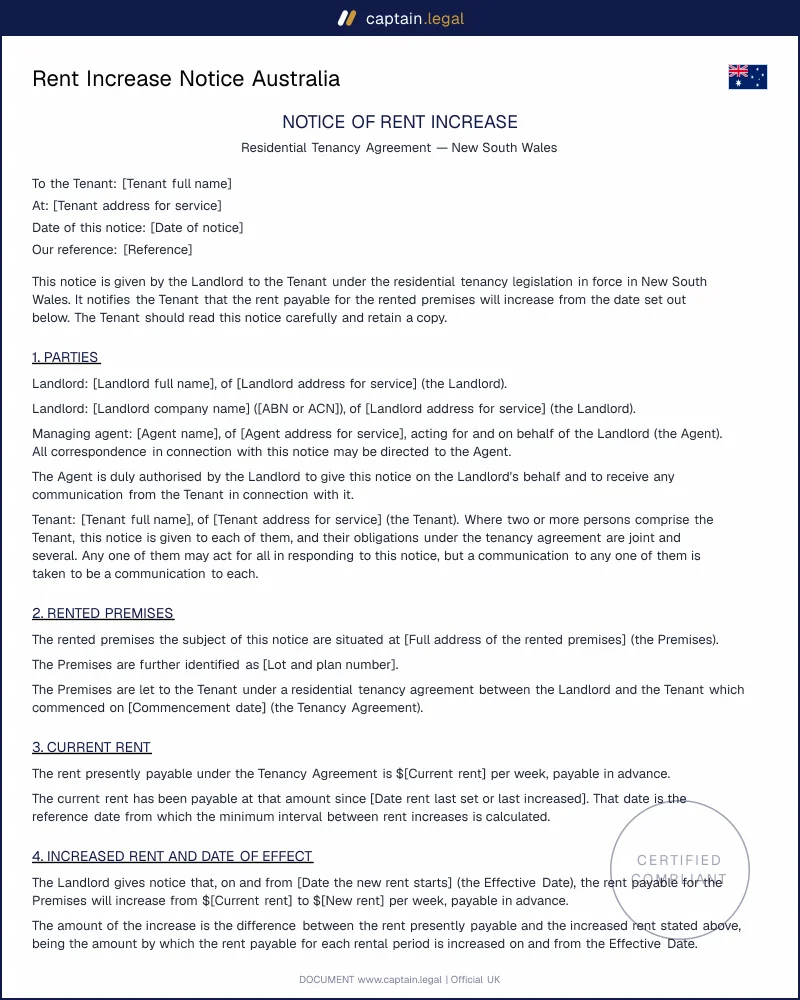
New South Wales requires at least 60 days written notice before the increase takes effect, and the landlord may draft their own notice, send an email, or use the NSW Fair Trading form. The frequency rule under the Residential Tenancies Act 2010 (NSW) is a twelve-month cap that survives renewal and conversion to a periodic tenancy. There is no cap on the amount, but the rent must not be excessive relative to comparable properties, and the tenant has 30 days from receipt to apply to NCAT. Tribunal evidence turns on market comparables, condition and amenities.

Victoria is now the strictest jurisdiction on both form and timing. The prescribed Consumer Affairs Victoria Notice of proposed rent increase is mandatory, and rent cannot be increased verbally, by text message, or by email without the correct form. Ninety days is the minimum under section 44 of the Residential Tenancies Act 1997, and a renter may seek a free rental assessment from CAV within 30 days, with excessive-increase disputes now routed through Rental Dispute Resolution Victoria rather than directly to VCAT.

Queensland requires at least two months written notice for a general tenancy and four weeks for a rooming accommodation agreement, with no prescribed form. The property-based twelve-month rule is the trap: a landlord who re-lets after a departing tenant's increase must count from that increase, not from the new lease.

Western Australia mandates the prescribed Form 10. Sixty days written notice applies, and increases are generally limited to once every twelve months. Because the form is prescribed, a compliant letter is not a compliant notice.

South Australia and Tasmania both work on 60 days. In Tasmania the increase can generally only take effect at the start, renewal or extension of a lease rather than mid-tenancy. The ACT requires eight weeks notice, one increase every twelve months, and caps most increases at 10% above the growth in the rents component of Canberra's CPI unless the landlord justifies more. The Northern Territory permits an increase only where the agreement expressly provides for it and states the amount or calculation method, with 30 days notice and a six-month interval.

5

How to fill out this rent increase notice

You begin by selecting the state or territory where the property sits, because that single choice drives the notice period, the frequency test and whether a prescribed form applies. From there the questionnaire asks for the current rent and the date it became payable, which lets the document confirm the twelve-month interval before you go further; if the interval has not elapsed, you will see it at that point rather than after service. You then enter the proposed new rent as a total figure, and the template converts it into the payment period used in the tenancy agreement so the notice matches the lease.

The effective date is calculated from your intended service date with the statutory lead time applied, and where you indicate postal service the document adds the delivery allowance rather than leaving you to guess. Victorian and Western Australian selections route you to the prescribed form structure with the mandatory particulars in the required order. You then record the calculation method, name every tenant on the agreement, and download the notice in Word if you want to adjust wording, or PDF for immediate service. Keep the signed copy and the proof of service together, as they are the evidence you will produce if the tenant applies to the tribunal. Landlords managing an entire portfolio often prepare the notice alongside the underlying agreement from the complete catalogue of Australian legal document templates.

6

Common mistakes to avoid

The most frequent failure is arithmetic on the calendar. Landlords count from the day they post the notice rather than the day the tenant receives it, then lose two days to Australia Post and serve 58 days when the statute demands 60. The second is stating the increase instead of the new rent, which reads naturally in a letter and is fatal in NSW. The third is using a home-made letter in Victoria or Western Australia, where the prescribed form is not a suggestion. A perfectly worded letter that is not the prescribed form is worth nothing in those two states. The fourth is the renewal reset: treating a lease renewal, a switch from fixed term to periodic, or a change of owner as a fresh start for the twelve-month clock. It is not, and this is now the single most common ground on which NSW increases are set aside.

The remaining errors cluster around evidence and temperament. Landlords increase rent under a fixed-term lease whose review clause says nothing useful, or says "market rent", and cannot defend the figure when challenged. They serve by email without ever having obtained the tenant's written consent to electronic service. They fail to record the date the current rent became payable, then cannot answer a Queensland tenant's statutory request within the 14 days allowed. And when a tenant seeks an assessment, some landlords respond with a notice to vacate, which converts a survivable rent dispute into a retaliatory conduct finding. Document the increase, serve it correctly, and let the tribunal process run. The paperwork wins these cases, and the same discipline applies across the Australian employment and workplace document templates that landlords with property management entities also rely on.

Key takeaways

Compliance

A defective notice means no increase

A rent increase notice is a statutory compliance document, not a polite heads-up. If the notice period, the effective date, the amount, or any prescribed form requirement is wrong, the increase simply does not take effect, even if the lease says otherwise. Expect tenants to test validity at NCAT, VCAT or the relevant tribunal, because technical defects are a common way increases get struck out.

Timing

Notice periods and frequency caps vary

Each state and territory sets its own minimum notice period and how often rent can be increased. The template is state-aware because the numbers change: NSW requires 60 days notice and Victoria requires 90 days notice under s 44(1) of the Residential Tenancies Act 1997 (Vic). WA can require a prescribed form (Form 10). Using the wrong state settings can void the notice.

Missteps

Do not misuse other tenancy documents

A rent increase notice is unilateral: the landlord notifies the change and the law decides if it works. Do not treat it as a rent review clause, a negotiated variation, or a workaround termination. If the lease has a rent review clause (for example CPI), the notice cannot demand something inconsistent like a market jump. Issuing a notice to vacate because the tenant challenges an increase can be treated as retaliatory and set aside.

Frequently Asked Questions

The template produces a notice that complies with the residential tenancies legislation of the state or territory you select, including the mandatory particulars, the correct statutory lead time and, where required, the prescribed form structure. The notice itself is not a contract; it is a unilateral statutory instrument, and its effect comes from the legislation rather than from the tenant's agreement. Once validly served, the new rent becomes payable on the stated date whether or not the tenant consents. What the template cannot do is validate an increase that breaches the frequency cap or exceeds a fixed-term lease's review clause. Those are substantive limits, and no drafting cures them.

It depends entirely on the jurisdiction. New South Wales, Western Australia, South Australia and Tasmania require 60 days. Victoria requires 90 days since 25 November 2025. Queensland requires two calendar months for a general tenancy and four weeks for rooming accommodation. The ACT requires eight weeks, and the Northern Territory 30 days. In every jurisdiction the period runs from the tenant's receipt of the notice, not from the date you sign or post it, so postal service demands an additional delivery allowance on top of the statutory minimum. Short notice cannot be fixed retrospectively; the increase simply does not take effect.

Yes. The completed notice is available in both Microsoft Word and PDF. Word suits landlords who need to adjust wording for a property manager's house style or add an accompanying explanation of the market evidence behind the figure. PDF is the format to use for service, because it fixes the document and produces a clean record for the tribunal. Where the jurisdiction prescribes a form, the PDF preserves the required structure exactly. Keep the served version and the proof of service in the same file. Landlords maintaining property through a corporate structure often store these alongside their Australian business and company legal templates.

Once every twelve months in most of Australia, including New South Wales, Victoria, Queensland, Western Australia, South Australia and the ACT. Queensland is the outlier that matters: the twelve-month limit attaches to the property, so an increase served on a previous tenant still counts against you after a re-letting. The Northern Territory works on a six-month interval and only where the tenancy agreement expressly permits increases. In New South Wales, renewing the agreement or shifting from a fixed term to a periodic tenancy does not restart the clock, because it remains the same rental agreement for these purposes.

Only in Victoria and Western Australia. Victoria requires the Consumer Affairs Victoria Notice of proposed rent increase, and Western Australia requires Form 10. In those two states, a letter containing every correct particular is still an invalid notice. New South Wales, Queensland, South Australia, Tasmania, the ACT and the Northern Territory accept a landlord's own written notice, provided it carries the mandatory content. NSW Fair Trading publishes an optional form that some landlords prefer for its familiarity, but nothing compels its use.

Only if the tenancy agreement expressly permits it and specifies either the exact amount or a precise method of calculation. A clause that says the rent will rise "in line with the market" or "by inflation" is generally too vague to enforce, because the tenant cannot work out what they will owe. A CPI reference identifying the series, or a stated dollar or percentage figure, will usually hold. The notice period still applies in full even where the clause is valid, and the increase can never exceed what the stated method produces.

Every jurisdiction gives the tenant a challenge route, and the timeframes are tight. In New South Wales the tenant has 30 days from receiving the notice to apply to NCAT for an excessive rent order. In Victoria the tenant requests a free rental assessment from Consumer Affairs Victoria within 30 days, then proceeds through Rental Dispute Resolution Victoria if unresolved. Queensland tenants apply to QCAT, South Australians to SACAT, ACT tenants to ACAT. The tribunals weigh comparable market rents, the condition and amenities of the property and the landlord's outgoings. They do not weigh the tenant's income or capacity to pay.

Nothing happens, which is precisely the problem. A defective notice does not increase the rent, and the tenant continues to owe the existing amount. If the tenant pays the higher figure under an invalid notice, they can generally recover the difference through the tribunal within a limitation period, which in New South Wales runs to twelve months from the increase. The landlord's remedy is to serve a fresh, compliant notice, restarting the full statutory period from that date. There is no partial credit for a near miss, and a landlord who serves 58 days where 60 is required has effectively served nothing.

Only where the tenant has given written consent to electronic service, which is usually recorded in the residential tenancy agreement itself. New South Wales expressly permits email as a form of written notice, and Victoria permits it only if the prescribed form is attached and consent exists. Without that consent, an emailed notice is not served, however clearly it was received. Registered post remains the safest method because it produces independent proof of delivery, which is the fact the tribunal will want established if timing is contested. Add the delivery days to your calculation, and keep the receipt with your Australian personal legal document templates records.

4.8/5

25 verified reviews · 50 000+ downloads

Rent Increase Notice Australia | s.44 RTA 1997 Compliant
  • Immediate access to the document
  • PDF + Word download
  • Compliant with 2026 legislation
  • Reviewed by lawyers
Fill in the template
Secure payment
Updated on July 16, 2026

You might also like

Residential Lease Renewal
Notice to Remedy Breach Template