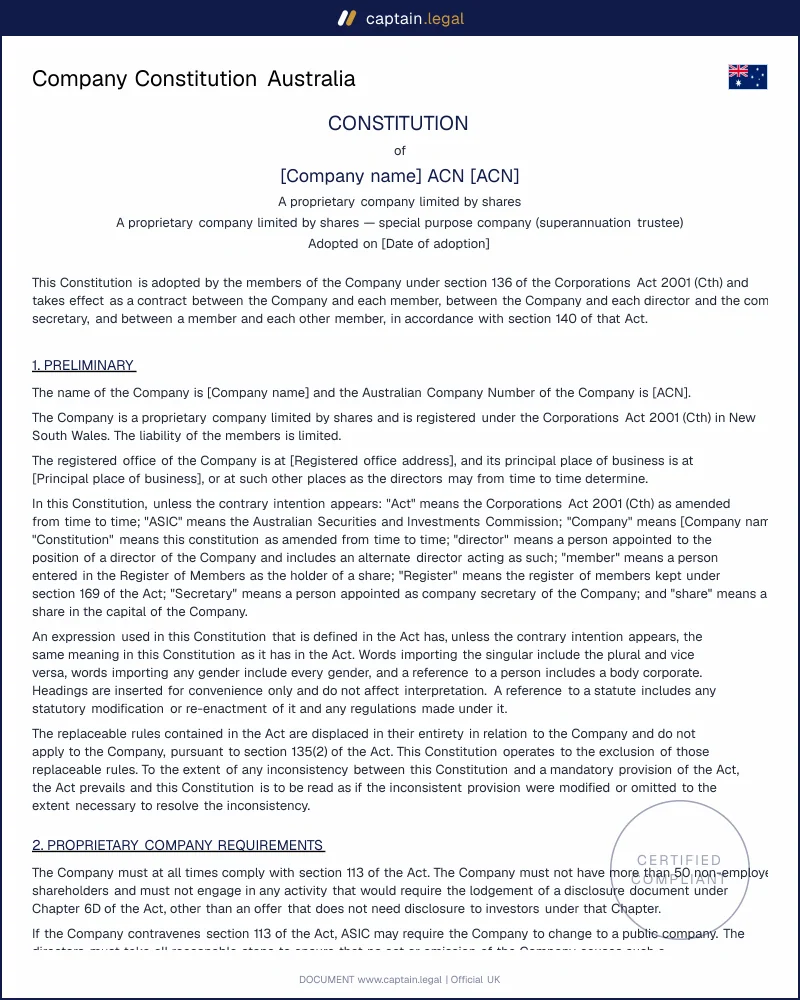
The governing statute is the Corporations Act 2001 (Cth), administered by the Australian Securities and Investments Commission. Part 2B.4 of the Act, sections 134 to 141, sets out the entire architecture. Section 141 lists the provisions that operate as replaceable rules in table form, running to 39 entries covering director appointment and remuneration, meetings of members and directors, share issues and transfers, and the appointment of a company secretary. Familiar examples include s 201G (company may appoint a director), s 254D (pre-emption on share issues in proprietary companies) and s 248A (circulating resolutions where there is more than one director).
Adoption timing matters. Under s 136(1)(a), a company adopts a constitution on registration if each person who consents to become a member agrees in writing to its terms before the application is lodged. After registration, adoption requires a special resolution under s 136(1)(b), meaning at least 75 per cent of votes cast by members entitled to vote. The same 75 per cent threshold applies to later modification or repeal under s 136(2). A constitution adopted pre-registration must be agreed in writing before you lodge, not afterwards. A pack assembled in the days following registration is not fatal, but it forces you down the special resolution route for something you could have had for free.
Lodgement obligations split by company type. A public company must lodge its constitution with ASIC under s 136(5), and where it has one on registration, a copy goes in with the s 117(3) application. A proprietary company lodges nothing unless ASIC directs it to under s 138. That exemption misleads founders into thinking the document is optional paperwork. It is not: s 139 requires the company to send a member a copy within seven days of a written request, and s 140(1) makes it enforceable as a contract.
Two traps deserve naming. First, s 135(1) switches the replaceable rules off entirely for a proprietary company while the same person is both sole director and sole shareholder, which is exactly why so many one-person companies need a constitution rather than merely wanting one. Second, the consent obligations in ss 201D and 204C are strict liability offences, and appointments made without prior written consent may be void. ASIC publishes its own plain-language guidance on company rules and constitutions on the ASIC website, which is worth reading alongside any template.