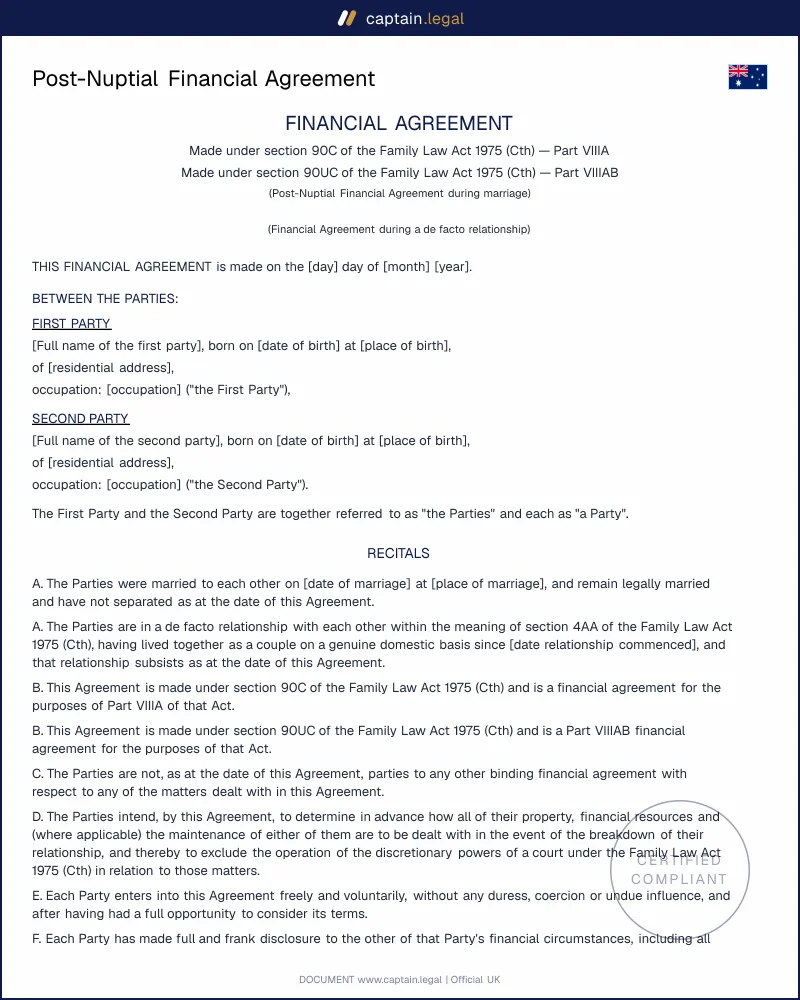
Everything begins with the Family Law Act 1975 (Cth). A financial agreement made during a marriage sits under section 90C, one made after separation under section 90D, and the de facto equivalents under sections 90UD and 90UE in Part VIIIAB. Whichever provision applies, the agreement only becomes binding if it satisfies the technical checklist in section 90G (marriages) or section 90UJ (de facto relationships). Those sections are not aspirational. Strict compliance is mandatory, and the courts have set aside agreements over deficiencies that looked minor on paper.
The central requirement is independent legal advice. Before signing, each party must receive advice from a separate legal practitioner about the effect of the agreement on their rights and about the advantages and disadvantages of signing at the time the advice is given. Husband and wife cannot share the same solicitor, and a de facto couple cannot lean on one adviser between them. Each lawyer then provides a signed statement of independent legal advice, often called a solicitor's certificate, and a copy is exchanged with the other side. The Full Court has made clear that this advice must be tailored to your actual asset pool and contribution history, referencing the section 75(2) factors and each party's likely entitlement under section 79. Template letters do not satisfy the section.
There is a discretionary safety valve. Under sections 90G(1A) and 90UJ(1A), a court may still declare an agreement binding despite a technical defect if it would be unjust or inequitable not to, a power the courts have used sparingly in cases such as Connery & Sims [2025]. Do not build a strategy around it. The court can also set an agreement aside entirely under section 90K or section 90UM, most commonly for fraud, material non-disclosure, or where circumstances relating to a child cause hardship. Since the Family Law Amendment Act 2024 commenced on 10 June 2025, the duty of financial disclosure now lives in the Act itself rather than the court rules, so hiding an asset is riskier than ever. The Federal Circuit and Family Court of Australia publishes the full list of formal requirements in its official guidance on financial agreements.