Create my document
Login

Choose country

AustraliaAustraliaChoose country
Non-Profit

Board Charter & Delegations | ACNC & s.198D Compliant

Board charter and delegations pack drafted to the ACNC Governance Standards and Corporations Act 2001 s.198D. For associations and companies. Word & PDF.
4.7/519 reviews50 000+ downloadsInstant download
Share

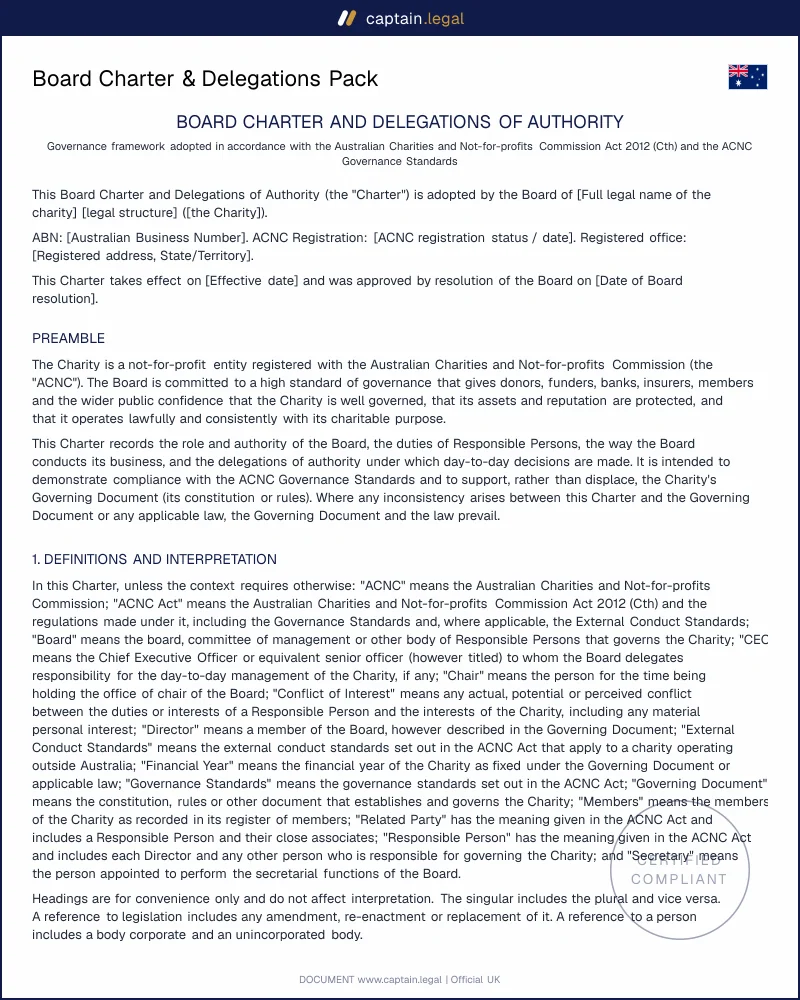
A Board Charter and Delegations of Authority Pack is the document that answers the question every serious funder, bank, and insurer eventually asks: who is actually allowed to decide what, and where is that written down? For an Australian not-for-profit or registered charity, it sets out the role of the board or committee, the powers it keeps, the decisions it hands to sub-committees, the chief executive, and staff, and the meeting procedures that make those decisions valid. Without it, authority lives in people's heads and memories, which is exactly where governance disputes begin.

This pack matters most at the moments when your organisation is being assessed from the outside. Grant due diligence, a bank wanting to update signatories, a professional indemnity or directors and officers insurer pricing your risk: each of them reads your governance paperwork before they read your mission statement. A clean charter and a well-drafted delegations schedule signal that the organisation is run properly, and that is often the difference between a smooth approval and weeks of follow-up questions.

Compliant

2026 Legislation

50,000+ clients

trust us

Affordable

From $4.90 / doc

Secure payment

Instant download

Board Charter & Delegations | ACNC & s.198D Compliant

Secure payment

Fill in the template

What is a board charter and delegations of authority pack?

A board charter is the internal document that describes how your governing body works. It records the board's purpose, its composition, the responsibilities it reserves to itself, the standing expectations of individual members, and the way meetings are called, quorums are met, and decisions are recorded. It sits underneath your constitution: the constitution is the legally binding rulebook filed with the regulator, while the charter is the practical operating manual that explains how the board discharges the duties the constitution assigns to it.

The delegations of authority schedule is the second half of the pack, and in practice it is the part people reach for weekly. It is a structured register that maps specific decisions to specific decision-makers, usually with financial thresholds attached. A committee treasurer might approve spending up to a set limit, the chief executive a higher band, and anything above that returns to the full board. It answers a deceptively simple question: can this person sign this, on their own, today? Getting that answer wrong is how charities end up with unauthorised contracts, invalid payments, and audit findings.

The two documents are drafted to work as a set. The charter establishes that the board may delegate; the schedule records exactly what has been delegated, to whom, and within what limits. A delegation that is never written into the minute book is legally fragile, which is why the pack ties both to your meeting records rather than leaving them as loose policy.

2

When do you need this document?

The most frequent trigger is a funding application that fails its due diligence check. A community group applies for a substantial grant, the funder asks for proof that the board approved its financial controls and that spending authority is properly limited, and suddenly a handshake culture has to become a paper trail overnight. A charter and delegations pack is exactly what closes that gap. The same pattern shows up when you approach a bank to change account signatories under a not-for-profit governance structure, because the bank wants written evidence of who holds authority before it updates its records.

Growth is the second driver. A charity that once ran on volunteer goodwill hires its first paid coordinator, and the board realises nobody has defined what that person can commit the organisation to without approval. Setting delegation bands early prevents the awkward conversation that follows an unauthorised purchase. Insurers create a similar pressure point: directors and officers cover is often priced more favourably when governance documentation is complete, and a professional indemnity renewal can stall while an underwriter waits for evidence of delegated authority limits.

There are two edge cases worth flagging. The first is the charity that operates across several states through branches or chapters, where the board needs to delegate operational authority to regional committees while keeping strategic and financial control central. The second is the organisation restructuring from an incorporated association into a company limited by guarantee, a change that alters the entire delegation framework because the underlying legislation shifts from a state Associations Incorporation Act to the Corporations Act 2001 (Cth). In both situations the charter is the document that keeps the transition orderly.

3

Key clauses included in our template

  • The statement of the board's role and reserved powers draws the line between governance and management. It lists the matters the board will not delegate under any circumstances, typically strategy, the appointment and removal of the chief executive, approval of the annual budget, and any change to the constitution. This clause is what stops a delegation schedule from quietly hollowing out the board's authority.
  • The delegations of authority schedule is the operational heart of the pack, structured as a register of decisions matched to decision-makers with clear financial thresholds. It sets the bands for expenditure approval, contract execution, banking, and staffing, so that everyone from a sub-committee chair to the chief executive knows the exact ceiling of their authority.
  • The meeting and decision-making procedures codify how the board actually functions: notice periods, quorum, voting, use of circular resolutions, and the standard for minute-taking. Because a delegation only holds if it is properly recorded, this clause ties every delegated power back to a resolution captured in the AGM minutes and resolutions pack.
  • The conflict of interest and abstention procedure requires responsible persons to declare material interests and step out of the relevant decision. This is a direct response to the ACNC duty to manage conflicts, and it protects both the individual and the charity when a related-party transaction arises.
  • The sub-committee terms of reference allow the board to stand up finance, audit, or risk committees with defined mandates, so delegated groups operate within a written scope rather than drifting into decisions the full board should be making.
4

State and structure-specific considerations

New South Wales associations operate under the Associations Incorporation Act 2009 (NSW), administered by NSW Fair Trading, which sets the baseline for committee duties and meeting procedure. Where a NSW association also employs staff, the delegations schedule needs to account for obligations under the Fair Work Act 2009 (Cth), and the charter should reference the volunteer agreement framework so that the boundary between delegated staff authority and unpaid volunteer roles stays clear.

Victoria runs under the Associations Incorporation Reform Act 2012 (Vic), regulated by Consumer Affairs Victoria, which prescribes model rules that many associations adopt. A board charter drafted for a Victorian association should explicitly state where it supplements those model rules and where the rules override the charter, because a charter clause that contradicts the registered rules has no effect. The registered rules always win over an internal charter, and treating the charter as a substitute for a proper constitution is a common and costly mistake.

Queensland associations fall under the Associations Incorporation Act 1981 (Qld), one of the older statutes in this area, which places particular weight on the management committee's collective responsibility. Delegation to individuals is possible but the committee retains ultimate accountability, so the Queensland version of the schedule keeps reporting lines back to the committee unusually tight.

For any charity structured as a company limited by guarantee, the state Associations Incorporation Acts fall away entirely and the Corporations Act 2001 (Cth) governs, particularly sections 198D and 190 on delegation and director responsibility. This is the structure most national charities adopt, and its delegation framework is drafted from the incorporated association and company constitution templates rather than the state model rules.

5

How to fill out this board charter and delegations pack

You begin by selecting your legal structure, because that single choice determines which legislation the pack cites and how the delegation clauses are framed. From there, the form asks you to confirm the board's reserved powers, the matters your governing body has agreed never to delegate, and it pre-populates the standard set that most Australian not-for-profits keep at board level. You then set your delegation bands, entering the financial thresholds for expenditure, contracts, and banking that suit the size of your organisation, so a small association and a multi-million-dollar charity end up with proportionate limits rather than a one-size template.

The next stage builds your meeting procedures, where you confirm notice periods, quorum numbers, and whether circular resolutions are permitted, all drawn to match your constitution or registered rules. The pack then generates the conflict of interest procedure and any sub-committee terms of reference you have chosen to include. Once complete, you download the charter and the delegations schedule in editable Word and clean PDF, ready to table at your next meeting for formal adoption. That adoption resolution is what gives the documents their authority, so the final prompt reminds you to record it in your minutes.

6

Common mistakes to avoid

The most damaging mistake is treating the charter as a replacement for the constitution. The constitution is the legally binding document filed with the regulator, and a charter can only supplement it, never contradict it. Boards that draft an ambitious charter without checking it against their registered rules often create clauses that are simply void, and they discover this at the worst possible moment, usually mid-dispute. The second recurring error is delegating authority without recording it in the minute book, which for a company limited by guarantee breaches the recording requirement in section 198D and leaves directors exposed under section 190. A delegation that exists only in practice is not a delegation the regulator or a court will recognise.

The third mistake is setting financial thresholds and then never revisiting them, so a charity that has doubled in size still runs on delegation limits designed for a fraction of its current budget. This forces trivial decisions back to the board and slows the organisation to a crawl, or worse, encourages people to quietly work around limits everyone knows are outdated. Boards also frequently forget to build a conflict of interest step into their delegated decisions, which the ACNC treats as a core governance duty. Finally, many organisations write the charter, adopt it once, and file it, never linking it to their ACNC compliance and governance framework or reviewing it against updated standards. A governance document that is never reviewed drifts out of alignment with both the law and the organisation within a couple of years.

Key takeaways

Purpose

Write down who can decide what

This pack answers the question funders, banks and insurers will ask: who has authority, and where is it recorded. The board charter explains how the board or committee operates, while the delegations schedule pinpoints which person or group can approve particular decisions. Without both, authority sits in memory, which is where disputes and governance breakdowns usually start.

Governance

Charter guides meetings, quorums and minutes

The charter sits under your constitution: the constitution is the regulator-facing rulebook, and the charter is the board’s operating manual. It sets expectations for members and spells out how meetings are called, quorums are met, and decisions are recorded so they are valid. If procedures are unclear or inconsistently followed, you can end up with contested resolutions and messy follow-up when external due diligence begins.

Delegations

Delegations must be recorded and controlled

For a company limited by guarantee, Corporations Act 2001 (Cth) s 198D permits directors to delegate powers, but the delegation needs to be documented in the company’s minute book and must not conflict with the constitution. The schedule then sets the practical limits, often with financial thresholds, to stop unauthorised contracts or payments. Getting signing authority wrong invites audit findings and operational delays.

Frequently Asked Questions

The pack is binding on the organisation once your board or committee formally adopts it by resolution and records that adoption in the minutes. It operates below your constitution, which remains the primary legally enforceable document, so the charter cannot override any constitutional clause or the requirements of your state Associations Incorporation Act or the Corporations Act 2001 (Cth). What makes it enforceable in practice is the adoption resolution and the delegations recorded in your minute book. For a company limited by guarantee, section 198D specifically requires delegated powers to be recorded there, so the paperwork trail is what gives the delegations their legal weight.

Yes, and this is the most important choice you make when generating the pack. Incorporated associations are governed by state or territory legislation such as the Associations Incorporation Act 2009 (NSW) or the Associations Incorporation Reform Act 2012 (Vic), while companies limited by guarantee sit under the Corporations Act 2001 (Cth). The delegation mechanics differ: the Corporations Act provides an express delegation power in section 198D with a corresponding director-responsibility rule in section 190, whereas associations rely on their model rules and committee duties. The template adjusts its legislative citations and clause framing based on the structure you select, so you are not left editing references by hand.

You receive both the board charter and the delegations of authority schedule in editable Microsoft Word format and in clean PDF. The Word version lets you adjust reserved powers, delegation thresholds, and meeting procedures to fit your organisation without retyping from scratch, which matters because these documents are meant to be reviewed and updated as you grow. The PDF gives you a tidy, professional version to circulate to funders, banks, and insurers who ask for governance documentation during due diligence.

A delegations schedule sets bands of authority tied to dollar limits, with each band assigned to a role rather than a named individual so the document survives staff changes. A common arrangement gives a coordinator or manager authority up to a modest ceiling, the chief executive a higher band, a finance sub-committee a higher one again, and reserves anything above that for full board approval. The right numbers depend entirely on your budget and risk appetite, which is why the pack lets you set your own rather than imposing a fixed structure. Thresholds should be reviewed at least annually, because limits that made sense at incorporation quickly become a bottleneck as the organisation grows.

Registered charities must satisfy the ACNC Governance Standards, which require responsible persons to understand and carry out their duties, the charity to act lawfully and protect its assets, and decision-making to be demonstrable to the regulator. A board charter documents those duties and the board's role, while the delegations schedule keeps financial control visible and accountable. Together they give you the evidence the ACNC looks for when it assesses governance, and they pair naturally with your broader compliance documents. They do not replace the substance of good governance, but they are the written proof that it exists.

Yes, and this is precisely what the pack is built to formalise. For companies limited by guarantee, section 198D of the Corporations Act 2001 (Cth) expressly permits directors to delegate powers to a committee, an individual director, an employee, or another person. The important safeguard is section 190, which keeps directors responsible for a delegate's conduct unless they held a reasonable belief that the delegate was competent and reliable. A written delegations schedule, kept current and recorded in the minute book, is the strongest evidence of that reasonable belief, which is why delegation should never be done informally.

Review the pack at least once a year, and always after a significant change such as hiring staff, restructuring your legal form, opening in a new state, or a major shift in budget. Delegation thresholds date faster than any other part of the document, because an organisation's financial scale changes while the limits sit untouched. An annual governance review, minuted properly, also demonstrates to the ACNC and to funders that your board actively oversees its own framework rather than adopting documents once and forgetting them. Tie the review to the same meeting where you approve your annual budget, and it becomes a habit rather than an afterthought.

4.7/5

19 verified reviews · 50 000+ downloads

Board Charter & Delegations | ACNC & s.198D Compliant
  • Immediate access to the document
  • PDF + Word download
  • Compliant with 2026 legislation
  • Reviewed by lawyers
Fill in the template
Secure payment
Updated on July 22, 2026

You might also like

Charity Governance Pack Australia
Incorporated Association Constitution