Create my document
Login

Choose country

AustraliaAustraliaChoose country
Employment

Termination Letter Pack | s.119 Fair Work Act 2009

Employment termination letters drafted to the Fair Work Act 2009: s.117 notice, s.119 redundancy scale and the Small Business Fair Dismissal Code. Word and PDF.
4.8/519 reviews50 000+ downloadsInstant download
Share

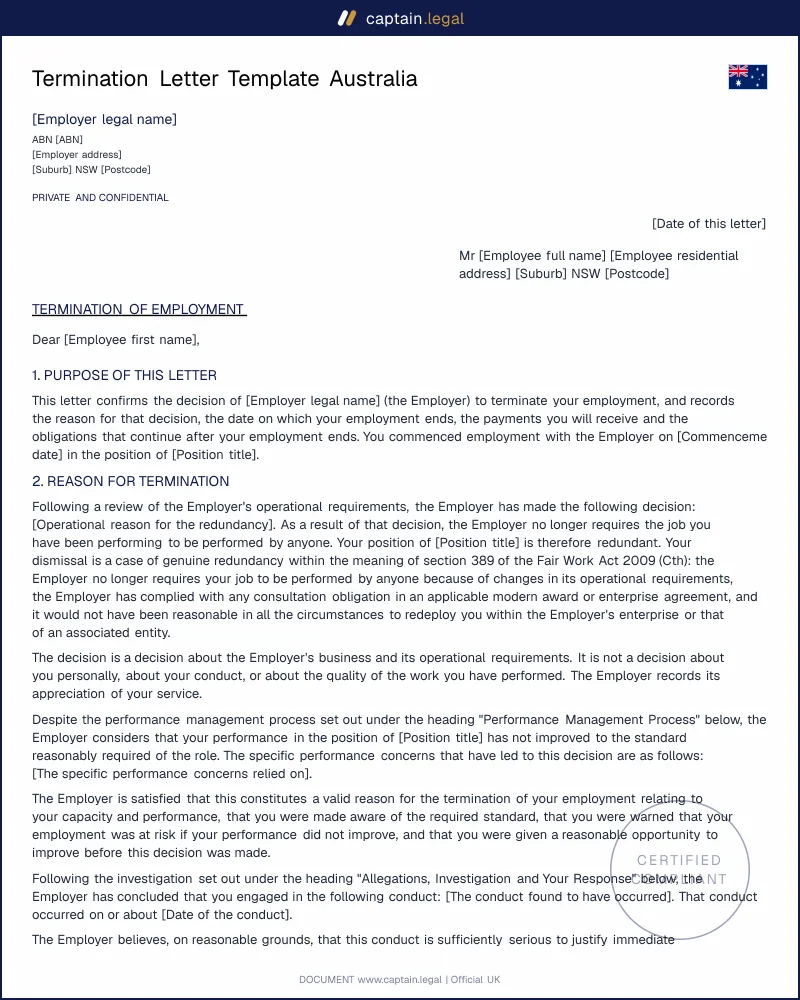
An employment termination letter is the written instrument that ends an employment relationship in Australia and, more importantly, the document that will be tendered as evidence if the employee later files a Form F2 with the Fair Work Commission. This pack contains three separate letters drafted for the three grounds that account for almost every dismissal in the Australian market: redundancy, calculated against the section 119 severance scale; sustained underperformance, structured to satisfy the Small Business Fair Dismissal Code; and serious misconduct, drafted for summary dismissal without notice. Each letter is written to the language of the Fair Work Act 2009 (Cth) and the National Employment Standards, so an employer, HR manager or company director can end an engagement without exposing the business to an unfair dismissal claim built on a defective letter.

Compliant

2026 Legislation

50,000+ clients

trust us

Affordable

From $4.90 / doc

Secure payment

Instant download

Termination Letter Pack | s.119 Fair Work Act 2009

Secure payment

Fill in the template

What is an employment termination letter under Australian law?

An employment termination letter is the employer's formal written notification that the employment relationship will end, stating the ground for dismissal, the effective date and the way notice is being handled. Australian law does not require dismissal to be in writing as a general rule, with one hard exception: section 117(1) of the Fair Work Act 2009 provides that an employer must not terminate an employee's employment unless written notice of the day of termination has been given. That single subsection does most of the work. A verbal dismissal followed by a payslip is technically non-compliant notice, and the Commission treats sloppy paperwork as circumstantial evidence of a sloppy process.

The distinction that matters is between a termination letter and a letter of separation or employment separation certificate. The separation certificate is a Services Australia form completed after the event so a former employee can claim income support; it has no evidentiary weight in a dismissal dispute. The termination letter is the operative document. It fixes the employer's stated reason at the moment of dismissal, and the employer cannot later invent a better reason. Where an employer writes "restructure" and then argues performance at hearing, the Commission reads the inconsistency as a sign the redundancy was never genuine within section 389. Templates covering the front end of the relationship sit in our Australian employment contracts and offer letters collection, and the termination letter should always be read against the contract it ends.

2

When do you need this document?

The most frequent trigger is an operational restructure where a role genuinely disappears. Section 389 is strict about what "genuine" means: the job must no longer be required to be performed by anyone because of changes in the operational requirements of the business, the consultation obligation in the applicable award or enterprise agreement must have been met, and redeployment elsewhere in the business or an associated entity must not have been reasonable. Refilling the position three months later is the classic way employers lose. The redundancy letter in this pack is drafted to record all three limbs on the face of the document, which is precisely what a Commission member looks for at conciliation.

Sustained underperformance is the second scenario, and the one small business employers most often mishandle. Performance dismissal requires a warning, an explanation of what is deficient, and a real opportunity to improve. The Full Bench has made clear that a small business must give a written or verbal warning explaining why the employee is at risk of dismissal and a reasonable chance to fix the performance, with short windows such as four days likely to be found insufficient. The performance letter here is the terminal step of that sequence, cross-referencing prior warnings by date.

Serious misconduct covers the third. Theft, fraud, violence, sexual harassment and serious breaches of work health and safety procedures each justify summary dismissal without notice, provided the employer holds a reasonable belief formed after a reasonable investigation. An edge case worth flagging: an employee earning above the high income threshold who is neither award-covered nor agreement-covered is not protected from unfair dismissal at all under section 382, but remains fully protected against adverse action under the general protections in Part 3-1. The letter still matters. So does the case where a dismissal in the first year of small business employment sits outside unfair dismissal jurisdiction yet squarely inside discrimination law. Related engagement documents for non-employees sit in our independent contractor and service agreement templates, since misclassified contractors are a growing source of dismissal claims.

3

Key clauses included in our template

  • The statement of ground and effective date opens each letter and is the clause the Commission reads first. It names the ground in statutory language, redundancy under section 389, dismissal for a valid reason relating to capacity, or summary dismissal for serious misconduct under regulation 1.07, and it fixes the date the dismissal takes effect, which is the date the 21-day clock in section 394 starts running.
  • The notice and payment in lieu clause is drafted to the section 117 scale, including the additional week for employees over 45 with two years of service. It states whether notice is worked or paid out, and where the contract provides a longer notice period than the statute, the letter applies the contractual figure because the NES is a floor and never a ceiling.
  • The redundancy pay calculation in the redundancy letter itemises the section 119 entitlement in weeks against the employee's completed years of continuous service, then confirms it is calculated at base rate excluding loadings and overtime. It also flags that periods of casual service do not count toward continuous service for this purpose.
  • The consultation and redeployment record captures the dates consultation occurred, who attended, what alternative roles were considered and why redeployment was not reasonable. Without this paragraph a redundancy letter is a bare assertion, and section 389(1)(b) is where genuine redundancy defences most often collapse.
  • The prior warning schedule in the performance letter lists each earlier warning by date, subject and improvement window given. This is the paragraph that evidences Code compliance, and it is the reason a completed Small Business Fair Dismissal Code Checklist should be kept with it.
  • The final pay and entitlements clause confirms payment of outstanding wages, accrued but untaken annual leave, any long service leave entitlement and superannuation, with the payment date stated. Final pay disputes are the most common add-on to an unfair dismissal claim.
  • The support person and investigation record notes that the employee was offered the opportunity to have a support person present at the discussion, since refusing that request is an express factor under section 387(d).
4

State and territory considerations

New South Wales, Victoria, Queensland, South Australia, Tasmania and the Northern Territory are, for private sector purposes, fully within the national workplace relations system. A Pty Ltd company in any of these jurisdictions is a constitutional corporation, the Fair Work Act 2009 applies directly, and the letters in this pack work without modification. The state overlay that does bite is long service leave, which remains state legislation and must be paid out on termination where the threshold is met. NSW applies the Long Service Leave Act 1955 (NSW) with a pro rata entitlement after five years in defined circumstances, while Victoria's Long Service Leave Act 2018 (Vic) allows access after seven years and requires payout on any termination after that point. Getting the final pay figure wrong in the letter invites a separate underpayment claim.

Western Australia is the genuine exception and the one that catches interstate employers. Sole traders, partnerships and unincorporated trusts operating in WA remain in the state system under the Industrial Relations Act 1979 (WA), which means the Fair Work Act notice and redundancy provisions do not apply to them and the WA Industrial Relations Commission, not the FWC, hears the claim. Termination in WA turns on the Minimum Conditions of Employment Act 1993 (WA) and the applicable state award. Confirm the employing entity's structure before serving a WA letter, because a Pty Ltd in Perth is national system and a partnership next door is not.

Queensland and Victoria add a further layer for employers with domestic and family violence provisions in enterprise agreements, and Queensland's Industrial Relations Act 2016 covers state and local government employees who sit outside the FWC entirely. The Australian Capital Territory follows the federal position without a state industrial system of its own, so ACT private employers use the federal letters as drafted, but the Long Service Leave Act 1976 (ACT) sets its own accrual and payout rules. Employers in any jurisdiction who are ending a director's or shareholder's engagement rather than an employee's should read the letter against the shareholders agreement for Australian Pty Ltd companies, because removing a person from payroll does not remove them from the register.

5

How to fill out this employment termination letter pack

You begin by selecting which of the three letters applies, and the form asks the questions that decide the answer rather than assuming you know. It asks headcount at the date of dismissal, because fewer than fifteen employees makes you a small business employer, which flips both the minimum employment period to twelve months and the section 119 redundancy obligation off. It asks the employee's start date and date of birth, then calculates the section 117 notice entitlement, adding the extra week where the employee is over 45 with at least two years of service. For the redundancy letter it applies the statutory scale to completed years of continuous service and prints the entitlement in weeks, including the step down at ten years that manual calculations routinely miss.

From there the form adapts to the ground. The performance letter prompts you for each prior warning by date and subject, and the misconduct letter prompts for the investigation dates, the allegations put to the employee and the employee's response. Both record whether a support person was offered. You then enter the final pay components and the payment date, add your business details and the signatory's position, and download in Word and PDF. Edit the Word file if your contract sets a longer notice period than the statute. Everything else is already drafted to the Act.

6

Common mistakes to avoid

The most expensive mistake is serving notice by text message or email without a signed letter, then arguing at hearing that section 117(1) was satisfied. It was not, and the Commission reads the shortcut as a proxy for the whole process. Nearly as common is backdating the effective date to shorten the payout, which does not shorten the twenty-one day window and does hand the applicant a credibility argument. Employers also miscalculate section 119 by reading the scale as rising indefinitely and paying sixteen or eighteen weeks at ten years of service when the statutory figure drops back to twelve, or by inflating the base rate with car allowances and commission that the section expressly excludes. Overpaying is not a defence to anything, but it is real money.

On the redundancy side, the recurring failure is treating consultation as an announcement. Almost every modern award requires the employer to consult once a definite decision to make major change is made, provide information in writing and genuinely consider employee responses. Telling someone their role has gone in the same meeting where you hand them the letter is not consultation, and it converts a defensible restructure into a section 389 problem. In performance cases, employers issue a final warning and dismiss four days later, which the Full Bench has already held is not a reasonable opportunity to improve. And in misconduct cases, the belief must be formed after an investigation, not before it. Dismiss first and investigate afterwards and the Code defence disappears, no matter how bad the conduct turns out to have been.

Key takeaways

NOTICE

Written notice of the termination date

A termination does not have to be in writing in every scenario, but s.117(1) of the Fair Work Act 2009 creates a hard rule: you must give written notice of the day of termination. A verbal dismissal backed only by a payslip is still non-compliant. The letter should also state whether notice is worked or paid in lieu at the full rate for ordinary hours.

EVIDENCE

Your letter locks in the reason

The termination letter is the operative document and will be relied on if an employee later lodges a Form F2 at the Fair Work Commission. It fixes the employer’s stated ground at the moment of dismissal, and you cannot later swap in a better story. If the letter says “restructure” but you argue performance later, that inconsistency can undermine any claim of a genuine redundancy under s.389.

REDUNDANCY

s.119 pay is non-linear and narrow

If the dismissal is redundancy, the letter needs to align with the s.119 redundancy pay scale, because this is where mistakes often happen. The statutory table is not a straight progression: it rises up to 16 weeks at 9 years, then drops to 12 weeks at 10 years or more. Redundancy pay is calculated on base rate for ordinary hours and excludes bonuses, loadings, allowances, overtime and penalty rates.

Frequently Asked Questions

Yes. Each letter in the pack is drafted to the Fair Work Act 2009 (Cth) and the National Employment Standards, and once signed and served it constitutes valid written notice of termination for the purposes of section 117(1). The letter records the ground, the effective date and the notice treatment, which are the three elements the Fair Work Commission examines first in any unfair dismissal matter. Bear in mind that a compliant letter does not make an unfair dismissal fair. It documents a fair process; it does not substitute for one. Where a modern award or enterprise agreement covers the role, check the consultation and notice clauses before serving, because those instruments can exceed the statutory minimum.

Section 117 sets a scale based on continuous service: one week for a year or less, two weeks for more than one year up to three, three weeks for more than three up to five, and four weeks for more than five years. An employee over 45 who has completed at least two years of continuous service gets an additional week on top. You may require the employee to work the notice or pay it out in lieu at the rate they would have received for working ordinary hours during that period. Serious misconduct is the exception: summary dismissal under regulation 1.07 requires no notice at all, though final pay entitlements remain payable in full.

Yes, but the Small Business Fair Dismissal Code sets the path. An employer with fewer than fifteen staff must give the employee a warning, preferably written, explaining that their job is at risk and what needs to improve, then allow a reasonable period to fix it. The Full Bench has treated windows as short as four days as inadequate. Complete the Code Checklist at the time of dismissal and keep it with the employee's file, because if a claim is filed the employer carries the burden of proving compliance. Employees of a small business cannot bring an unfair dismissal claim in the first twelve months of employment, though discrimination and general protections claims remain available from day one.

Redundancy pay is paid in weeks of the employee's base rate for ordinary hours, scaling with completed years of continuous service. The Fair Work Ombudsman's published scale starts at four weeks for at least one year and rises to sixteen weeks at nine years, then reduces to twelve weeks at ten years or more. Base rate excludes bonuses, incentive payments, loadings, allowances, overtime and penalty rates. Employers with fewer than fifteen employees are generally not required to pay NES redundancy at all, and employees with less than twelve months of continuous service are excluded regardless of employer size, although notice under section 117 is still owed.

Regulation 1.07 of the Fair Work Regulations 2009 defines it as wilful or deliberate behaviour inconsistent with the continuation of the contract, or conduct causing serious and imminent risk to the health and safety of a person or to the reputation, viability or profitability of the business. The Small Business Fair Dismissal Code names theft, fraud, violence and serious breaches of work health and safety procedures. Sexual harassment sits in the same category. The employer must hold that belief on reasonable grounds after a reasonable investigation, and the employee must be given the allegations and a genuine chance to respond. Suspicion alone will not support a summary dismissal.

You download all three letters in Word (.docx) and PDF. The Word version is fully editable, which matters when your employment contract sets a longer notice period than section 117 or your enterprise agreement imposes consultation steps beyond the award standard. The PDF is the version to sign and serve. Keep the signed copy, the delivery record and, for small business dismissals, the completed Code Checklist together in the employee's file. Our Australian employment document templates cover the surrounding paperwork, from offer letters through to confidentiality terms.

Twenty-one calendar days from the date the dismissal takes effect, under section 394(2). Not twenty-one business days, and the clock runs from the effective date stated in your letter rather than the date you handed it over. The Commission may allow a late application only in exceptional circumstances, and that bar is high. Once lodged, the matter goes to conciliation before any hearing. This deadline is the practical reason to date the letter accurately and keep proof of service: a dispute about when the twenty-one days started is a dispute you should never have to argue.

Almost certainly. Every modern award and virtually every enterprise agreement contains a consultation clause requiring the employer to notify affected employees once a definite decision to make major workplace change has been made, provide relevant information in writing, and genuinely consider their responses. Section 389(1)(b) makes compliance with that clause part of the definition of genuine redundancy, so skipping it removes the redundancy defence entirely and exposes the dismissal to an unfair dismissal finding. You must also consider whether redeployment within your business or an associated entity was reasonable. Where fifteen or more employees are being made redundant, written notification to Services Australia is also required.

Yes, provided the plan was real. A performance improvement plan is evidence of the warning and the opportunity to improve that section 387 requires the Commission to consider, but only if it identified specific deficiencies, set measurable expectations and allowed a period proportionate to the role. Dismissing at the end of a genuine plan where performance has not improved is defensible. Dismissing mid-plan, or at the end of a plan that was drafted purely to paper the file, is not. The employee must also be allowed a support person at the dismissal meeting, and the Australian family and personal document templates are unrelated here, but the same evidentiary discipline applies: contemporaneous records beat recollection every time.

4.8/5

19 verified reviews · 50 000+ downloads

Termination Letter Pack | s.119 Fair Work Act 2009
  • Immediate access to the document
  • PDF + Word download
  • Compliant with 2026 legislation
  • Reviewed by lawyers
Fill in the template
Secure payment
Updated on July 16, 2026

You might also like

Flexible Work Arrangement Agreement AU
Casual Employment Contract Australia