Create my document
Login

Choose country

AustraliaAustraliaChoose country
Personal

Australian Will Template | Succession Act Compliant

Last Will and Testament drafted to state succession law (Succession Act 2006, Wills Act 1997). Correct witnessing rules for a valid, probate-ready will.
4.5/518 reviews50 000+ downloadsInstant download
Share

A Last Will and Testament is the document that tells the courts, your executor, and your family who inherits your estate, who administers it, and what happens to specific gifts once you are gone. In Australia it is governed by state and territory succession law, not a single national statute, so the way it is signed and witnessed matters as much as what it says. This template is drafted for modern households: blended families, children from more than one relationship, mortgaged property, and specific personal legacies. Get the execution wrong and the whole thing can fall into an informal will application, so the witnessing instructions built into this will template are not decoration.

Compliant

2026 Legislation

50,000+ clients

trust us

Affordable

From $4.90 / doc

Secure payment

Instant download

Australian Will Template | Succession Act Compliant

Secure payment

Fill in the template

What is a last will and testament in Australia?

A will is a written declaration of how you want your property distributed after death, appointing an executor to carry out those wishes and administer your estate. The person making it is the testator. Until the moment of death it has no legal effect and can be revoked or replaced at any time, which is why a will is a snapshot of your intentions on the day it was signed, not a binding contract with your beneficiaries.

People confuse a will with a few neighbouring documents. It is not an enduring power of attorney, which only operates while you are alive and loses all force the instant you die. It is not a binding death benefit nomination, the separate form that directs your superannuation fund, and it is not an advance care directive, which speaks to medical treatment rather than money. A will sits at the centre of estate planning, but it rarely controls everything you own. Superannuation and life insurance often pass outside the estate under fund rules and binding nominations, and property held as joint tenants passes to the survivor by survivorship regardless of what the will says. A will only governs assets that form part of your estate, and misunderstanding that boundary is the single most common planning error we see. If you are also organising authority for someone to act while you are alive, an enduring power of attorney template built for Australian rules is the natural companion document.

2

When do you need this document?

The obvious trigger is having something to leave and someone to leave it to, but the sharper answer is that you need a will whenever intestacy would produce the wrong result. Die without one and a statutory formula distributes your estate in fixed shares, which routinely ignores stepchildren, unmarried partners of short standing, and the specific person you wanted to receive a particular item. Anyone with children, a mortgage, or a business interest is already past the point where intestacy is safe.

Blended families are the scenario where this template earns its keep. If you have children from a previous relationship and a current partner, the default rules can leave your biological children with far less than you intend, or force your partner and your adult children into a fight over the family home. A properly drafted will can ring-fence gifts, create a life interest in property, and name guardians for minor children, which intestacy never does. New parents, newly separated people, and anyone who has just bought property in joint names should also revisit their arrangements, because each of those events can quietly rewrite or revoke what an old will was meant to achieve.

There are edge cases worth flagging. If you own mortgaged property, you need to decide whether a specific beneficiary takes the asset subject to the debt or whether the debt is cleared from the residue first, because silence creates litigation. And if you suspect an eligible person may bring a family provision claim, such as an adult child left out or a dependent former partner, the will should be drafted with reasons and structure that anticipate that challenge rather than inviting it. For couples formalising financial arrangements alongside their estate planning, a binding financial agreement under the Family Law Act often sits beside the will.

3

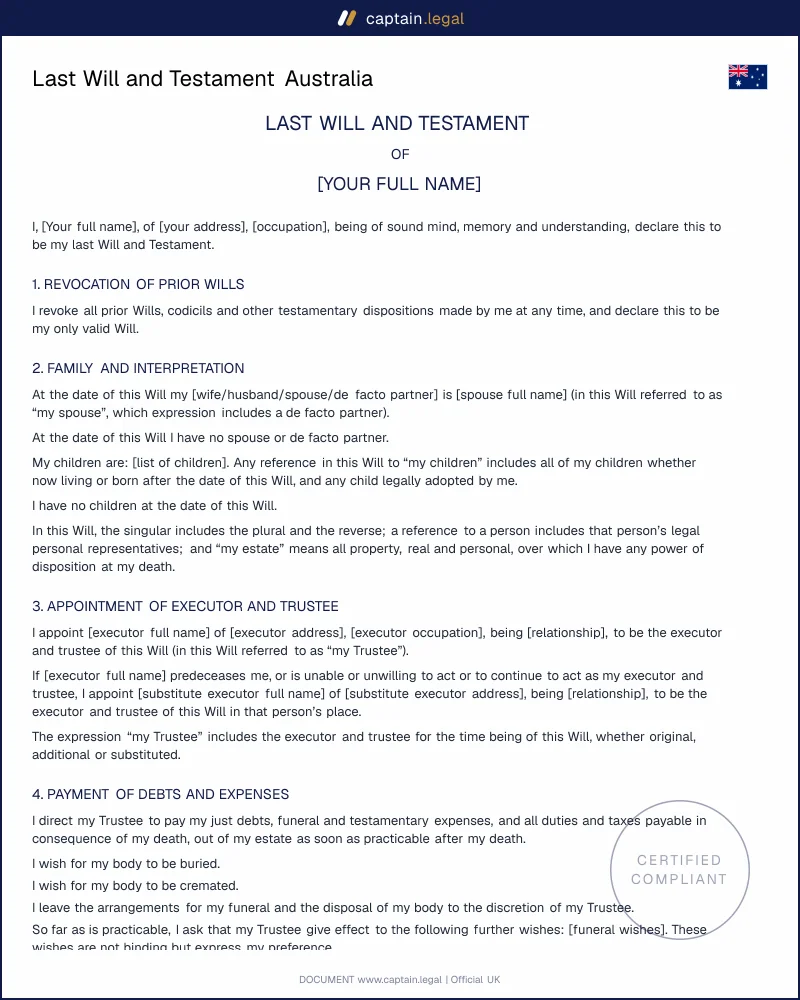
Key clauses included in our template

  • The revocation clause opens the will by cancelling every earlier will and codicil, which prevents an old document surfacing after your death and competing for probate. It is short, but leaving it out is one of the most common causes of confusion in estate administration.
  • The appointment of executors names the person or people who will administer your estate, with a substitute executor if the first choice cannot or will not act. The template lets you appoint executors jointly or as a chain, and it flags that an executor should be over 18 and willing, because a reluctant executor can stall a probate application for months.
  • The guardianship clause appoints a guardian for any children under 18, a provision that matters enormously to parents and that intestacy cannot supply. It sits early in the document so it is impossible to miss.
  • The specific gifts and legacies section lets you leave named items, sums, or particular assets to particular people, including the treatment of a mortgaged property so the beneficiary and the estate both know who carries the debt. Each gift is drafted to survive the death of a beneficiary through a substitution provision.
  • The residuary clause catches everything not specifically dealt with and everything that lapses, so no asset falls into a partial intestacy. A will without a residuary clause is a will with a hole in it.
  • The attestation clause records the circumstances of signing and witnessing, which speeds up probate because the registry can rely on the formalities rather than reconstructing them from affidavits.
4

State and territory considerations

New South Wales governs wills under the Succession Act 2006 (NSW), requiring the testator's signature to be made or acknowledged before two witnesses present together. A beneficiary who acts as a witness generally forfeits their gift under s 10, so the template steers you toward independent witnesses. Family provision claims run under s 57, which lets spouses, de facto partners, children, former dependants, and people in a close personal relationship apply, and the twelve month claim window from the date of death is strict.

Victoria operates under the Wills Act 1997 (Vic), and it is one of the two jurisdictions where a beneficiary-witness keeps their gift by virtue of s 11, though best practice still favours neutral witnesses. Family provision, known locally as a testator's family maintenance claim, is brought under Part IV of the Administration and Probate Act 1958 (Vic), and eligibility is narrower than it once was, turning on financial dependency and a defined list of relationships.

Queensland applies the Succession Act 1981 (Qld), which sets out the same two-witness formula and, under Part 4, gives a spouse, child, or dependant an unconditional right to bring a family provision claim within nine months of death. Marriage revokes a prior Queensland will unless made in contemplation of it, and divorce strips a former spouse of gifts and appointments. Queensland's shorter claim notice periods reward executors who pause distribution rather than paying out early.

Western Australia relies on the Wills Act 1970 (WA), notable because s 8 imposes the two-witness requirement but WA does not void a gift to a witnessing beneficiary, unlike the eastern states. Marriage and divorce both revoke a WA will in the usual way, and the Probate Registrar checks execution formalities closely at the grant stage, which makes clean signing and pagination worth the effort.

5

How to fill out this last will and testament

You start by identifying yourself as the testator with your full legal name and address, then confirm you are over 18 and making the will freely, which anchors the testamentary capacity the courts expect under the Banks v Goodfellow test. From there the form walks you through appointing your executor and a backup, then a guardian if you have children under 18, so the people who will run your estate and raise your children are settled before you reach the money.

Next you set out your gifts. The template lets you list specific legacies first, name the beneficiary and a substitute for each, and then direct everything left over through the residuary clause so nothing is missed. If you own mortgaged property, you tell the form whether the debt follows the asset or is paid from the residue. Once the content is complete, the document generates a full attestation clause and clear signing instructions: sign in blue ink, in front of two independent adult witnesses who are present together, and have each of them sign in your presence. You download it in editable Word and print-ready PDF, then execute the paper copy, because an unsigned will is not a will. If your affairs also need someone to speak for your medical wishes, pair it with the personal legal documents range for Australian households.

6

Common mistakes to avoid

The mistake that ruins the most wills is botched execution. People sign without two witnesses in the room at the same time, or they let a beneficiary witness the document and quietly destroy that person's gift in every state except Victoria and South Australia. Others make handwritten changes after signing, which the court presumes were added later and therefore ignores, so a crossed-out beneficiary can still inherit. The fix is dull but reliable: two independent adult witnesses, one pen, everyone present, no alterations after the fact, and a signature on every page.

The second cluster of errors is about what a will can and cannot reach. Owners forget that superannuation and life insurance often pass outside the estate, so they gift money in the will that the will never controlled, leaving a beneficiary shortchanged and a binding nomination pointing elsewhere. Some assume separation changes their will; it does not, and a still-married but estranged spouse keeps every benefit until a formal divorce or a new will removes them. Failing to update after marriage is equally dangerous, because in most states marriage revokes the entire document and throws the estate into intestacy. And leaving out an eligible person without thought invites a family provision claim, so a considered structure beats an angry silence. For business owners, coordinating the will with a shareholders agreement under the Corporations Act prevents the estate and the company from pulling in opposite directions.

Key takeaways

What it controls

A will only covers estate assets

Your will directs what happens to assets that form part of your estate, but it will not catch everything you own. Superannuation and life insurance may pass under fund rules and binding nominations, and jointly held property as joint tenants usually passes by survivorship no matter what your will says. Misunderstanding that boundary is a common reason plans fail.

Execution rules

Two witnesses, same time, properly

State and territory laws differ in name, but the execution basics are consistent: the will must be in writing, signed by you (or someone at your direction and in your presence), and the signing must be made or acknowledged in front of two adult witnesses present at the same time. If the witnessing steps are botched, you may be pushed into an informal will application.

Witness risks

Do not use a beneficiary witness

A classic trap is letting someone who receives a gift under the will act as a witness. In New South Wales, Queensland, Western Australia and several other jurisdictions, an interested witness can cause that beneficiary to lose their gift, even if the rest of the will stands. Victoria and South Australia allow the gift to survive (s 11 Wills Act 1997 (Vic), s 13 Succession Act 2023 (SA)), but it is still poor practice.

Frequently Asked Questions

Yes, provided you execute it correctly for your state or territory. The template is drafted to the common execution formula across Australian succession law: a written document, signed by you, with your signature made or acknowledged in front of two adult witnesses present at the same time, who then sign in your presence. A will that meets those formalities is admitted to probate on the strength of its attestation clause. If the formalities fail, a court can sometimes rescue the document through the dispensing power, but that is a slow and expensive backstop you should never rely on. Follow the signing instructions and the document carries full legal force.

You need two witnesses, both adults with capacity, present at the same time when you sign or acknowledge your signature. They must then attest and sign while you watch. The safest choice is two people who take nothing under the will, because in New South Wales, Queensland and most jurisdictions a beneficiary who witnesses forfeits their gift, even though the will itself stays valid. Victoria and South Australia protect a beneficiary-witness's gift, but using independent witnesses everywhere avoids the argument entirely. A witness who cannot see the signing cannot validly attest, so choose people who can physically observe you sign.

Yes. Once you complete the form, the document is generated in editable Word format and print-ready PDF. The Word version lets you make final adjustments to names, gifts, or executor details before you print, while the PDF gives you a clean copy for execution. You must print and sign a physical copy, because a valid Australian will has to be signed on paper in front of your two witnesses. Keep the executed original somewhere your executor can find it, and tell them where it is, since a will no one can locate causes the same problems as a will that was never made.

Both events change your will automatically. In almost every Australian state and territory, marriage revokes an existing will unless the will was expressly made in contemplation of that specific marriage, which means marrying after signing can throw your whole estate into intestacy. Divorce does not revoke the entire will, but it cancels gifts to your former spouse and their appointment as executor or guardian, treating them as if they had died before you. Separation alone changes nothing, so an estranged but still-married spouse keeps every benefit until you divorce or sign a new will. Review your will after any change in relationship status.

Yes. Every jurisdiction allows an eligible person to bring a family provision claim if they believe the will fails to make adequate provision for their proper maintenance. Eligibility varies: spouses, de facto partners, and children generally qualify, and dependants or people in a close personal relationship may too. Claims run to strict deadlines, roughly six to twelve months from death depending on the state, which is why executors are wise to pause distribution rather than pay out immediately. You cannot make a will completely challenge-proof, but a well-structured document that addresses your obligations reduces the odds of a successful claim.

No. Australian law does not require a solicitor to draft or witness a will, and a properly executed template is legally valid. The value of doing it yourself with a structured template is speed and control over straightforward estates: a home, superannuation, savings, and clear beneficiaries. Complex situations still benefit from advice, such as blended families with competing interests, testamentary trusts, business succession, or a real risk of a family provision claim. For most households the honest answer is that the document is only as good as the facts you put into it, so accuracy about your assets and debts matters more than who typed the words.

Store the signed original somewhere safe and tell your executor exactly where it is. Options include a home safe, a bank safe deposit box, or lodgement with the probate registry or a trustee company in states that offer it. Avoid stapling, unstapling, or paper-clipping the executed will, because puncture marks and clip impressions raise questions at probate about whether a page was removed. Keep it flat, keep it complete, and do not write on it after signing. An executor who cannot find the original may be forced to prove a copy, which is harder and slower than presenting the document you actually signed.

4.5/5

18 verified reviews · 50 000+ downloads

Australian Will Template | Succession Act Compliant
  • Immediate access to the document
  • PDF + Word download
  • Compliant with 2026 legislation
  • Reviewed by lawyers
Fill in the template
Secure payment
Updated on July 20, 2026

You might also like

Change of Name Usage Declaration
Advance Care Directive Australia