Create my document
Login

Choose country

AustraliaAustraliaChoose country
Non-Profit

ACNC Governance Pack | Charities Act 2013 Compliant

Governance pack drafted to the Charities Act 2013 (Cth) and six ACNC Governance Standards. Charitable purpose, not-for-profit and winding-up clauses included.
4.6/5— 23 reviews50 000+ downloadsInstant download
Share

Registering a charity with the Australian Charities and Not-for-profits Commission is not the finish line, it is the point where the paperwork has to prove itself. A Charity Registration Governance Pack brings together the constitutional clauses and governance instruments the ACNC expects to see: the not-for-profit and winding-up clauses, a charitable purpose statement drafted to the Charities Act 2013 (Cth), and the declarations that show each Responsible Person is fit to serve. This is the document set that turns a good idea into a registrable charity and keeps it compliant afterwards.

The pack is built for people setting up an incorporated association, a company limited by guarantee, or an unincorporated body applying to the ACNC. It gives you the six ACNC Governance Standards translated into clauses you can adopt at committee level, plus the registers and undertakings that a grant-maker, auditor, or the Commissioner will ask to see when they test whether your governance is real or just written down.

Compliant

2026 Legislation

50,000+ clients

trust us

Affordable

From $4.90 / doc

Secure payment

Instant download

ACNC Governance Pack | Charities Act 2013 Compliant

Secure payment

Fill in the template

What is a charity governance pack under ACNC rules?

A charity governance pack is a bundle of constitutional provisions and internal governance documents drafted to satisfy the conditions of registration set by the Australian Charities and Not-for-profits Commission Act 2012 (Cth) and the Charities Act 2013 (Cth). It is not itself your constitution. It supplies the specific clauses your governing document must contain and the supporting instruments, declarations, registers, and undertakings, that demonstrate ongoing compliance with the six Governance Standards.

People often confuse a governance pack with a constitution or a set of rules, and the distinction matters. Your governing document is the single instrument that a court would read to determine how the organisation is run: its name, its objects, its membership, its meeting procedures. The governance pack is broader. It contains the clauses that belong inside that governing document, such as the charitable purpose, not-for-profit, and winding-up provisions, and it also contains the operational documents that sit outside it, such as the Responsible Persons declarations, the conflict of interest register, and the record-keeping checklist. The ACNC does not register a charity on the strength of good intentions. It looks at whether the governing document carries the right clauses and whether the organisation can produce evidence, minutes, registers, signed undertakings, that the Standards are actually met. This pack is the practical answer to both tests, and it works alongside the broader suite of not-for-profit and charity templates built for Australian community organisations.

2

When do you need this document?

The clearest trigger is a fresh application to the ACNC. You have an ABN, a committee, and a purpose, and now you need a governing document that carries the charitable purpose, not-for-profit, and winding-up clauses in a form the Commissioner will accept on the first pass rather than after weeks of requisitions. Getting the constitutional architecture right at this stage saves the most painful kind of delay, the one that holds up bank signatories and grant agreements while you redraft.

A second trigger is remediation after a governance failure. A director resigns and the committee discovers the register of Responsible People was never kept, or a complaint forces the board to show how it handles conflicts and finds it has no register and no procedure. In practice most disputes start because roles and decision-making were never written down, so people fill the gaps with assumptions, and a governance pack is how you close those gaps before the ACNC or a funder asks. Grant conditions are a third common driver. Funders increasingly require evidence that policies exist and that the board formally approved them, and a charity that cannot produce minutes recording those approvals looks ungoverned even when it is well run.

The edge cases are worth flagging. An unincorporated association converting to a company limited by guarantee needs its purpose and surplus clauses carried across cleanly, or it risks losing charitable eligibility mid-transition. And any charity contemplating deductible gift recipient endorsement needs a tighter winding-up clause than the ACNC baseline, because surplus DGR assets can only pass to another DGR fund with a similar purpose. Charities restructuring their board should also review the company constitution provisions that interact with these governance clauses.

3

Key clauses included in our template

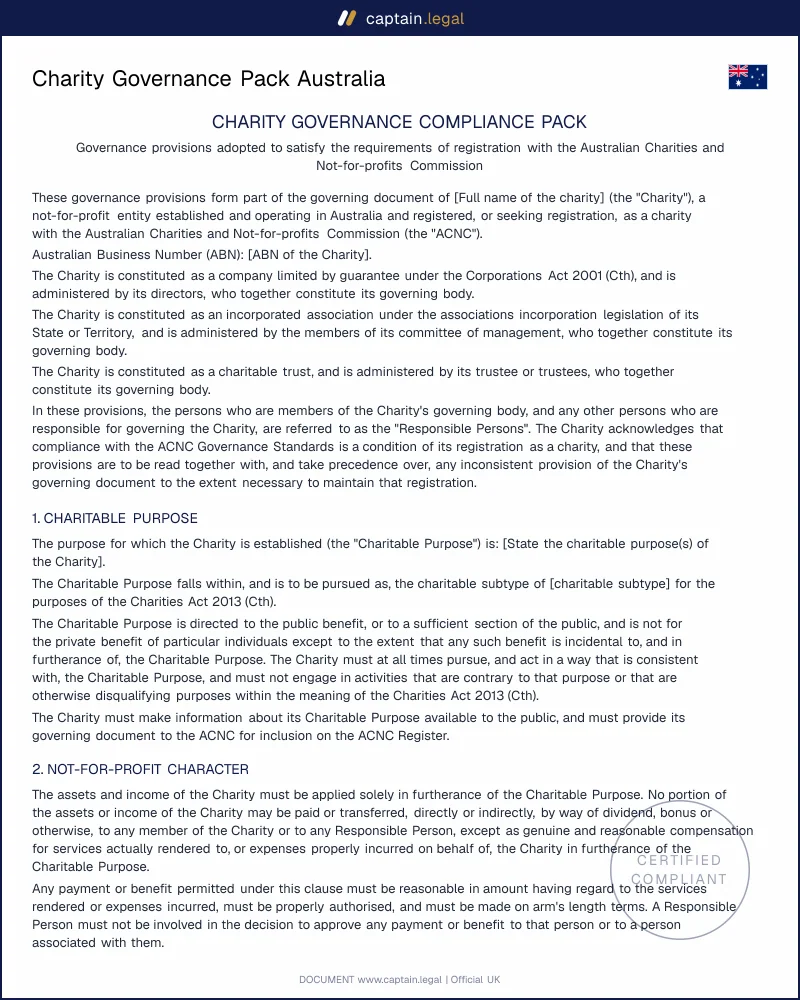
  • The charitable purpose clause states the organisation's objects in language that maps onto one or more of the twelve heads of charity in the Charities Act 2013 (Cth). It is drafted to survive ACNC scrutiny, avoiding the member-benefit framing that gets recreational and social groups refused, and it is positioned to take precedence over inconsistent provisions elsewhere in the document.
  • The not-for-profit clause confirms that assets and income are applied solely to further the objects and prohibits any distribution to members, whether during operation or on winding up, except as genuine compensation for services or reimbursement of expenses. This is the clause the ACNC treats as the structural test of not-for-profit status under Governance Standard 1.
  • The winding-up clause, sometimes called the dissolution clause, requires that surplus assets remaining after debts and liabilities are met be transferred to another charity with similar charitable purposes whose rules also prohibit distribution to members. A DGR variant tightens this so surplus passes only to another DGR.
  • The Responsible Persons undertakings capture the duties required by Governance Standard 5, acting with care and diligence, acting in the charity's best interests, disclosing conflicts, and not trading while insolvent, in a signed instrument each director or committee member executes on appointment.
  • The suitability declaration implements Governance Standard 4, with each Responsible Person confirming they are not disqualified from managing a corporation under the Corporations Act 2001 (Cth) and have not been disqualified by the ACNC Commissioner in the previous twelve months.
  • The conflict of interest register and procedure documents declarations, records abstentions, and sets the meeting process for managing related party transactions, the evidence Governance Standard 5 expects when a conflict is disclosed and managed rather than ignored.
4

Regional considerations

Charity registration is a Commonwealth matter, but the underlying legal structure of most small charities is set by state and territory law, and that interaction shapes how the pack is used.

New South Wales incorporated associations sit under the Associations Incorporation Act 2009 (NSW), administered by NSW Fair Trading. An association registered there and then registered with the ACNC benefits from streamlined reporting, but its rules must still carry the charitable purpose and winding-up clauses in a form that satisfies both the state Act and the Commissioner. Where the model rules conflict with ACNC requirements, the charity-specific clauses should be drafted to prevail.

Victoria operates under the Associations Incorporation Reform Act 2012 (Vic) through Consumer Affairs Victoria, which publishes model rules that many small associations adopt wholesale. Those model rules are a starting point, not a compliant charity constitution, so the not-for-profit and dissolution provisions almost always need tailoring before an ACNC application. Adopting the model rules unamended is a frequent cause of registration delay in Victoria.

Queensland associations fall under the Associations Incorporation Act 1981 (Qld), regulated by the Office of Fair Trading. Queensland's own rules on surplus distribution on winding up must be reconciled with the ACNC winding-up clause, and the two are not always identical, so the governing document needs a clause that satisfies the stricter of the two.

Companies limited by guarantee are national and governed by the Corporations Act 2001 (Cth), but once registered with the ACNC most of their ASIC reporting obligations are replaced by the ACNC regime. The governance pack for a company structure therefore leans on the constitution rather than state model rules, and the purpose, not-for-profit, and winding-up clauses must be drafted to override any inconsistent provision and to prevent members from resolving away the charitable character of the company.

5

How to fill out this governance pack

You start by selecting your legal structure, because the clauses differ between an incorporated association and a company limited by guarantee, and the pack adjusts the wording accordingly. From there you enter your charitable objects, and this is the step to slow down on, since the purpose has to map onto a recognised head of charity rather than describe member benefits. The template then generates the not-for-profit and winding-up clauses, with the option to switch to the tighter DGR winding-up wording if you intend to seek deductible gift recipient endorsement.

Next you list your Responsible People and the pack produces a suitability declaration and a duties undertaking for each of them to sign, along with a conflict of interest register ready for the first board meeting. You finish by reviewing the record-keeping checklist, which sets out the governance and compliance documents the ACNC expects you to hold and produce on request. The output comes in editable Word format and clean PDF, so you can adapt individual clauses without retyping the document, then lodge the governing document with your application and file the declarations and registers internally.

6

Common mistakes to avoid

The most damaging mistake is a purpose clause written for the members rather than the public. A committee drafts objects around running events, maintaining a clubhouse, or supporting its own membership, then cannot understand why the ACNC refuses registration. The Commissioner reads the governing document literally, and a purpose that primarily benefits members is not charitable no matter how much good the group does in practice. The second recurring error is treating state model rules as a finished charity constitution. Consumer Affairs and Fair Trading model rules are drafted for associations generally, not for charities, and their winding-up provisions often fall short of what the ACNC requires, so lodging them unamended invites a requisition.

A third mistake is neglecting the Responsible Persons obligations entirely. Charities collect the declarations at registration, then never repeat the disqualification checks, when Governance Standard 4 expects reasonable ongoing steps and many well-run boards re-run the checks annually. Skipping conflict of interest records is just as common, and a board that manages a conflict verbally but records nothing has no evidence it complied with Governance Standard 5. Finally, charities forget that registration is a continuing condition, not an event. The Governance Standards must be met every year the charity stays registered, and minutes that record real decisions rather than vague "noted" entries are what prove it. Organisations that also employ staff should pair this pack with a compliant employment contract aligned with the Fair Work Act, because a charity is an employer like any other.

Key takeaways

ACNC registration

Registration depends on clauses and proof

ACNC charity registration is not won by good intentions. The ACNC checks your governing document contains the right constitutional clauses (charitable purpose, not-for-profit, winding-up) and that you can produce supporting evidence that governance is actually happening. Think minutes, registers and signed undertakings, ready to show a grant-maker, auditor or the Commissioner when your compliance is tested.

Legal framework

Charities Act sets your purpose boundaries

Your charitable purpose statement must match the Charities Act 2013 (Cth), including public benefit. If your objects read like member benefits, social or recreational aims, registration can be refused even if you call yourself a charity. The governance pack is drafted to help your governing document point clearly to a recognised charitable purpose rather than drifting into non-charitable language.

Ongoing duties

Governance Standards are continuous conditions

Under the Australian Charities and Not-for-profits Commission Act 2012 (Cth), compliance with the six ACNC Governance Standards is a standing condition of being registered, not a one-off application step. The pack translates the Standards into committee-level clauses and operational tools such as Responsible Person declarations, a conflict of interest register and a record-keeping checklist so you can evidence compliance over time.

Frequently Asked Questions

The clauses become binding when they are properly incorporated into your governing document and adopted according to your existing rules, which usually means a members' resolution passed at a properly convened meeting. The Responsible Persons declarations and undertakings bind each individual once signed. The pack itself is a professionally drafted set of provisions, not a substitute for the adoption process, so the binding force comes from following your constitution's amendment procedure correctly. For a company limited by guarantee, altering the constitution requires a special resolution under the Corporations Act 2001 (Cth), and getting the meeting notice and voting threshold right is what makes the change valid.

Yes, unless your charity qualifies as a Basic Religious Charity, which is a narrow category. Compliance with the six ACNC Governance Standards is a standing condition of registration under the ACNC Act 2012 (Cth), not a checklist you satisfy once. Standards 1 through 3 are addressed largely through your constitutional clauses on purpose, accountability, and lawful operation, while Standards 4 and 5 are met through the Responsible Persons declarations and duties undertakings. Standard 6 requires reasonable steps toward the National Redress Scheme only where your charity is or may be involved in child abuse, so many charities meet it simply by confirming it does not apply.

The governance pack is provided in editable Microsoft Word format and in clean PDF. The Word version lets you adapt individual clauses to your structure and objects without retyping the whole document, which matters because a charitable purpose clause almost always needs tailoring to your specific objects. The PDF gives you a clean copy to lodge and to circulate to your committee. You upload the completed governing document with your ACNC application and keep the signed declarations and registers in your internal records.

Registration timing depends heavily on the quality of your governing document. A complete application with a compliant constitution, correct not-for-profit and winding-up clauses, and a clearly charitable purpose can move through in a matter of weeks, while an application with a defective purpose clause or model rules adopted unamended can stall for months while the Commissioner issues requisitions. This is exactly why the constitutional clauses matter so much, since the single biggest cause of delay is a governing document that does not carry the right provisions. Getting the clauses right before you lodge is the fastest path to registration.

A Responsible Person is anyone who is a member of your charity's governing body, typically the directors of a company limited by guarantee or the committee members of an incorporated association, and in some structures the trustees. These are the people who make the key decisions, control the finances, and carry the duties under Governance Standard 5. Each of them signs a suitability declaration under Governance Standard 4 confirming they are not disqualified, and a duties undertaking. If you appoint a new board or committee member later, they sign the same instruments on appointment, and the register is updated to reflect the change.

You can, though the pack works most cleanly with an incorporated structure. An unincorporated association can register with the ACNC provided its rules carry the charitable purpose, not-for-profit, and winding-up clauses and it can identify its Responsible People. Many groups use ACNC registration as the prompt to incorporate, either as a state incorporated association or a company limited by guarantee, because incorporation gives the organisation legal personality and limits member liability. If you are converting, the critical step is carrying your purpose and surplus clauses across without dilution, since a break in the not-for-profit character can jeopardise charitable eligibility during the transition. Reviewing your broader business governance documents at the same time helps keep the structures consistent.

The ACNC expects you to keep operational and financial records that show you remain entitled to registration and meet your obligations under the ACNC Act 2012 (Cth) and tax law. In practice this means your current governing document, minutes recording real decisions, the register of Responsible People, the conflict of interest register, and evidence that the board approved key policies. You must also notify the ACNC of changes to your Responsible People and to your governing documents. The record-keeping checklist in the pack maps these expectations, so the point is not to look corporate but to keep paperwork that matches what your charity actually does.

4.6/5

23 verified reviews · 50 000+ downloads

ACNC Governance Pack | Charities Act 2013 Compliant
  • Immediate access to the document
  • PDF + Word download
  • Compliant with 2026 legislation
  • Reviewed by lawyers
Fill in the template
Secure payment
Updated on July 18, 2026

You might also like

AGM Minutes & Resolutions Pack
Conflict of Interest Pack Australia