Create my document
Login

Choose country

AustraliaAustraliaChoose country
Personal

Advance Care Directive & Decision Maker | State Compliant

Drafted to the Medical Treatment Planning and Decisions Act 2016 and each state's rules. Appoint your decision maker and set your wishes correctly.
4.6/531 reviews50 000+ downloadsInstant download
Share

An Advance Care Directive lets you record, in advance, the medical treatment you consent to or refuse if illness or injury ever leaves you unable to speak for yourself, while a Medical Treatment Decision Maker is the person you formally appoint to make those calls when the directive does not cover the situation. Together they are the backbone of advance care planning in Australia, and they answer the question every hospital eventually asks a family: "Who decides, and what did the patient actually want?" Getting these documents right means your voice still carries weight in an intensive care unit or an aged care facility, even when you can no longer say a word.

The catch is that Australia has no single national form. Each state and territory runs its own regime, with its own document name, its own witnessing rules, and its own view on what is legally binding. A directive that is watertight in Melbourne may be treated as guidance only across the border. Our template is built to follow the format required by your state or territory, so the finished document sits inside the correct statutory framework rather than floating in a legal grey zone.

Compliant

2026 Legislation

50,000+ clients

trust us

Affordable

From $4.90 / doc

Secure payment

Instant download

Advance Care Directive & Decision Maker | State Compliant

Secure payment

Fill in the template

What is an Advance Care Directive and a Medical Treatment Decision Maker?

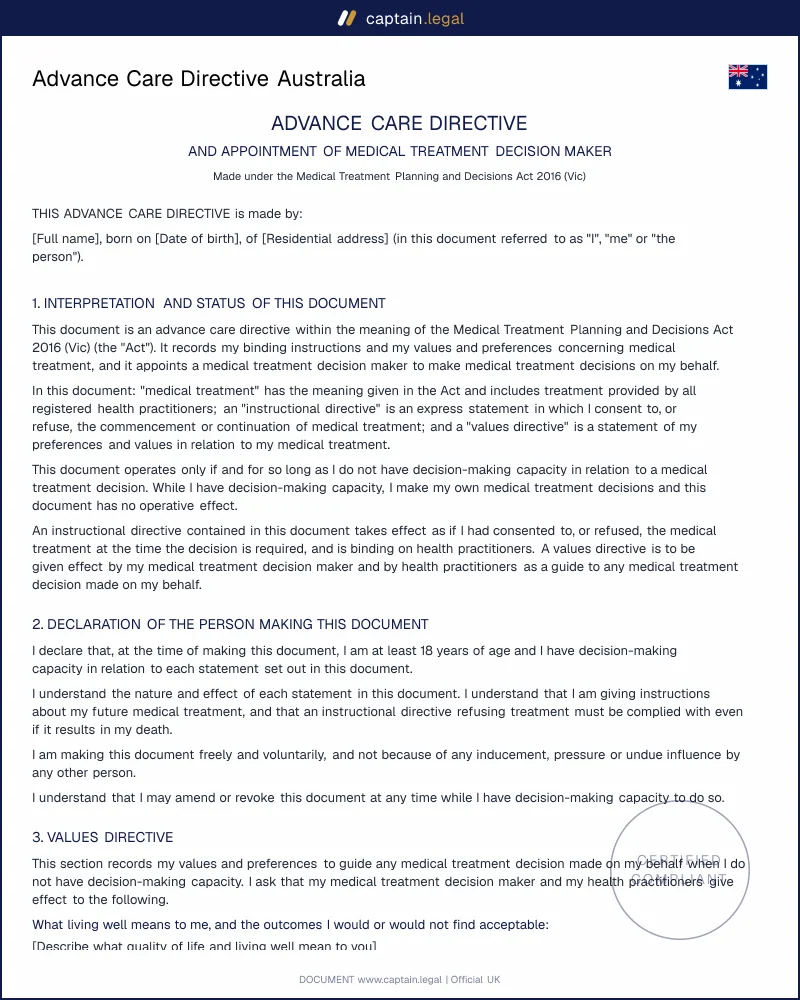
An Advance Care Directive is a written statement of your future health care wishes, made while you still have decision-making capacity, that takes effect only once you lose the ability to make or communicate those decisions yourself. It usually holds two kinds of content: binding instructions that consent to or refuse specific treatment, and non-binding values that describe how you want decisions weighed. In Victoria the binding part is called an instructional directive and the guidance part a values directive, a split created by the state and territory documents in our personal legal templates range so that each section carries the correct legal force.

A Medical Treatment Decision Maker is different. This is a living person, not a document clause, whom you authorise to make health decisions on your behalf when the directive is silent or when judgment is needed. The role has a different name in almost every jurisdiction. It is a Medical Treatment Decision Maker in Victoria, an enduring guardian in New South Wales, Western Australia and Tasmania, a substitute decision-maker in South Australia, and an attorney for personal matters under a Queensland Advance Health Directive or enduring power of attorney. Confusing the directive with the appointment is one of the most common and costly mistakes people make, because a directive without a decision maker leaves gaps, and a decision maker without a directive leaves them guessing.

2

When do you need this document?

The everyday trigger is simply reaching an age or stage where you want a safety net in place before anything goes wrong. You are healthy, you have decision-making capacity today, and you want your future self protected: that is exactly the moment the law expects you to act, because a directive is only valid if made while you can still understand it. People who wait until a diagnosis lands often discover the window has closed. Alongside your will and your financial power of attorney, an Advance Care Directive completes a basic estate plan, which is why our personal legal documents including wills and powers of attorney are so often prepared together in one sitting.

Life changes are the next big prompt. A separation, a new partner, a new diagnosis, or simply changing your mind about who you trust with the decision each justify a fresh directive. A document naming an ex-spouse as your Medical Treatment Decision Maker, signed years ago and never revisited, is the kind of thing that detonates inside a family during a crisis. The same applies when the person you appointed has moved overseas, fallen ill, or is no longer someone you would trust in an emergency.

Then there are the acute situations. A parent's health is declining, and the family is trying to organise aged care, consent to treatment, and end-of-life choices while doctors wait for someone with authority. An edge case worth flagging: minors generally cannot appoint a decision maker themselves, and in Victoria a child's parent or guardian is recognised as the default decision maker instead. Another is dementia, where timing is everything, because a directive signed too late, once capacity is already in doubt, invites a challenge that can undo the whole document.

3

Key clauses included in our template

  • The appointment of your Medical Treatment Decision Maker names the person (and ideally a substitute) using the exact role title your state recognises, whether that is enduring guardian in New South Wales or Medical Treatment Decision Maker in Victoria. Naming a backup matters because a single appointee who is overseas or unwell when the crisis hits can leave you with no valid decision maker at all.
  • The instructional directive sets out the specific treatments you consent to or refuse, drafted in language clear enough that a clinician can act on it without second-guessing. Vague wording is the enemy here, so the template pushes you toward concrete statements about interventions such as resuscitation, ventilation, or artificial nutrition rather than general sentiment.
  • The values directive records what matters to you: the outcomes you would find acceptable, your views on quality of life, and the beliefs that should guide any decision the instructions do not cover. This section is not binding in the same way, but health practitioners and your decision maker must take it into account, which is why it carries real weight in borderline cases.
  • The witnessing and certification block is built to your jurisdiction's signing rules, because these vary sharply. South Australia demands an authorised witness who certifies your capacity and understanding under section 15 of the Advance Care Directives Act 2013, while Western Australia requires two adult witnesses, one authorised to take declarations such as a Justice of the Peace.
  • The revocation and review statement confirms this document supersedes any earlier directive and prompts you to date it clearly, so there is never a dispute about which version governs. A well-drafted revocation clause quietly prevents the "battle of the forms" that arises when an old directive resurfaces after your death or incapacity.
4

Regional considerations

Victoria runs the most fully integrated regime under the Medical Treatment Planning and Decisions Act 2016. Your Advance Care Directive can hold both a binding instructional directive and a values directive, and you appoint a Medical Treatment Decision Maker who must decide according to what they believe you would have wanted rather than their own preference. The forms are witnessed under the Act's specific requirements, and a support person can also be appointed to help you make and communicate decisions while you still have capacity. Victorians should know that a values directive, while not binding in the strict sense, must still be given effect where possible, so it is far from decorative.

New South Wales is the outlier: there is no statutory advance care directive form, so your written wishes take effect as a common law directive recognised by the courts, while your decision maker is appointed as an enduring guardian under the Guardianship Act 1987 (NSW). The appointment must be witnessed by an eligible witness, and once you lose capacity your enduring guardian can only resign with the approval of the NSW Civil and Administrative Tribunal. Because the directive itself is common law rather than statutory, clarity and dating are doubly important, since there is no prescribed form to fall back on if the wording is ambiguous.

Queensland uses an Advance Health Directive made under the Powers of Attorney Act 1998 (Qld), and it is worth knowing that only statutory advance health directives are legally binding in Queensland, not informal common law ones. The document lets you give directions about future treatment and appoint an attorney for personal and health matters, and it carries its own execution and medical certification requirements. Queenslanders often pair the directive with an enduring power of attorney so that financial and health authority sit in a coherent package.

South Australia consolidated everything into the Advance Care Directives Act 2013 (SA): one document records your wishes and appoints a substitute decision-maker covering both medical and lifestyle matters. The witnessing standard under section 15 is stricter than for an ordinary power of attorney, because the authorised witness must certify that you understood the legal effect and appeared to have capacity. Anyone appointed as your decision-maker, or with an interest in your estate, is disqualified from acting as that witness.

5

How to fill out this Advance Care Directive

You start by telling the form where you live, because that single choice drives everything that follows. From there the template selects the correct document type and terminology for your state, so a Victorian receives a Medical Treatment Decision Maker appointment while a resident of New South Wales is guided toward an enduring guardian appointment under the Guardianship Act 1987. You then enter your own details and nominate your decision maker, along with a substitute if you have one, and the form prompts you to confirm each person has agreed to take on the role.

Next you work through your treatment wishes, separating the binding instructions from the values that should guide the harder judgment calls. The template offers plain-language prompts so you can be specific about interventions rather than leaving a clinician to interpret vague phrasing. Once the content is complete, it generates the witnessing and certification section tailored to your jurisdiction, then produces a clean editable Word file and a print-ready PDF. You sign in the presence of the witness your state requires, keep the original safe, and give copies to your decision maker, your GP, and ideally the hospital you are most likely to attend. For related authority over your money and property, many people prepare a financial enduring power of attorney from our personal document range at the same time.

6

Common mistakes to avoid

The single most frequent error is treating one state's form as good enough for the whole country. It is not: a directive drafted for Queensland can be refused in Western Australia, and families discover this at the worst possible moment, at a hospital admission desk. Almost as common is signing too late, once capacity is already slipping, which hands a challenger the perfect ground to argue the document is invalid. People also forget the witnessing rules entirely, and a directive witnessed by the very person appointed as decision maker, or by a beneficiary of the estate, can be struck down under provisions like section 15 of the South Australian Act. When you are organising your affairs, it is worth reviewing your wills and estate planning templates so the whole plan stays consistent.

The other cluster of mistakes is about aftercare rather than drafting. A perfect directive locked in a drawer that nobody knows about is useless, so failing to distribute copies to your GP and decision maker defeats the entire exercise. Appointing two decision makers jointly, without saying what happens if they disagree or one is unreachable, builds a deadlock into the very moment you needed speed. And people routinely forget to revoke and replace an old directive after a separation or a change of heart, leaving two contradictory documents for a grieving family to fight over. Review the document whenever your relationships or health change, not once a decade.

Key takeaways

Purpose

Your treatment wishes still speak for you

An Advance Care Directive records, in advance, what medical treatment you consent to or refuse if you later cannot communicate. It only operates once you lose decision-making capacity. It can include binding treatment instructions and non-binding values to guide judgement. Hospitals and aged care facilities ask the same question: what did the patient want? This document is your answer when you cannot speak.

Appointment

A decision maker fills the gaps

A Medical Treatment Decision Maker is a person you formally appoint to make health decisions when your directive does not cover the situation or when judgement is needed. The title changes by jurisdiction (for example, enduring guardian in NSW/WA/Tas, substitute decision-maker in SA, attorney for personal matters in Qld). Mixing up the directive with the appointment is a common mistake that leaves either gaps or guesswork.

Compliance

State rules decide whether it binds

Australia does not have one national form, so the legal effect depends on your state or territory, including witnessing requirements and what must be followed. Victoria’s framework sits under the Medical Treatment Planning and Decisions Act 2016, recognising binding instructions and values guidance. South Australia uses the Advance Care Directives Act 2013 (SA), with strict witnessing under section 15, including limits on who can witness.

Frequently Asked Questions

Yes, provided it is completed and executed according to the rules of your state or territory. Our template follows the format prescribed by your jurisdiction, whether that is a Victorian directive under the Medical Treatment Planning and Decisions Act 2016 or a South Australian one under the Advance Care Directives Act 2013. Binding force varies: instructional directives that consent to or refuse specific treatment are generally binding on health practitioners, while values directives must be considered but leave room for judgment. In New South Wales, which has no statutory form, your directive operates as a recognised common law directive. The key to enforceability is correct witnessing and clear, current wording that applies to the actual medical situation.

The directive is a document that records your wishes, and the decision maker is a person who acts on them. Your Advance Care Directive states, in advance, what treatment you consent to or refuse. Your Medical Treatment Decision Maker, called an enduring guardian in New South Wales and Western Australia and a substitute decision-maker in South Australia, steps in to make decisions when the directive is silent or when the situation needs interpretation. You generally want both, because a directive alone cannot cover every scenario, and a decision maker without written guidance is left guessing what you would have chosen.

Yes. The finished document is generated in an editable Microsoft Word file and a print-ready PDF, so you can adjust wording before signing and then print a clean copy for execution. The PDF is formatted for the witnessing and certification blocks your state requires, which matters because these documents must usually be signed on paper in the physical presence of a witness. Keep the signed original somewhere safe and distribute copies to your decision maker, your GP, and any hospital or aged care provider likely to treat you.

That depends entirely on your state. In South Australia, section 15 of the Advance Care Directives Act 2013 requires an authorised witness who certifies that you understood the legal effect of the document and appeared to have capacity, and that witness cannot be your decision-maker or a beneficiary of your estate. Western Australia requires two adult witnesses, one of whom must be authorised to take declarations, such as a Justice of the Peace. New South Wales requires an eligible witness for an enduring guardian appointment. Choosing the wrong witness is a leading reason directives are later rejected, so match the witness to your jurisdiction's rule before you sign.

It takes effect only when you lose the capacity to make or communicate the relevant decision yourself, not before. While you retain capacity, you continue to make your own medical decisions and your directive sits dormant. The moment a treating team assesses that you can no longer understand, weigh, or communicate a decision, the directive and your appointed decision maker come into play. This is precisely why the document must be made while you clearly have capacity, because a directive signed once that capacity is in doubt is vulnerable to being challenged and set aside.

Yes, as long as you still have decision-making capacity. You can revoke an existing directive and make a new one at any time, and a well-drafted document includes a revocation statement confirming it supersedes earlier versions. This matters because contradictory directives cause real disputes, so dating each document clearly and destroying superseded copies keeps the picture clean. Review is not a one-off task: a separation, a new relationship, a fresh diagnosis, or a change of heart about your appointed decision maker are all reasons to redo the document rather than leave an outdated one in force.

No, you are not legally required to use a lawyer, and the statutory forms in most states are designed to be completed without one. That said, the value of a properly structured template is that it steers you toward your jurisdiction's correct format, terminology, and witnessing rules, which is where self-made documents most often fail. If your circumstances are complex, involving contested family dynamics, significant assets, or specific religious or cultural treatment wishes, independent legal or medical advice is sensible. For most people, a clear template completed carefully and witnessed correctly does the job the law intends.

4.6/5

31 verified reviews · 50 000+ downloads

Advance Care Directive & Decision Maker | State Compliant
  • Immediate access to the document
  • PDF + Word download
  • Compliant with 2026 legislation
  • Reviewed by lawyers
Fill in the template
Secure payment
Updated on July 20, 2026

You might also like

Statutory Declaration Template
Appointment of Enduring Guardian