Create my document
Login

Choose country

AustraliaAustraliaChoose country
Non-Profit

Volunteer Agreement Template | Fair Work Act 2009

Volunteer agreement and handbook drafted to the Fair Work Act 2009 and state WWCC rules. Non-employment, insurance and confidentiality clauses. Word and PDF.
4.7/521 reviews50 000+ downloadsInstant download
Share

Australian not-for-profits run on goodwill, but goodwill is not a legal structure. A volunteer agreement paired with a volunteer handbook is the document set that puts your relationship with an unpaid worker in writing: what the role involves, what insurance covers them, what confidentiality they owe, and where the line sits between volunteering and paid employment. Used properly, it protects the volunteer, protects the organisation, and keeps the Fair Work Act 2009 (Cth) from turning a well-meaning arrangement into an employment claim you never intended to create.

Committees reach for this template at two moments: when they onboard their first cohort of volunteers and want to do it once, correctly, and when a grant-maker or insurer asks to see the paperwork and the cupboard is bare. Both are the right instinct. A signed agreement backed by a clear handbook is what turns "we trust each other" into something an auditor, a regulator, or a court will actually respect.

Compliant

2026 Legislation

50,000+ clients

trust us

Affordable

From $4.90 / doc

Secure payment

Instant download

Volunteer Agreement Template | Fair Work Act 2009

Secure payment

Fill in the template

What is a volunteer agreement and volunteer handbook?

A volunteer agreement is a written record of a voluntary arrangement between an organisation and an individual who gives time without expecting payment. It sets out the role, the hours the volunteer is willing to offer, the support the organisation provides, and the mutual expectations around conduct and confidentiality. Its most important legal feature is what it is not: it is deliberately drafted to sit outside a contract of service, so that no employment relationship is created by accident. The document usually states plainly that it is not legally binding as an employment contract and that the volunteer is under no obligation to attend or perform work.

The volunteer handbook is the companion policy layer. Where the agreement is short and personal, the handbook carries the detail: the code of conduct, the complaints pathway, the work health and safety expectations, privacy handling, reimbursement of out-of-pocket expenses, and child-safety obligations where relevant. Australian courts distinguish sharply between a genuine contract and an internal policy document that the organisation can change unilaterally, and that distinction matters. Keeping enforceable promises in the agreement and operational guidance in the handbook is exactly how you preserve the volunteer classification. The pairing mirrors the way an employment contract template built around the Fair Work Act separates binding terms from workplace policy, except here the whole point is to stay off the employment side of that line.

2

When do you need this document?

The clearest trigger is onboarding volunteers into any role with responsibility, risk, or access to sensitive information. A community legal centre taking on intake volunteers, a sporting club recruiting coaches, a food-relief charity rostering warehouse help: each is handling people, data, or physical risk that a handshake cannot manage. The agreement fixes expectations before the first shift, and the handbook gives volunteers something to refer back to when a situation is not obvious.

Funding conditions are the next most common driver. Grant agreements routinely require proof of safeguarding policies, complaints handling, and evidence that the committee approved them, and a volunteer program with signed agreements is exactly the kind of governance artefact funders and insurers want to see. The same paperwork reassures a bank asking about your controls before opening accounts or extending signatory authority. Organisations formalising their structure often pair this with a company constitution aligned with the Corporations Act so that governance sits on one coherent footing.

Two edge cases deserve attention. The first is the volunteer who starts receiving more than reimbursement: regular allowances, honoraria calculated like wages, or benefits tied to hours worked. That is the exact fact pattern that has pushed "volunteers" across the line into employment in Australian tribunals, and it is where a clear agreement, honestly applied, earns its keep. The second is the volunteer moving into child-related work partway through their involvement. A person cleared for back-office tasks who is later asked to mentor minors needs a valid Working with Children Check before that new work begins, not after.

3

Key clauses included in our template

  • The role description and scope sets out what the volunteer will actually do, the skills expected, and the reporting line. Vague role descriptions are where employment risk creeps in, so the clause is written to describe contribution rather than obligation, reinforcing that attendance is voluntary and not directed like paid work.
  • The non-employment declaration states in plain terms that the arrangement is not a contract of employment, that no wages or entitlements arise, and that the volunteer is free to withdraw at any time. This is the single most important clause for avoiding a Fair Work Act reclassification, and it is drafted to align with the Fair Work Ombudsman's stated characteristics of genuine volunteering.
  • The confidentiality clause binds the volunteer to protect personal information, donor details, beneficiary records, and any commercially sensitive material they encounter. For organisations handling health or vulnerable-person data, this connects to obligations under the Privacy Act 1988 (Cth) and is written to survive the end of the volunteer's involvement.
  • The insurance and work health and safety terms explain what cover the organisation carries, typically volunteer personal accident and public liability, and set out the volunteer's own duty under the Work Health and Safety Act 2011 to follow safety directions and report hazards. This clause matters because volunteers are not automatically covered by workers' compensation.
  • The Working with Children Check clause requires the volunteer to hold and maintain a valid clearance for the jurisdiction where they work, to disclose any change in status, and to authorise the organisation to verify it. It is drafted to accommodate the different state and territory names, from the Blue Card in Queensland to the Working with Vulnerable People registration in the ACT and Tasmania.
  • The conduct, complaints and termination terms point the volunteer to the handbook's code of conduct and complaints pathway, and confirm that either party may end the arrangement without notice or penalty, which itself reinforces the voluntary character of the relationship.
4

Regional considerations across states and territories

Australia has no single Working with Children Check, and the volunteer agreement has to bend to whichever regime applies. New South Wales runs the Working with Children Check through the Office of the Children's Guardian, where the check bundles in a National Police Check and is free for volunteers, valid for five years, with continuous monitoring throughout. NSW does not issue a physical card, so the organisation verifies the volunteer's clearance number online, and the handbook should build that verification step into onboarding. NSW child-safe reforms commencing in 2026 have tightened recruitment and staffing obligations, so a current template matters more here than it did a few years ago.

Victoria treats the Working with Children Check and the police check as separate processes, administered through Service Victoria, with identity verification completed in person and processing that can run several weeks. Volunteer checks are free, but the lead time is real, so the agreement should require a valid clearance before child-related duties commence rather than during. During 2025 and 2026 Victoria strengthened its recognition of interstate exclusions and its suspension powers, which is worth reflecting in the handbook's ongoing-suitability language.

Queensland operates the Blue Card system under a "No Card, No Start" principle for regulated child-related work, meaning a volunteer cannot begin until the card is issued. The agreement for a Queensland organisation should make commencement expressly conditional on a current Blue Card, and the handbook should explain the Customer Reference Number and online application path so volunteers are not left guessing.

The Australian Capital Territory and Tasmania use a broader Working with Vulnerable People registration that covers both children and vulnerable adults, so an organisation operating there should frame the clause around vulnerable-person work rather than children alone. Across all jurisdictions, the national reforms endorsed by attorneys-general in late 2025 are moving toward mutual recognition of negative notices, often summarised as "banned in one, banned in all", and continuous checking of criminal-history changes. A volunteer program that already collects clearance details and monitors status is well placed for that shift. Organisations that also engage independent helpers on a paid basis should keep the boundary clean with a separate independent contractor agreement drafted to the Fair Work Act.

5

How to fill out this volunteer agreement and handbook

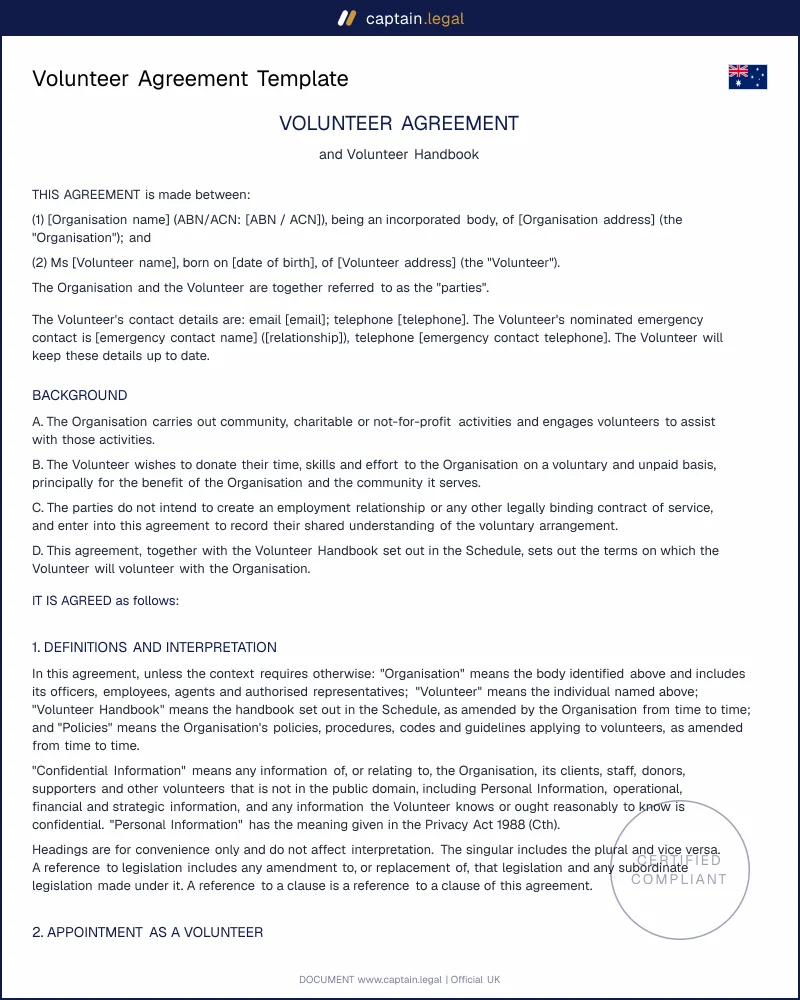
You start by choosing your structure and state, because the template adjusts its Working with Children Check language and its work health and safety references to match your jurisdiction. From there you describe the role in the volunteer's own terms of contribution, naming the tasks, the rough time commitment, and the person they report to, while keeping the language away from anything that reads like a directed job. The form then walks you through the non-employment declaration, prompting you to confirm that no wages, allowances beyond genuine reimbursement, or entitlements are on offer, which is what keeps the arrangement clearly voluntary.

Next you set the confidentiality and privacy terms to the sensitivity of the information the volunteer will handle, and you select the insurance cover your organisation actually carries so the agreement does not promise protection that does not exist. If the role touches children or vulnerable people, you switch on the clearance clause and record the check type for your state. The handbook sections then populate from your policy choices on conduct, complaints, and safety. Once the details are in, you download the pack in editable Word and clean PDF, ready for the volunteer to read and sign. Organisations building out a full governance set often complete the picture with templates from the Australian non-profit and charity document library.

6

Common mistakes to avoid

The most damaging mistake is letting the arrangement drift toward employment without noticing. Once an organisation starts paying regular allowances that look like wages, imposing fixed rosters with consequences for non-attendance, and managing performance the way it would manage staff, the "volunteer" label stops protecting anyone. Australian tribunals look at substance over description, so a signed agreement only holds up if the day-to-day reality matches it. The fix is discipline: reimburse genuine out-of-pocket costs, keep attendance voluntary, and resist turning goodwill into an unpaid version of a role that should be a paid position, which is something Volunteering Australia's code of practice specifically warns against.

The second cluster of errors sits around child safety and record-keeping. Allowing a volunteer to begin child-related work before a valid clearance is issued is not a paperwork slip, it is a breach in states running "No Card, No Start" rules, and the consequences fall on the organisation. Treating the handbook as a binding contract is another trap: policies you can change unilaterally are generally not contracts of employment, and blurring that helps no one. Finally, organisations forget that work health and safety duties apply to volunteers regardless of the Fair Work Act, so leaving safety obligations out of the handbook exposes both the volunteer and the committee. Getting the surrounding governance right, including how the committee approves policies, sits alongside the same discipline you would apply to a shareholders agreement under the Corporations Act 2001 or any other core governance instrument.

Key takeaways

FAIR WORK

Keep it volunteering, not employment

This template is drafted to keep the arrangement outside a contract of service under the Fair Work Act 2009 (Cth). It should state the volunteer is unpaid, not obliged to attend or perform work, and that neither party intends a legally binding employment relationship. If rosters, performance management or “allowances” start to look like wages, the volunteer label may not protect you.

DOCUMENTS

Use the agreement with a handbook

The agreement and handbook do different jobs. Put the personal, enforceable points in the agreement (role, hours the volunteer is willing to offer, support provided, confidentiality and conduct expectations). Keep operational detail in the handbook (code of conduct, complaints pathway, work health and safety, privacy handling, reimbursements, and child-safety rules where relevant). That split helps preserve volunteer status and lets policies be updated.

RISK

Paperwork is what auditors will ask for

Committees often need this set when onboarding the first volunteers, or when a grant-maker or insurer asks for evidence and there is nothing on file. A signed volunteer agreement backed by a clear handbook turns informal goodwill into documents a regulator, auditor or court can rely on. It also clarifies what insurance covers and what confidentiality the volunteer owes, reducing disputes later.

Frequently Asked Questions

A volunteer agreement is deliberately not binding as an employment contract, and that is its purpose. It records mutual expectations and confidentiality obligations, but it is drafted so that no contract of service arises and no wages or entitlements are created. Some elements, such as confidentiality and privacy undertakings, can carry legal weight in their own right, particularly where the volunteer handles sensitive personal or donor information. The document's strength lies in evidence: if a dispute ever questions whether someone was a volunteer or an employee, a clearly written agreement, honestly applied, is powerful proof of the parties' intention. What undermines it is a reality that contradicts the paper, so the agreement only protects you if the arrangement genuinely stays voluntary.

Volunteers need a valid Working with Children Check whenever their role involves child-related work, and the requirement is set by each state and territory rather than nationally. In New South Wales the check is free for volunteers and valid for five years, Queensland uses the Blue Card under a "No Card, No Start" rule, and the ACT and Tasmania fold children into a broader Working with Vulnerable People registration. The agreement should make commencement of any child-related duties conditional on a current clearance, require the volunteer to disclose any change in status, and authorise the organisation to verify it. Because processing can take several weeks in some states, build the check into onboarding well before the first shift rather than after.

The volunteer agreement and handbook come in both editable Microsoft Word and clean PDF format. The Word version lets you adapt clauses to your structure, insert your organisation's name and role details, and adjust the Working with Children Check language to your jurisdiction without retyping from scratch. The PDF is the tidy version for signing and for handing to funders, insurers, or a bank that wants to see your governance documents. Most committees keep the Word file as their working master, update it when policies change, and issue a fresh PDF to each new volunteer. Having both formats means the same document serves as your internal template and your presentation-ready record.

The agreement reduces Fair Work risk by aligning the paperwork with the Fair Work Ombudsman's characteristics of genuine volunteering: work performed to benefit others, no intention to create employment, no obligation to attend, and no expectation of payment. The non-employment declaration states this plainly, and the role description avoids language that reads like directed work. The document cannot save an arrangement that behaves like employment, since Australian tribunals weigh substance over labels, but combined with disciplined practice it is strong evidence that both parties intended a volunteer relationship. Because volunteers cannot bring unfair dismissal claims under the Fair Work Act 2009 (Cth), keeping the classification clean is what protects the organisation.

Volunteers are generally not covered by workers' compensation, which is why the insurance clause matters. Most not-for-profits carry volunteer personal accident cover and public liability insurance, and the agreement records what your organisation actually holds so the volunteer knows where they stand. Separately, work health and safety duties apply regardless of the Fair Work Act: under the model Work Health and Safety Act 2011, your organisation owes volunteers a duty of care, and volunteers owe a reciprocal duty to follow safety directions and report hazards. The handbook sets out those safety expectations. Check your specific policy wording, because cover varies between insurers and some activities need additional protection.

Yes, and this is the risk the agreement is built to manage. A relationship that begins as genuine volunteering can shift into employment if the organisation starts paying wage-like allowances, imposing binding rosters, or managing performance with real consequences. The Fair Work Ombudsman warns that the more formalised an arrangement becomes, the more likely a court is to find employment despite the volunteer label. If your organisation decides a role should become paid, the right move is to formalise it properly rather than leave an ambiguous hybrid in place. A clean transition to an Australian employment contract protects everyone and removes the uncertainty.

The agreement is the short, signed document personal to each volunteer, recording the role, the non-employment declaration, confidentiality, and clearance obligations. The handbook is the broader policy layer that applies to all volunteers: the code of conduct, complaints process, work health and safety expectations, privacy handling, and reimbursement rules. Keeping them separate is deliberate. Australian courts distinguish between a genuine agreement and an internal policy document the organisation can change unilaterally, and that distinction helps preserve the volunteer classification. Enforceable promises live in the agreement, operational guidance lives in the handbook, and together they give volunteers clarity while giving the committee a governance record that funders and regulators respect.

4.7/5

21 verified reviews · 50 000+ downloads

Volunteer Agreement Template | Fair Work Act 2009
  • Immediate access to the document
  • PDF + Word download
  • Compliant with 2026 legislation
  • Reviewed by lawyers
Fill in the template
Secure payment
Updated on July 20, 2026

You might also like

AGM Minutes & Resolutions Pack
Conflict of Interest Pack Australia