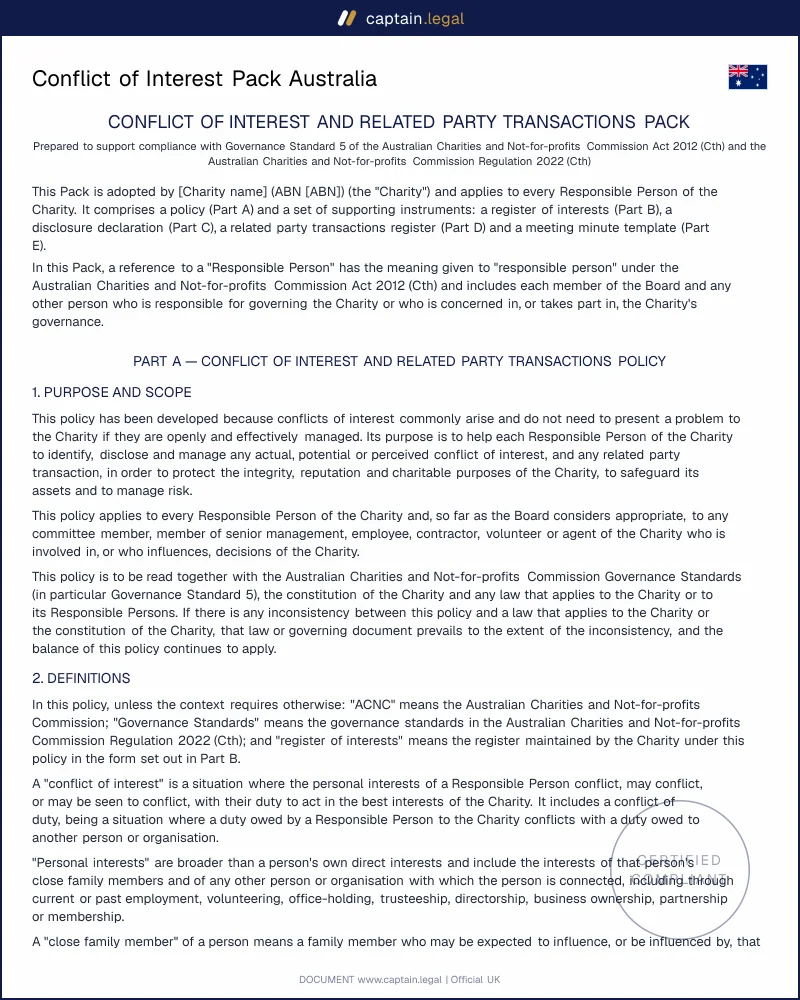
The controlling instrument is Governance Standard 5, one of the six standards in the Australian Charities and Not-for-profits Commission Regulations 2013 made under the Australian Charities and Not-for-profits Commission Act 2012 (Cth). Standard 5 requires a charity to take reasonable steps to ensure its responsible people are subject to, and comply with, a set of legal duties: to act with reasonable care and diligence, to act honestly and fairly in the best interests of the charity and its charitable purposes, not to misuse their position or information, to disclose perceived or actual conflicts, to ensure the charity's finances are managed responsibly, and not to allow the charity to trade while insolvent. The ACNC's own guidance is explicit that a conflicted responsible person should disclose the conflict and should not discuss or vote on the matter, and where every responsible person is conflicted, the disclosure moves up to the members. Your pack operationalises exactly that expectation, which is why the ACNC lists a documented conflicts process among the reasonable steps a charity is expected to take.
Sitting beside Standard 5 is the related party reporting obligation. Since the 2023 Annual Information Statement, every charity except a basic religious charity must report its related party transactions to the ACNC. The definition scales with size: for a small charity (annual revenue under $500,000), a related party is a person or organisation connected to the charity with significant influence over it; medium and large charities apply the Australian Accounting Standards definition in AASB 124. A "transaction" is defined broadly as a transfer of resources, services, or obligations, and captures fees paid to a related party, loans in either direction, salary paid to a related party's relative, transfers of charity property, discounted goods or services, and significant use of charity property. Records for this reporting must be kept from the start of the relevant reporting period, not reconstructed at year end. For company-limited-by-guarantee charities, the Corporations Act 2001 (Cth) duties around material personal interests run in parallel. The ACNC's official guidance on managing conflicts of interest for registered charities sets out the regulator's baseline expectation and is worth reading before you adapt the templates. Charities that also employ staff should read this alongside their Fair Work Act obligations for not-for-profit employers.