Create my document
Login

Choose country

AustraliaAustraliaChoose country
Family & Divorce

Consent Orders Application Pack | Family Law Act 1975

Prepare consent orders under s.60CC and s.79 of the Family Law Act 1975. Parenting and property pack with the mandatory FCFCOA safety notice.
4.7/513 reviews50 000+ downloadsInstant download
Share

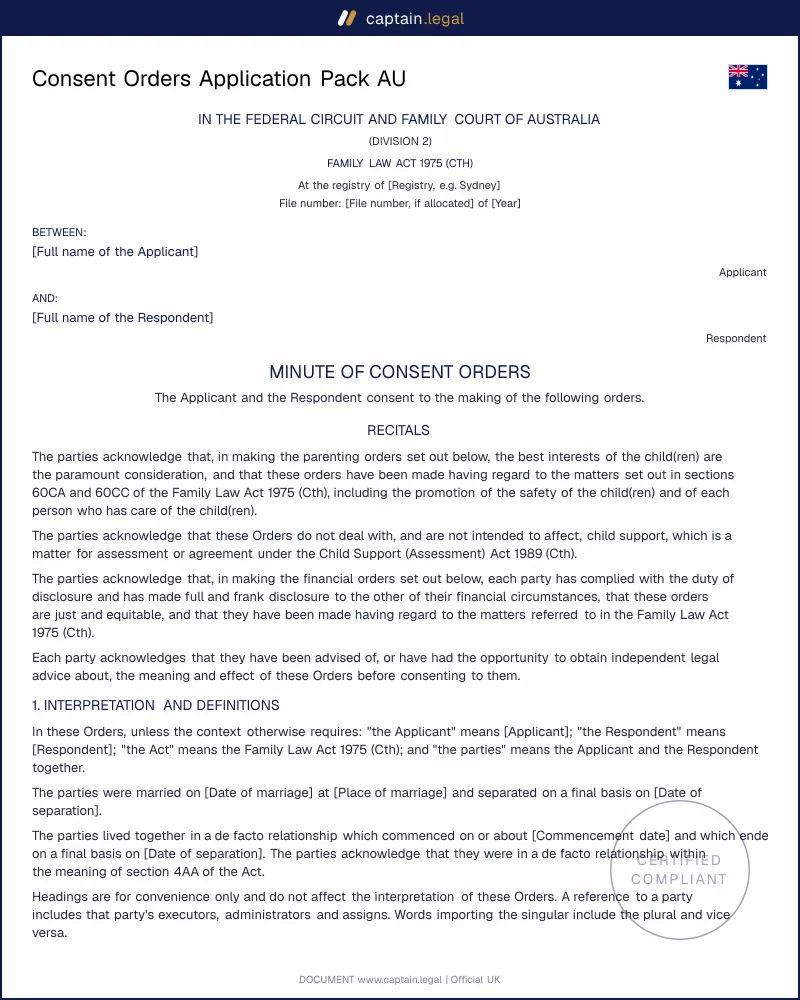
A consent orders application pack turns an agreement you have already reached into orders that carry the full weight of the court. Once the Federal Circuit and Family Court of Australia (FCFCOA) seals them, your parenting and property terms become enforceable in exactly the same way as orders made after a contested hearing, without either of you setting foot in a courtroom. This pack is built for separated or divorcing couples who have negotiated their arrangements (often through mediation or family dispute resolution) and now want them recognised under the Family Law Act 1975 (Cth). It walks you through the Application for Consent Orders, the proposed orders themselves, and the mandatory safety notice, so the paperwork matches the legal category instead of sitting in a drawer as a well-meaning note.

The difference between an informal agreement and a sealed consent order is the difference between a promise and a court obligation. If your former partner stops following a parenting arrangement or refuses to transfer a property, an informal separation agreement leaves you negotiating from scratch. A consent order lets you go straight to enforcement.

Compliant

2026 Legislation

50,000+ clients

trust us

Affordable

From $4.90 / doc

Secure payment

Instant download

Consent Orders Application Pack | Family Law Act 1975

Secure payment

Fill in the template
2

When do you need this document?

The most common trigger is a settled separation where you and your former partner have agreed on the children and the money, and you want that agreement locked in before anyone changes their mind. Mediation and family dispute resolution frequently end with a signed heads of agreement that has no legal force on its own; converting it into consent orders is the step that makes it stick. This is especially important once a property transfer is involved, because a sealed order unlocks the stamp duty exemptions and superannuation splitting mechanisms that a private agreement cannot reliably deliver.

A second scenario is the clean financial break after divorce. Remember the clock: once a divorce order takes effect, married couples generally have 12 months to apply for property and spousal maintenance orders, while de facto couples have 2 years from separation under section 44. Filing consent orders inside that window is far simpler than asking the court's leave to proceed out of time, which is never guaranteed. Our Australian separation agreement covering the s.44 time limits is often the interim step people use while finalising the consent orders themselves.

Then there are variations. Life moves on, a parent relocates, work hours change, a child's needs shift, and the old parenting arrangements stop working. Consent orders can vary or discharge existing family law orders, so you do not have to relitigate from the beginning. One edge case worth flagging: if you already have a parenting plan rather than orders, you may want to formalise it, and our section 63C parenting plan template pairs naturally with a later consent orders application when the arrangements have proven stable. Another edge case is third-party debt. A consent order that says one of you will "take a name off the mortgage" does not bind the bank; refinancing is a separate process the lender controls.

3

Key clauses included in our template

  • The application details and financial disclosure section captures the identity of both parties, the children, the length of the relationship, and a full picture of assets, liabilities and superannuation. The court uses this to test whether the proposed property split is just and equitable, so incomplete disclosure is the fastest route to a rejected application.
  • The proposed parenting orders are drafted in the numbered-paragraph format the court requires, covering with whom the child lives, the time they spend with each parent, allocation of parental responsibility for major long-term decisions, changeover arrangements, holidays and communication. Each order is written to the post-6 May 2024 framework so it reflects the current section 60CC considerations.
  • The proposed property and financial orders set out transfers of real estate, division of bank accounts and personal property, superannuation splits, and how joint debts will be handled. They are drafted to survive scrutiny under the codified section 79 pathway.
  • The Notice of child abuse, family violence or risk is included as the mandatory safety form both parties sign when parenting orders are sought. It is not a formality; the court reads it before making any parenting order.
  • The statement of consent and signature blocks confirm that both parties agree to every order and understand its effect, dated and signed on each page as the court requires. A supporting annexure to proposed consent parenting orders is included where the matter involves existing proceedings.
4

State and territory considerations

Family law in Australia is federal, so the Family Law Act 1975 (Cth) and the FCFCOA govern consent orders uniformly across every state and territory. That said, the ground shifts once your orders touch state-administered systems, and this is where a nationally-drafted pack still needs local awareness.

New South Wales, Victoria and Queensland each administer their own stamp duty (transfer duty) regime, and a sealed consent order transferring the matrimonial home is what triggers the family-law exemption from that duty. Without the court seal, Revenue NSW, the State Revenue Office Victoria or the Queensland Revenue Office will generally treat the transfer as a dutiable dealing. The order must be drafted precisely enough for the revenue office to accept it.

Western Australia is the significant outlier. For de facto couples, WA has historically operated under its own Family Court Act 1997 (WA) and a separate Family Court of Western Australia, so de facto property matters there follow the state pathway rather than Part VIIIAB of the Commonwealth Act. Married couples in WA still use the federal system. If you are a de facto couple in Western Australia, confirm which court and which Act applies before drafting, because filing in the wrong forum wastes the filing fee and delays everything.

South Australia, Tasmania, the ACT and the Northern Territory follow the Commonwealth pathway for both married and de facto couples, but land titles offices in each still require the sealed order and a correctly completed transfer form before they will register a property change. Titles registration is a separate step from the court order itself, and people routinely forget it.

6

Common mistakes to avoid

The most damaging mistake is drafting parenting orders in the language of the old law. Since 6 May 2024 the equal-shared-parental-responsibility presumption is gone, and orders that assume it, or that use the retired terminology, get bounced back or refused. The second is treating financial disclosure as optional. Applicants who leave off a superannuation fund, a credit card, or an investment property hand the Registrar an easy reason to refuse, because the court cannot certify a division as just and equitable when it cannot see the whole pool. Vague orders are the third trap: "the parties will share the children fairly" is not an order a court can enforce, and neither can a school or a police officer act on it. Every order must be specific enough that a stranger could follow it.

The fourth mistake is ignoring third parties. An order between the two of you does not bind a bank, so promising to remove someone from a joint mortgage means nothing until the lender agrees to refinance or release the liability. The fifth is the timing slip: letting the 12-month post-divorce window (or the 2-year de facto window) lapse turns a straightforward filing into an application for leave that the court may refuse. Diarise your limitation date the moment you separate or your divorce is finalised. Finally, people forget the mandatory family violence notice, and an application seeking parenting orders without it is simply incomplete. If you are also setting up broader personal arrangements, a well-drafted Australian will aligned with state succession law is worth revisiting after separation, since your existing will may still name your former partner.

Key takeaways

Court seal

Consent orders make your deal enforceable

A sealed consent order is not just an understanding between ex-partners. Once the Federal Circuit and Family Court of Australia (FCFCOA) seals it, your parenting and property terms carry the same force as orders made after a contested hearing. If someone stops following the arrangement or refuses a transfer, you can move straight to enforcement rather than renegotiating from scratch.

Best interests

Parenting orders must fit the 2024 test

For parenting, the court can only make orders that meet the Family Law Act 1975 and reflect the child’s best interests (s 60CA). Reforms commencing 6 May 2024 removed the old presumption of equal shared parental responsibility and reshaped the s 60CC factors around safety and the child’s views. Drafting in pre-May-2024 language can lead to the application being rejected.

Property split

Consent orders differ from financial agreements

Consent orders are made by a Registrar and become court orders; a binding financial agreement is a private contract under Part VIIIA or Part VIIIAB that requires independent legal advice for each party and does not involve the court. The court seal matters in practice: consent orders are directly enforceable and can be preferable when dealing with third parties, including superannuation splitting and stamp duty exemptions.

Frequently Asked Questions

Yes. Once a Registrar of the Federal Circuit and Family Court of Australia seals your consent orders, they have exactly the same legal effect as orders made by a judicial officer after a contested hearing under the Family Law Act 1975. They are directly enforceable: if your former partner breaches a parenting order or fails to transfer a property, you can apply to the court to enforce compliance, and contravention can carry serious consequences. This is the key advantage over a private separation agreement, which only creates contractual obligations between the two of you. The court seal is what converts your negotiated agreement into an obligation the state will back.

The pack contains the Application for Consent Orders, which sets out the parties, children, financial position and the orders you seek; your proposed orders drafted in numbered paragraphs; and, where parenting orders are sought, the mandatory Notice of child abuse, family violence or risk that both parties must sign. Signature and consent blocks appear on each page, and an annexure to proposed consent parenting orders is included for matters with existing proceedings. You complete these, sign them, and file them together. The court needs the complete set before it will consider making orders, so a missing safety notice or unsigned page stalls the whole application.

Yes. The consent orders application pack is delivered in both editable Word and print-ready PDF formats. The Word version lets you and your former partner refine the proposed orders through negotiation, adjusting parenting time, changeover details, property transfers and superannuation splits until the wording reflects exactly what you have agreed. Once the terms are settled, the PDF gives you a clean, professional document ready to sign on each page and eFile through the Commonwealth Courts Portal. Having both formats matters because family law orders often go through several drafts before both parties are comfortable, and you want a tidy final version for the court file.

Once you file a complete and correct application, it generally takes around two weeks for the court to make your consent orders, though this varies with the court's workload and the complexity of your orders. The application is processed by a Registrar rather than heard by a judge, which is why it is far faster than a contested matter. The main cause of delay is an incomplete application: missing disclosure, an absent family violence notice, or orders drafted too vaguely for the Registrar to be satisfied they are just and equitable or in the child's best interests. Getting the pack right the first time is the fastest route to a sealed order.

Not necessarily, but there is a meaningful difference. A parenting plan under section 63C is a written, signed agreement that a court can take into account, but it is not directly enforceable on its own. Consent orders are. If your arrangements are stable and you want the certainty of enforceability, converting a working parenting plan into consent orders is a sensible step. Many families start with a plan during the uncertain early months, then formalise it once the routine has proven itself. If flexibility still matters more than enforceability, a plan may be enough for now.

Consent orders only work where you agree on every order you ask the court to make. If there is a single sticking point, you have a few options: keep negotiating (often with the help of a mediator or family dispute resolution practitioner), narrow the dispute and file consent orders on everything you do agree on while resolving the rest separately, or, as a last resort, ask the court to decide the contested issue. The pack is designed for genuine agreement, so if disagreement runs deep, resolving it before filing saves you a rejected application and a wasted filing fee.

Yes. Whenever your application seeks parenting orders, the Notice of child abuse, family violence or risk is mandatory and must be filed by both parties, regardless of how amicable your separation is. It is not an accusation; it is a safety screening step the court requires so it can make parenting orders that are genuinely in the child's best interests. Since the 6 May 2024 reforms placed safety at the centre of the section 60CC framework, the court takes this notice seriously and will not process parenting orders without it. Complete it honestly even when there is nothing to report.

4.7/5

13 verified reviews · 50 000+ downloads

Consent Orders Application Pack | Family Law Act 1975
  • Immediate access to the document
  • PDF + Word download
  • Compliant with 2026 legislation
  • Reviewed by lawyers
Fill in the template
Secure payment
Updated on July 22, 2026

You might also like

Post-Nuptial Financial Agreement
Separation Agreement Australia