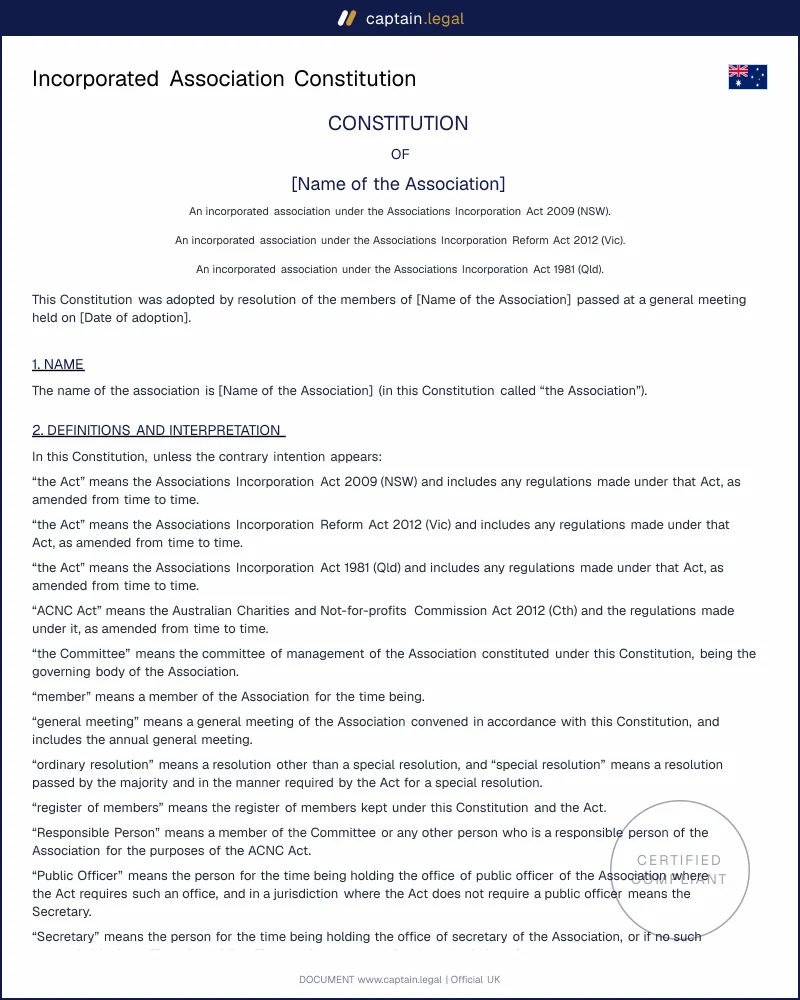
Incorporated associations are creatures of state and territory law, so the governing statute depends on where you register. In New South Wales the relevant law is the Associations Incorporation Act 2009 (NSW), which lists 17 matters that every constitution must address, with the equivalent clause from the model constitution in Schedule 3 of the Associations Incorporation Regulation 2022 (NSW) read in wherever a document falls short. Victoria operates under the Associations Incorporation Reform Act 2012 (Vic), administered by Consumer Affairs Victoria, and requires the rules to cover 23 scheduled matters, with the model rules in Schedule 4 of the regulations filling any gaps. Queensland's Associations Incorporation Act 1981 (Qld), overseen by the Office of Fair Trading, was substantially reworked by the Associations Incorporation and Other Legislation Amendment Act 2020 (Qld), which since 2022 has required every association's rules to include a compliant grievance procedure with a mediation step.
A recurring theme across all three jurisdictions is the special resolution. Changing the constitution, altering the name, or amending the objects almost always demands a resolution passed by at least 75% of the members who vote, preceded by a formal notice period. In NSW that notice is at least 21 days before the meeting, and a resolution passed without proper notice is invalid, which can unravel a name change, a bank signatory update, or a tax endorsement built on top of it.
If you register as a charity, you also answer to the Australian Charities and Not-for-profits Commission Act 2012 (Cth). The ACNC expects your constitution and your conduct to meet six Governance Standards covering not-for-profit purposes, accountability to members, compliance with the law, responsible-person duties, and financial record-keeping. The regulator publishes a plain-English breakdown of what each standard demands in the ACNC Governance Standards guidance for registered charities, and a constitution drafted with those standards in mind saves a great deal of correction later. Employment adds a further layer: the moment you pay staff you are an employer under the Fair Work Act 2009 (Cth), and our Australian employment contract templates sit alongside your governance documents once you take that step.