Create my document
Login

Choose country

AustraliaAustraliaChoose country
Real Estate

Tenancy Condition Report: Protect Your Bond at Handover

Condition report and tenancy application rules by state: Form 1a and 14a (QLD s.65), Form 4 (VIC s.35), NSW s.29, SA Form A1. Deadlines and penalties.
4.7/523 reviews50 000+ downloadsInstant download
Share

A residential tenancy application and condition report is the paperwork pair that opens and closes every rental in Australia: the application by which a prospective tenant puts forward their identity and capacity to pay, and the condition report that records the state of the premises room by room at the start and the end of the tenancy. The second document decides bond disputes. Tribunals across the country treat a signed entry report as the baseline against which the exit report is compared, and a landlord without one is arguing from memory. This template gives landlords, self-managing owners and tenants a working set for both stages, sized for Australian conditions and drafted around the evidentiary standards applied by NCAT, VCAT and QCAT.

Australian tenancy law is state and territory law, not federal law. Every jurisdiction runs its own Residential Tenancies Act, its own bond authority, and in several cases its own prescribed form that cannot be replaced by a private template. Read the sections below before you use anything here.

Compliant

2026 Legislation

50,000+ clients

trust us

Affordable

From $4.90 / doc

Secure payment

Instant download

Tenancy Condition Report: Protect Your Bond at Handover

Secure payment

Fill in the template

What is a residential tenancy application and condition report?

Two documents, two different jobs, two different moments. The application comes first. It is the instrument a prospective tenant uses to identify themselves, evidence income, and nominate referees, and it is the basis on which a landlord or agent decides who gets the keys. The condition report comes second, at handover, and it is a factual record: for each room and each item, whether it is clean, working and undamaged, with comments where it is not.

The distinction that matters most in practice is between a prescribed form and a private template. In Queensland, the Entry condition report (Form 1a) is an approved form under section 65 of the Residential Tenancies and Rooming Accommodation Act 2008, with a matching Exit condition report (Form 14a) at the end. Victoria prescribes Form 4 under section 35 of the Residential Tenancies Act 1997 and regulation 18 of the Residential Tenancies Regulations 2021. New South Wales prescribes the report form under section 29 of the Residential Tenancies Act 2010. Where a form is prescribed, the prescribed form is the one that must be used. A private template does not displace it, and using a substitute exposes the landlord to a penalty and, worse, to an evidentiary hole at the tribunal.

So what is this template for? Preparation, documentation and the parts of the process the prescribed forms do not reach: the applicant's own working copy before submission, the photographic schedule that accompanies the statutory report, the room-by-room walkthrough a tenant conducts before signing, and the exit comparison record. Landlords in jurisdictions with no mandatory application form use it as their application document outright. Everyone else uses it as the layer around the statutory paperwork. Our Australian real estate document templates sit alongside the official forms rather than in place of them.

2

When do you need this document?

The obvious moment is handover. Keys change hands, and somebody has to walk the property with a form and a camera. But the higher-value moment is earlier, at inspection, when a prospective tenant should be building their own record of what they are about to accept. Most disputes trace back to a tenant who signed the landlord's entry report without checking it, discovered the burn mark in the carpet in month two, and had no way to contest the exit claim eleven months later. Victoria's section 36 makes that outcome mathematically certain rather than merely likely.

The application stage generates its own need. A tenant applying for three properties in a week needs a consistent, complete set of details and documents ready to submit, because in a tight market the application that arrives first and complete wins. A landlord in a jurisdiction without a prescribed form needs a document that collects what is lawful to collect and nothing more, given how sharply the ground has shifted on what may be asked.

Exit is the third trigger, and the most neglected. In Queensland the tenant prepares the Exit condition report (Form 14a) on or before the day the agreement ends and the landlord has 3 business days to sign, mark disagreements and return it. In Victoria the rental provider inspects and completes within 10 days, with the renter present or given a reasonable opportunity to attend. Miss the window and you are arguing without the document the tribunal expects to see.

Two edge cases worth flagging. Water charging in Queensland turns on the entry report: if you intend to pass on consumption costs, the meter reading belongs in both the entry and exit reports, or the charge is contestable. And where the tenancy is a share house with tenants coming and going, each change of named tenant should trigger a fresh record, because a report signed by a departed housemate proves nothing about the person now in the room. Landlords running multiple properties will also want the Australian business legal templates that sit behind a property portfolio.

3

Key clauses included in our template

  • The party and premises identification block names every adult who will occupy the premises, not merely the person who signed. Where a jurisdiction requires a separate application per prospective tenant, as South Australia now does under Form A1, the template reflects that structure rather than collapsing everyone onto one page. The property address, agent details and applicable registration number sit in the same block.
  • The applicant capacity section collects identity and income evidence within the limits each jurisdiction imposes. South Australia caps the landlord at two documents in each category: identity, financial capacity, suitability. The template flags that ceiling rather than inviting a document dump, and it omits the fields now prohibited in prescribed-form states, including date of birth and the ages of other occupants.
  • The room-by-room condition schedule mirrors the structure of the approved forms, working through entry, lounge, kitchen, dining, bedrooms, bathrooms, laundry and external areas, with clean, working and undamaged marked separately for each item. Separate columns record the landlord's assessment and the tenant's comment on that assessment, which is the architecture the tribunals expect.
  • The photographic and meter annexure attaches date-stamped images keyed to the item they evidence, plus water, gas and electricity meter readings at entry and exit. This is the part landlords skip and later wish they had not.
  • The signature and acknowledgement block captures dates of preparation, handover, return and finalisation, because the statutory deadlines run from those dates and a report with no date record cannot demonstrate compliance with section 65(2) or section 35.
  • The exit comparison record repeats the entry schedule against the exit findings, isolating changes and separating fair wear and tear from damage. Wear and tear is not defined by statute in most jurisdictions; the comparison is what allows the argument to be made at all.
4

State and territory considerations

New South Wales requires the landlord to complete the report before the agreement is handed over for signing, not afterwards, under section 29(1) of the Residential Tenancies Act 2010. Two copies or one electronic copy go to the tenant at or before signing, and the tenant returns theirs within 7 days of taking possession. The reciprocal obligation in section 29(3A) is the one landlords forget: a landlord who never provided the report cannot then complain that the tenant did not return it. Termination triggers a joint completion of the retained copy, in the presence of the other party or after a reasonable opportunity to attend. NSW Fair Trading publishes the sample form, and the state's broader reform package removed no-grounds terminations, which raises the evidentiary stakes on every document a landlord holds.

Victoria is the most demanding jurisdiction in the country on both documents. Section 35 mandates the report in Form 4 before the renter moves in, with failure carrying a penalty of up to 25 penalty units. Section 36 makes a jointly signed report conclusive evidence, and the renter has 5 business days to return their marked copy. Since 29 March 2021, the returned report doubles as written notice that repairs are needed. From 31 March 2026 the application side is locked down: the Consumer Affairs Victoria standard form is mandatory, information outside it cannot be requested or considered, pets cannot be raised at application stage, and direct employer contact for income verification is off the table. Third-party application platforms commit an offence by charging renters fees.

Queensland runs on sections 65 and 66 of the Residential Tenancies and Rooming Accommodation Act 2008. Form 1a at entry, Form 14a at exit, both approved forms administered by the RTA. The landlord's copy must reach the tenant on or before the occupation day; the tenant has 7 days to return; the landlord finalises within 14 days. If the tenant does not return the report, they are taken to agree with the landlord's description, and the failure is itself an offence. Reports should be kept for at least 1 year after the agreement ends. The water-charging rule makes the meter reading non-optional for any landlord passing on consumption.

South Australia made Form A1 mandatory for applications from 1 January 2026, one form per prospective tenant, with applicants able to nominate a preferred tenancy duration. Landlords cannot require more than 2 documents in each of the identity, financial capacity and suitability categories. Rent bidding is prohibited and premises must be advertised at a fixed amount. Bond is capped at 4 weeks for rent at or below the prescribed weekly threshold and 6 weeks above it. Condition reports are called inspection sheets and are required at both ends of the tenancy.

Australian Capital Territory, Tasmania, Western Australia and the Northern Territory each maintain their own regime. The ACT requires a condition report at the start of the tenancy and publishes its own form through the ACT Revenue Office. Tasmania requires reports at both ends where a bond or security deposit is paid, using the Consumer, Building and Occupational Services form. Confirm the current approved form and version for your jurisdiction before you complete anything, because forms are reissued and an outdated version invites a challenge.

5

How to fill out this tenancy application and condition report

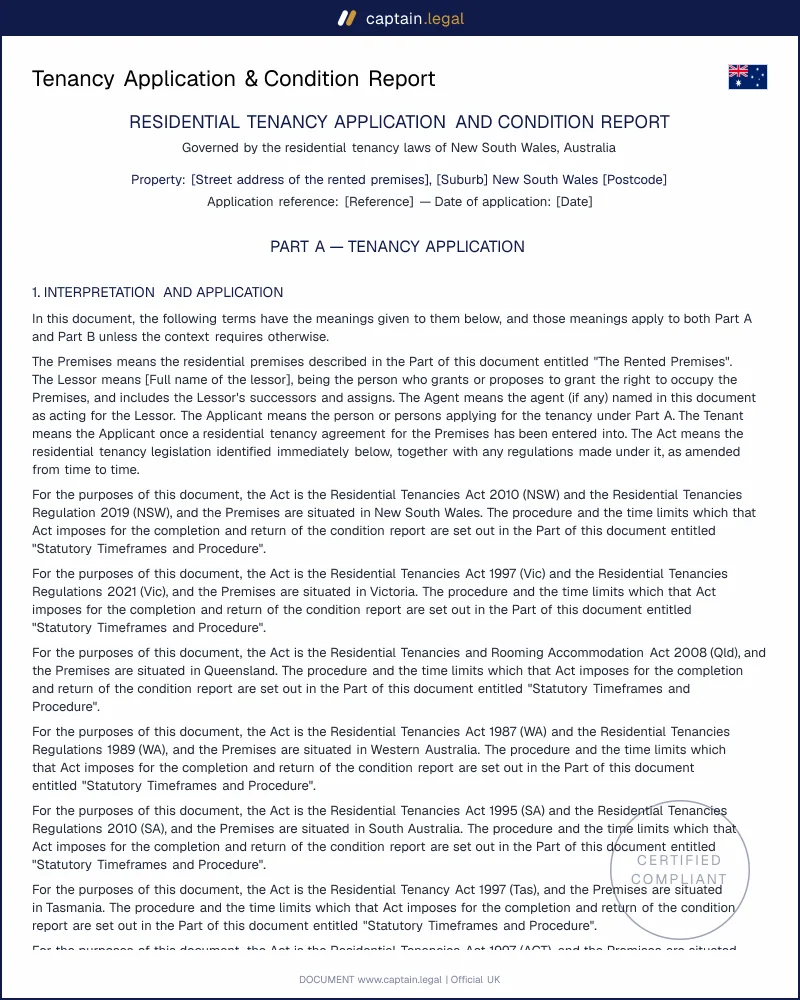
You start by selecting the state or territory where the property sits, because that single choice determines whether a prescribed form applies, what the return deadlines are, and what may lawfully be asked at application stage. From there the template adjusts the schedule structure and the deadline references to match the applicable Act. If you are in a prescribed-form jurisdiction, the template points you to the official form and produces the supporting record around it rather than pretending to replace it.

Next comes the property profile: type of dwelling, number of rooms, whether it is furnished, which utilities are separately metered. That profile builds the room-by-room schedule, so a two-bedroom unit does not carry six pages of blank bedroom entries. You then walk the property with the schedule open, marking clean, working and undamaged for each item and writing a comment wherever the answer is no. Photographs attach as you go, keyed to the item.

The application module runs the same way. You enter the applicant details, the template applies the document limits and prohibited fields for the jurisdiction, and you produce a submission-ready pack. Download in Word if you want to keep editing, or PDF for signature and lodgement. Tenants comparing their obligations across documents will find the wider Australian personal legal document library useful for statutory declarations and related paperwork.

6

Common mistakes to avoid

The costliest mistake is a bare tick sheet. A report that says "clean, working, undamaged" for every item in a twelve-year-old rental is not evidence, it is an assertion, and any competent representative will say so. Detail wins: not "carpet damaged" but "burn mark, 3 cm, bedroom 2, left of window, photographed", with a date stamp. The second mistake belongs to tenants, who accept the landlord's report without inspecting. In Victoria that is close to fatal, because section 36 converts the signed report into conclusive evidence, and the 30-day VCAT amendment window under section 35A closes quickly. Sign nothing you have not walked.

Missing the deadline is the third. Queensland's entry report must be with the tenant on or before occupation day, not the following week; Victoria's must be given before move-in, not after. Landlords also breach by using a superseded version of an approved form, which is easily avoided by downloading fresh from the regulator each time. On the application side, the newest and fastest-growing error is asking for information no longer permitted: date of birth in South Australia, anything outside the standard form in Victoria, pets at application stage. Agents who carried old application templates into 2026 are now collecting data unlawfully.

Finally, landlords forget the exit report or complete it alone without giving the tenant a reasonable opportunity to attend. That failure does not merely annoy; it undermines the comparison the whole bond claim rests on. Owners who let through a company structure should also check that the entity named on the report matches the entity on the lease, and the Australian employment contract templates are worth reviewing where property managers are engaged directly rather than through an agency.

Key takeaways

CONDITION REPORT

The entry report sets the bond baseline

Bond disputes are won and lost on evidence. Tribunals like NCAT, VCAT and QCAT commonly treat a signed entry condition report as the starting point, then compare it to the exit report. If the entry report is missing or thin on detail, the rental provider is left arguing from memory. Do a room-by-room check, add clear comments, and back it with dated photos.

PRESCRIBED FORMS

Use the state form, not a substitute

Residential tenancies are governed by state and territory Residential Tenancies Acts, and some jurisdictions mandate a prescribed condition report form. Queensland uses Entry condition report (Form 1a) and Exit condition report (Form 14a) under s 65 of the Residential Tenancies and Rooming Accommodation Act 2008. Victoria prescribes Form 4 under s 35 of the Residential Tenancies Act 1997. NSW prescribes a form under s 29 of the Residential Tenancies Act 2010. If a form is prescribed, a private template does not replace it.

DEADLINES

Meet the handover and return timeframes

Timing is part of compliance and part of protecting the bond. In Queensland, the lessor must prepare and sign the entry report in the approved form and give it to the tenant on or before the day the tenant occupies the premises, with a stated maximum penalty of 20 penalty units for non-compliance. The tenant then has 7 days to note disagreements, sign and return it, and the lessor must provide a final copy within 14 days.

Frequently Asked Questions

The condition report becomes legally significant once both parties sign it, and in Victoria a jointly signed report is conclusive evidence of the property's condition under section 36 of the Residential Tenancies Act 1997. That said, this template does not replace a prescribed form. Queensland requires Form 1a, Victoria requires Form 4, New South Wales prescribes its report by regulation, and South Australia requires Form A1 for applications. Where a form is prescribed, use it. This template prepares, supplements and documents around the official form: the photographic schedule, the applicant's working copy, the exit comparison. In jurisdictions and situations where no form is prescribed, the completed and signed document stands on its own terms.

Both. Word suits the preparation stage, when you are adding rooms, adjusting the schedule to the dwelling, or building an applicant pack you will reuse across several properties. PDF suits handover and signature, since it locks the layout and travels cleanly by email, which matters when a jurisdiction permits electronic service of the report. Most landlords generate the Word version, walk the property, finalise, then export to PDF for signing. Keep both. Queensland expects reports to be retained for at least a year after the agreement ends, and a Word original makes the exit comparison far easier to assemble.

It depends on the state. Queensland gives the tenant 7 days from the later of the day they occupied the premises or the day they received the report, under section 65 of the Residential Tenancies and Rooming Accommodation Act 2008, after which the landlord has 14 days to return a finalised copy. Victoria gives the renter 5 business days from the move-in date under section 35 of the Residential Tenancies Act 1997. New South Wales allows 7 days from taking possession under section 29(3) of the Residential Tenancies Act 2010. If you miss the window, you are generally taken to accept the landlord's description, which is why the deadline matters more than any other date in the tenancy.

Your obligation to return one falls away. Section 29(3A) of the Residential Tenancies Act 2010 in New South Wales says so directly: the tenant's 7-day duty does not apply where the landlord failed to provide copies in the first place. Queensland attaches a penalty of up to 20 penalty units to the landlord's failure under section 65, and Victoria up to 25 penalty units. Practically, the absence of a report hurts the landlord far more than the tenant, because a bond claim for damage rests on proving the property was undamaged at entry. Document the property yourself with date-stamped photographs on move-in day and email a copy to the agent, so the record exists regardless.

No, and the limits tightened sharply. Since 31 March 2026 Victorian landlords and agents must use the Consumer Affairs Victoria standard form and cannot ask for, require or consider information outside it. South Australia's Form A1 has been mandatory since 1 January 2026 and prohibits fields including date of birth and the ages of other occupants, while capping landlords at two documents in each of the identity, financial capacity and suitability categories. Pets cannot be raised at application stage in Victoria; they go through the formal pet request process after a tenancy is offered. If you are asked for something outside the form, you can decline and report it to the regulator.

Fair wear and tear is the deterioration that happens through ordinary use over time: carpet flattening in a hallway, paint fading near a window, a tap washer perishing. Damage is what happens through act or neglect: a hole in plasterboard, a burn in the carpet, a cracked basin. No Australian statute defines the line precisely, which is exactly why the entry and exit comparison carries the argument. A tribunal looks at the two reports, the photographs, and the length of the tenancy. Ten-year-old carpet showing traffic wear after a four-year tenancy is wear; the same carpet with a stain absent from the entry report is not.

The report attaches to the premises, not the person, so one report per tenancy is the norm. Complications arise when the named tenants change. If a housemate leaves and a new tenant is added to the agreement, the incoming tenant has signed nothing about the condition of the room they are taking on, and the original report is weak evidence against them. The safer practice is a fresh record at each change of named tenant, even where the Act does not require one. In South Australia, note separately that each prospective tenant must lodge their own Form A1 application, so the application stage is genuinely individual.

Queensland sets a floor of 1 year after the agreement ends for condition reports. South Australia requires successful applicants' personal information to be destroyed 3 years after the end of the tenancy, and unsuccessful applicants' information within 30 days after the tenancy is let, or 6 months with the applicant's agreement. Those two rules pull in opposite directions, so keep the condition report and the photographs for the retention period, and purge the application data on the destruction schedule. Tribunal limitation periods vary by jurisdiction, and a bond dispute can surface months after handover, so the practical answer for most landlords is to keep the condition report for the longer of the statutory floor and any live dispute.

4.7/5

23 verified reviews · 50 000+ downloads

Tenancy Condition Report: Protect Your Bond at Handover
  • Immediate access to the document
  • PDF + Word download
  • Compliant with 2026 legislation
  • Reviewed by lawyers
Fill in the template
Secure payment
Updated on July 16, 2026

You might also like

Residential Lease Renewal
Rent Increase Notice Australia