Create my document
Login

Choose country

AustraliaAustraliaChoose country
Employment

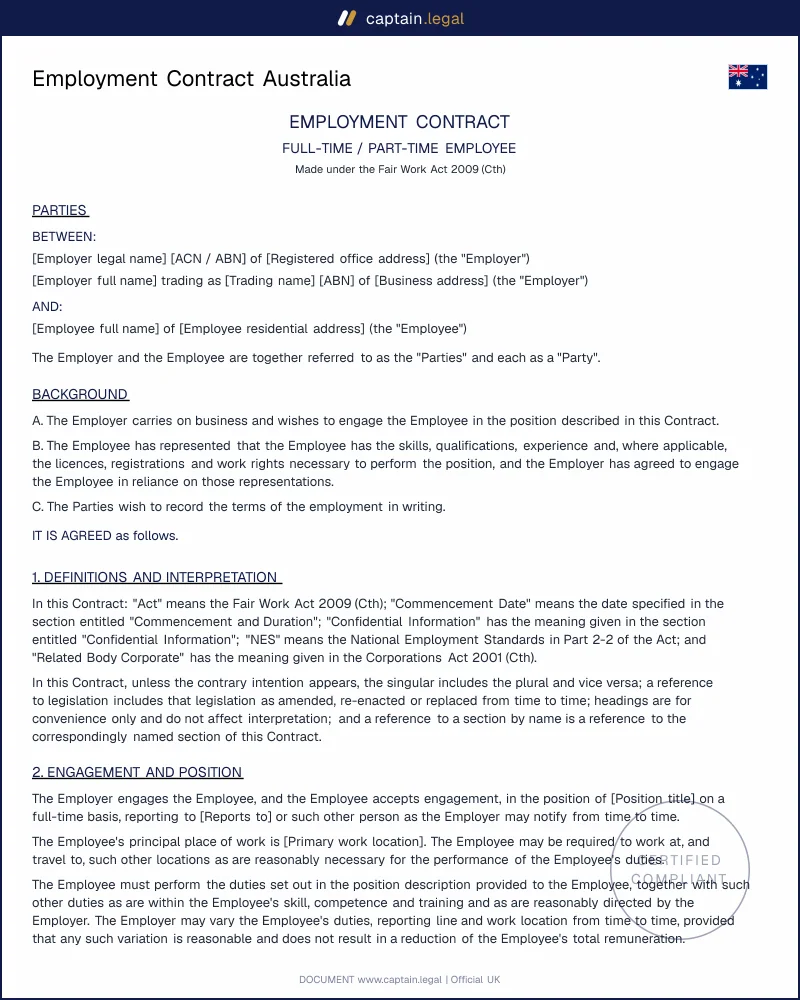
Employment Contract Australia | Fair Work Act 2009

Employment contract drafted to the Fair Work Act 2009 and the 11 National Employment Standards: Modern Award, s.117 notice, post-Woolworths set-off clause.
4.8/527 reviews50 000+ downloadsInstant download
Share

A written employment contract is the document that fixes the terms of an ongoing full-time or part-time engagement in Australia: position, hours, remuneration, leave, notice and confidentiality. Nothing in the Fair Work Act 2009 (Cth) forces an employer to put those terms in writing, yet every practitioner who has defended an underpayment claim knows what an oral arrangement costs when the Fair Work Ombudsman asks for the paperwork. This employment contract Australia template is built for national system employers hiring permanent staff under a Modern Award or above it, and it does the work that matters: it names the award, sets the classification, records the ordinary hours, and states plainly what the salary is meant to cover.

Compliant

2026 Legislation

50,000+ clients

trust us

Affordable

From $4.90 / doc

Secure payment

Instant download

Employment Contract Australia | Fair Work Act 2009

Secure payment

Fill in the template

What is an employment contract in Australia?

An employment contract is a common law agreement between an employer and an employee that creates the employment relationship and sets its terms. It sits underneath a statutory floor that cannot be contracted out of. The National Employment Standards in Part 2-2 of the Fair Work Act apply to every national system employee regardless of what the contract says, and any Modern Award or enterprise agreement covering the role applies on top of them. A contract term that gives less than the floor is simply void to that extent under s.61 and s.56 of the Act. What the contract does, then, is fill the space above the floor and clarify the parts the legislation leaves open: probation, notice beyond the statutory minimum, intellectual property, restraint of trade, confidentiality, and the precise scope of the role.

The distinction employers get wrong most often is between an employment contract and a letter of offer. A letter of offer announces the job and its headline terms. It rarely names the award, rarely defines ordinary hours, and almost never contains a set-off clause. When a dispute reaches the Fair Work Commission, the letter is treated as the contract by default, gaps included, and the gaps are read against the party who drafted them. The second confusion is with an independent contractor agreement, which creates a fundamentally different relationship and is now assessed under s.15AA of the Act by reference to the real substance and practical reality of the arrangement, not the label on the cover page. If the worker is integrated into the business and follows its processes, calling the document a services agreement changes nothing. Businesses engaging genuine contractors should use a purpose-built independent contractor agreement compliant with s.15AA of the Fair Work Act rather than adapting an employment contract.

2

When do you need this document?

The obvious trigger is a new permanent hire, full-time or part-time, where you want the terms fixed before the first shift rather than reconstructed afterwards. The less obvious triggers are where the money is. Converting a casual to permanent employment under the s.66AAB employee choice pathway requires a fresh instrument, because casual loading disappears and leave accruals begin: continuing to pay the loaded casual rate after conversion is an overpayment you cannot recover and an underpayment of leave you can be prosecuted for. A promotion or classification change under an award is the same problem in miniature. A variation letter that does not restate the classification leaves the old one operating, and the old one is what an inspector will use to calculate the shortfall.

Restructures generate the third category. When ordinary hours shift from 38 to 30, when a part-time employee's agreed pattern changes, or when a role moves from award-free to award-covered because the high income guarantee was not renewed, the contract needs to catch up. Most awards require a part-time employee's ordinary hours to be agreed in writing, including the days and start and finish times, before work begins. An unwritten part-time roster exposes every hour outside the pattern to overtime rates.

One edge case worth flagging: employers hiring staff who will work partly from home should treat the right to disconnect under s.333M as a drafting issue, not a policy issue. The right has applied to every employer, including small business, since August 2025. If a role genuinely requires out-of-hours availability, an on-call allowance or availability loading written into the contract is far more defensible than an informal expectation nobody documented.

3

Key clauses included in our template

  • The award and classification clause names the applicable Modern Award and the exact classification level, because a contract that says "any award that may apply" identifies nothing. It also records the employee's classification on commencement and provides for review on progression, which is where award-based increment disputes usually start.
  • The ordinary hours and pattern of work clause sets the 38 ordinary hours for full-time roles and, for part-time roles, the agreed number of hours plus the specific days and start and finish times most awards require in writing. Reasonable additional hours are addressed by reference to the s.62 factors rather than an open-ended availability promise.
  • The remuneration and set-off clause is drafted to the post-Woolworths position. It identifies the specific award entitlements the above-award component is intended to satisfy, states that set-off operates within each pay period and not across periods, and preserves NES entitlements from set-off entirely. A reconciliation and top-up mechanism sits alongside it.
  • The superannuation clause records the Superannuation Guarantee obligation on ordinary time earnings, the employee's choice of fund and the default fund arrangement, and keeps salary expressed exclusive of super unless the parties genuinely intend a package.
  • The probationary period clause is drafted to reflect what probation actually is in Australia: a review period, not a suspension of statutory notice. Section 117 notice applies from day one and the clause says so.
  • The termination clause sets notice at or above the s.117 scale, provides for payment in lieu at the full rate of pay, and preserves summary dismissal for serious misconduct as defined in reg.1.07 of the Fair Work Regulations 2009.
  • The confidentiality, intellectual property and post-employment restraint clauses assign work-created IP to the employer and draft the restraint in cascading form, since Australian courts sever unreasonable limbs rather than rewriting them.
4

State and territory considerations

New South Wales, Queensland, South Australia, Tasmania and Victoria referred their industrial relations powers to the Commonwealth, so employees of trading corporations and, in most cases, unincorporated businesses fall inside the national system and the Fair Work Act applies without qualification. The practical divergence in these States is long service leave, which remains State legislation. Long service leave in New South Wales accrues under the Long Service Leave Act 1955 (NSW) with an entitlement after 10 years and a pro rata right after five in defined circumstances, while Victoria's Long Service Leave Act 2018 (Vic) allows access after seven years. A contract that recites a single national long service formula is wrong in at least one State.

Western Australia is the outlier that catches national employers off guard. WA never referred its powers, so sole traders, partnerships and other unincorporated businesses operating in WA remain in the State system governed by the Industrial Relations Act 1979 (WA) and the WA award structure, not the Fair Work Act. The s.327A wage theft offence expressly does not reach certain unincorporated employers in the referring States either. Before drafting for a WA employer, confirm the trading structure, because the wrong system means the wrong award, the wrong minimum rate and the wrong notice scale.

Victoria adds a layer through the Labour Hire Licensing Act 2018 (Vic), which requires providers supplying workers to third parties to hold a licence. Queensland and South Australia operate equivalent schemes. An employment contract that contemplates placing the employee with host businesses may trigger licensing obligations the drafter never considered.

The Australian Capital Territory and Northern Territory operate entirely within the national system, and the Territories' portable long service leave schemes in construction, cleaning and security create obligations that survive changes of employer. Employers in business formation and governance across Australia frequently discover these schemes only when a levy notice arrives.

5

How to fill out this employment contract

You begin by selecting whether the engagement is full-time or part-time, because the ordinary hours clause branches from that choice and the part-time path asks for the agreed days and times that most awards require in writing. From there you identify the Modern Award and classification level. If you are unsure which award applies, the Fair Work Ombudsman's award finder resolves it by industry and role in a few steps, and getting this right at the start saves reconstructing pay records later. The form then asks for remuneration and, if the salary sits above the award minimum, whether you intend a set-off. Choosing set-off opens the clause that lists the specific entitlements the above-award component covers, drafted to operate within each pay period rather than across a reconciliation window.

The remaining inputs are the ones most people skip and should not: probation length, notice above the statutory scale if any, restraint radius and duration, and the confidentiality scope. Each field carries plain-English guidance explaining the legal consequence of the choice. You then download in Word and PDF, edit anything the form did not anticipate, and sign. Employers building out a full document set usually pair this with materials from the complete Australian legal document catalogue.

6

Common mistakes to avoid

The most expensive mistake is the vague set-off clause. A clause saying the salary satisfies "all award entitlements" identifies nothing specific, and after Woolworths it cannot pool an over-award payment from one fortnight against a shortfall in the next. The second is treating probation as though it suspends statutory obligations: it does not, notice under s.117 runs from the first day, and unfair dismissal protection begins at six months (12 for small business employers) regardless of what the probation clause says. The third is a classification set once and never reviewed, which quietly generates a shortfall every time the employee progresses through award increments.

Then there are the record-keeping failures. Woolworths confirmed that paying an all-inclusive salary does not excuse an employer from recording the overtime hours actually worked, and an employer who cannot produce those records carries the reverse onus under s.557C. Fourth, restraints drafted as a single unreasonable clause rather than in cascading form get struck out entirely instead of read down. Fifth, and most avoidable, is the contract that never records that the Fair Work Information Statement was provided, which is a discrete NES breach under s.125 attracting its own penalty. Employers handling terminations should also review their Australian employment law templates and termination documents as a set, since notice, final pay and separation paperwork interact.

Key takeaways

LEGAL FLOOR

NES and Awards override your contract

An employment contract sits under the Fair Work Act 2009. The 11 National Employment Standards in Part 2-2 apply to every national system employee, and any Modern Award or enterprise agreement applies on top. If your contract gives less than those minimums, that term is void to the extent of the inconsistency (see ss.56 and 61).

AWARD SETUP

Name the Modern Award and classification

The practical drafting work is identifying the right Modern Award and then locking in the correct classification, ordinary hours and what the salary is meant to cover. Awards drive minimum rates, overtime, penalty rates and allowances. Get the award wrong or leave it unstated and you can end up with underpayment exposure, even when the employee agreed to the headline salary.

COMPLIANCE

Give the Fair Work Information Statement

Every new employee must be given the Fair Work Information Statement before they start, or as soon as practicable after starting (s.125). The contract is a sensible place to record that it was provided. If the Fair Work Ombudsman asks for evidence during a complaint, a written record reduces argument about what was given and when, compared with relying on an oral onboarding process.

Frequently Asked Questions

Yes. Once both parties sign, it is a binding common law contract enforceable in the Federal Circuit and Family Court or the relevant State court. The template is drafted to the Fair Work Act 2009 (Cth) and the National Employment Standards, and it does not attempt to contract below the statutory floor, which is what invalidates terms under s.61. The important qualification is that no contract can displace a Modern Award or the NES. If you name the wrong award or set a rate below the award minimum, the contract remains binding but that term is unenforceable and the award rate applies instead. Identify the award correctly before signing.

No statute compels a written contract for permanent employees. The Fair Work Act requires you to give every new employee the Fair Work Information Statement under s.125, and casual employees the Casual Employment Information Statement, but the employment terms themselves can be oral. In practice, an unwritten contract is a liability. Without writing, you have no set-off clause, no restraint, no IP assignment, no confidentiality obligation, and no evidence of the agreed ordinary hours. In an underpayment investigation the employer who cannot produce records carries the burden of disproving the employee's version under s.557C. Some awards separately require part-time hours to be agreed in writing.

The s.117 scale runs from one week for up to one year of continuous service, two weeks for one to three years, three weeks for three to five years, and four weeks beyond five years. Add one week if the employee is over 45 and has completed at least two years of continuous service, giving a maximum of five weeks. Notice must be in writing and must state the day the employment ends, or you pay in lieu at the full rate of pay for the hours the employee would have worked. This is a floor. If your contract, award or enterprise agreement provides more, the higher figure applies. Casuals and fixed-term employees ending at natural expiry sit outside s.117.

The contract downloads in both Microsoft Word (.docx) and PDF. The Word version is the working file: you can amend clauses, insert your letterhead, adjust the restraint radius, or add schedules such as a position description or a remuneration annexure. The PDF is the execution copy, formatted for signing and for your employee records. Both are generated from the same completed form, so they are identical in substance. Australian employers should retain the executed contract for at least seven years alongside pay records, which is the retention period required by the Fair Work Regulations 2009.

You can, and the template provides for it, but understand what probation does and does not do. It creates a review period during which you assess suitability and typically apply a shorter contractual notice. It does not suspend the s.117 statutory minimum, which applies from day one. It does not affect unfair dismissal, where the minimum employment period is six months, or 12 months for a small business employer with fewer than 15 employees, and that period runs regardless of what the probation clause says. A three-month probation followed by dismissal at month eight offers no protection at all. General protections claims under Part 3-1 have no minimum service period whatsoever.

Narrowly. In Fair Work Ombudsman v Woolworths Group Limited [2025] FCA 1092 the Federal Court held that an above-award salary can only discharge award entitlements arising in the same pay period, because s.323 requires payment in full at least monthly and the parties had contracted for fortnightly pay. Pooling across a 26-week reconciliation period does not work. A clause drafted today should identify the specific award entitlements being set off, confirm the set-off operates within each pay period, exclude NES entitlements from set-off, and commit to topping up any shortfall. Awards containing their own annualised wage provisions have separate rules on outer limits and reconciliation that must be followed instead.

Award coverage turns on the industry of the employer and the occupation of the employee, and there are 121 awards to choose between. Some are industry-based, such as the General Retail Industry Award 2020, and some are occupational and follow the role across industries, such as the Clerks Private Sector Award 2020. Where both could apply, industry awards generally prevail. The Fair Work Ombudsman's award finder gives a reliable answer from your industry and role. Employees earning above the high income threshold with a written guarantee of annual earnings under s.330 are award-free, but the guarantee must be in writing and accepted, and the threshold changes each 1 July.

It does not have to be, since s.333M operates whether or not you mention it, and it has covered every employer including small business since August 2025. Addressing it in the contract is still the better practice. The employee's right to refuse out-of-hours contact only bites where the refusal is reasonable, and reasonableness turns partly on whether the employee is compensated for remaining available and on the nature of the role. A contract that builds an on-call allowance or availability loading into the remuneration, and defines the circumstances in which out-of-hours contact is expected, makes the employer's position far stronger than an undocumented assumption. Employers with hybrid staff should also review their Australian workplace and personal legal documents for consistency.

4.8/5

27 verified reviews · 50 000+ downloads

Employment Contract Australia | Fair Work Act 2009
  • Immediate access to the document
  • PDF + Word download
  • Compliant with 2026 legislation
  • Reviewed by lawyers
Fill in the template
Secure payment
Updated on July 16, 2026

You might also like

Employee Offer Letter Australia
Employee Warning Letter & PIP Template