Personal

Private Loan Agreement AU | Outside National Credit Code

Family and friends loan agreement drafted outside s.5 National Credit Code, with state limitation periods, guarantor clauses and deed execution.
4.7/5— 14 reviews50 000+ downloadsInstant download
Share

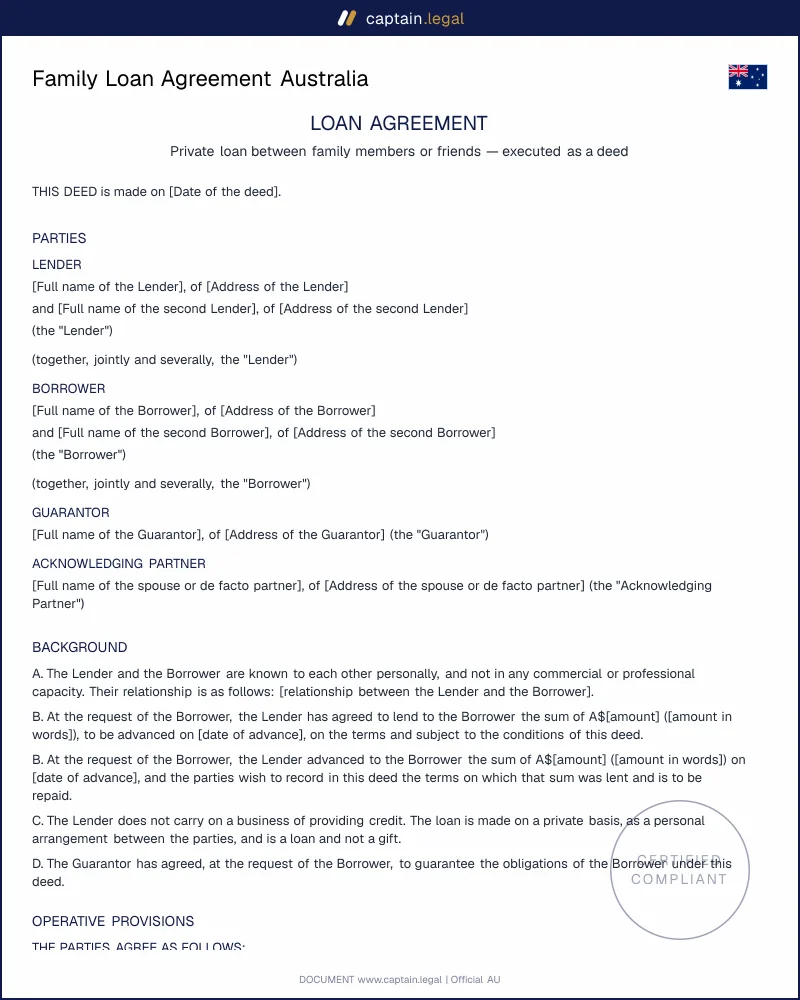
A family loan agreement records the terms on which one person lends money to a relative or friend in Australia: the amount advanced, when and how it comes back, whether interest applies and what happens if repayments stop. It is written for private lenders who are not in the business of providing credit, which keeps the arrangement outside the National Credit Code. Parents helping with a home deposit and friends covering a cash shortfall need the same thing: a signed record that turns a handshake into an enforceable debt. Our template covers the repayment schedule, nil or fixed interest, default and acceleration, an optional guarantor, and signing as a deed where that is the safer choice.

Compliant

2026 Legislation

50,000+ clients

trust us

Affordable

From $4.90 / doc

Secure payment

Instant download

Private Loan Agreement AU | Outside National Credit Code

Secure payment

Fill in the template

What is a family loan agreement?

In Australian law a loan is a contract: the lender advances money and the borrower promises to repay an equivalent sum, with or without interest. A family loan agreement is that contract put in writing between people who know each other, most often a parent and an adult child, siblings or close friends. An oral loan can be enforced, but proving one after the relationship sours is another matter. The usual pattern: money moves, nothing is signed, and years later the recipient calls it a gift. Where the transfer runs from parent to child, the presumption of advancement confirmed by the High Court in Nelson v Nelson (1995) 184 CLR 538 starts the analysis on the gift side, and the parent must rebut it with evidence of intention.

The document is often confused with two neighbours. A deed of gift for money handed over without repayment records the opposite intention, and Centrelink, banks and family courts expect the paperwork to match reality. A personal loan from a bank is a regulated credit contract with disclosure, hardship and responsible lending obligations; a private loan between relatives carries none of them. Our template can also be executed as a loan deed, which removes any argument about consideration for a guarantor and, in most jurisdictions, lengthens the time available to sue.

When do you need this document?

The most common request is the home deposit from the Bank of Mum and Dad. Parents usually want the money back if their child's relationship ends, which only works when the loan is documented before settlement and disclosed to the mortgage lender. When a couple separates, the Federal Circuit and Family Court of Australia decides in a property settlement under section 79 of the Family Law Act 1975 whether a parental advance is a genuine debt or a soft loan nobody meant to enforce. Families wanting more certainty pair the loan with a binding financial agreement signed by the couple under the Family Law Act.

Smaller loans for a car, course fees or rent between jobs follow the same logic. Friends backing a new venture should lend to the company rather than to the founder, and where they also take equity the terms belong in a shareholders agreement for an Australian Pty Ltd. Parents who want to treat their children equally use a loan agreement so that an advance to one child can be brought into account against that child's inheritance. And a lender on the Age Pension should know that Services Australia assesses an outstanding loan as a financial asset subject to deeming, while forgiving it later is treated as a gift under the deprivation rules.

Key clauses included in our template

  • The parties, principal and purpose clause names every borrower, states the amount advanced and records how the funds were paid. The purpose statement matters if a court or Services Australia later asks what the money was for.
  • The repayment schedule offers regular instalments, a single lump sum on a fixed date, or repayment on demand after a minimum period. Early repayment is allowed without charge, and payments go to interest first.
  • The interest clause can be set at nil or at a fixed annual rate calculated daily. The lender's tax obligation on interest received is flagged.
  • The default and acceleration clause gives the borrower a written notice and a fixed period to catch up before the whole balance becomes payable. Any default interest is capped at a modest margin to stay on the right side of Paciocco.
  • The guarantee and indemnity is a separate schedule signed by the guarantor. The guarantor confirms in writing that they received independent legal advice before signing, the best protection against an Amadio or Garcia challenge.
  • The death, forgiveness and estate clause states whether the debt survives the lender's death or is released, so the agreement lines up with a last will and testament drafted for Australian succession law.
  • The execution and governing law block lets you sign as a simple agreement or as a deed, nominates the state or territory whose law applies and adds a negotiation step before litigation.

State and territory considerations

New South Wales gives a lender six years to sue on a simple contract under section 14 of the Limitation Act 1969 and twelve years on a deed under section 16. An individual can execute a deed without a seal if it is signed and witnessed by a non-party, as section 38 of the Conveyancing Act 1919 allows. Written acknowledgement or part payment restarts the clock under section 54. Guarantors there can also invoke the Contracts Review Act 1980 against an unjust contract.

Victoria keeps the six-year period for contracts under section 5(1)(a) of the Limitation of Actions Act 1958 but allows fifteen years on a deed under section 5(3). A guarantee is unenforceable unless it is in writing and signed by the guarantor, as required by section 126 of the Instruments Act 1958. The seal requirement for deeds by individuals was removed by section 73A of the Property Law Act 1958.

Queensland changed its rules when the Property Law Act 2023 commenced on 1 August 2025. For deeds made after that date, the limitation period under the Limitation of Actions Act 1974 fell from twelve years to six. A Queensland lender who chose a deed for its longer limitation period no longer gets that benefit on a new deed. Contract claims stay at six years under section 10(1)(a).

Western Australia applies a six-year period under section 13 of the Limitation Act 2005. The Statute of Frauds 1677 still requires a guarantee to be evidenced in writing and signed.

Northern Territory is the outlier. Section 12 of the Limitation Act 1981 gives only three years to sue on a simple contract, half the period in South Australia, Tasmania and the ACT, so Territory lenders should chase arrears early or sign a deed, covered by section 14.

How to fill out this family loan agreement

You start by choosing the state or territory whose law will govern the loan, usually where the borrower lives. The form then adjusts the execution block and guarantee formalities to match. Next you enter the lender and borrower details, the principal and the payment method; a bank transfer referenced "family loan" leaves a far better trail than cash.

The repayment section asks you to pick instalments, a lump sum or repayment on demand, then set the interest rate or leave it at nil. If a guarantor is involved, you add their details and the form generates the separate guarantee schedule with the independent advice acknowledgement. You then decide between a simple agreement and a deed, with the effect of each explained on screen.

Once the answers are complete, you download the document in Word and PDF, print it, and sign with the required witness. Each party keeps a signed original of the loan agreement and a record of every repayment.

Common mistakes to avoid

The most expensive mistake is signing after the money has already moved. An agreement prepared once a separation is looming invites the argument that it was manufactured for litigation. Never backdate a loan agreement; sign a fresh document that acknowledges the earlier advance and its real date instead. Handing over cash is the second mistake, since it leaves no evidence of the principal. Lenders who never ask for a repayment and never obtain a written acknowledgement let the limitation period run, and in the Northern Territory that can happen in three years.

Guarantees fail for predictable reasons. A parent guaranteeing a sibling's loan at the kitchen table, with the borrower in the room and no independent advice, is exactly the fact pattern the High Court has refused to enforce. Default interest that doubles the rate after one missed instalment will likely be read as a penalty. Finally, a loan left out of the will creates disputes the agreement itself cannot fix.

Key takeaways

Credit Code

Know when the Code stays out

A private loan between relatives or friends sits outside the National Credit Code only if the section 5 elements are not all met. A parent lending once to a child usually fails the business test, and a no-interest advance also fails the charge test. Repeated lending for profit can change that position and raise licensing issues under section 29 of the National Consumer Credit Protection Act 2009.

Loan evidence

Turn the transfer into evidence

When money moves inside a family, the later fight is often loan versus gift. A signed agreement records the amount, repayment schedule, interest position and default rights before memories shift. For parent-to-child transfers, Nelson v Nelson starts with the presumption of advancement, so the lender needs clear evidence that repayment was intended.

Enforcement

Draft enforcement without overreaching

Default clauses, acceleration and guarantees need careful drafting because ordinary contract and equity rules still apply. A fee out of proportion may be treated as a penalty under Paciocco, and a family guarantor can raise undue influence or unconscionable dealing issues under Amadio, Garcia and Thorne. Signing as a deed can remove consideration arguments and extend the time to sue in most jurisdictions.

Frequently Asked Questions

Yes. Once both parties sign, it is an enforceable contract, and signing it as a deed makes it binding even on a guarantor who receives nothing in return. The written agreement also rebuts the presumption of advancement that would otherwise treat a transfer from parent to child as a gift. Keep the bank transfer record with the signed original as proof of the advance.

A simple agreement needs only the signatures of the parties. A deed requires each signature to be witnessed by an adult who is not a party, and the witness should not be the borrower's partner or another family member with an interest in the loan. No lawyer is needed for the lender or borrower. A guarantor is different: independent legal advice before signing is what makes a family guarantee hard to set aside later.

No. An interest-free loan is perfectly valid, and it also keeps the arrangement clearly outside the National Credit Code. If you do charge interest, the lender declares it as income. A private company lender is different: Division 7A requires a minimum benchmark rate, so a family company should never lend informally.

In most of Australia you have six years from the date the debt fell due to start court proceedings on a simple agreement. The Northern Territory allows only three years. Deeds carry longer periods in most jurisdictions, twelve years in New South Wales and fifteen in Victoria, although new Queensland deeds are now limited to six. A signed acknowledgement or a part payment generally restarts the clock.

Yes. The completed document is available as an editable Word file, handy if your accountant wants to adjust the repayment dates, and as a print-ready PDF for signing and witnessing. Both versions keep the same jurisdiction-specific execution block, so nothing needs to be rebuilt by hand. You can find related templates in the full catalogue of Australian legal documents.

Unless the agreement releases it, the outstanding balance becomes an asset of the lender's estate and the executor must collect it. Our template lets you choose whether the debt is forgiven on death, and that choice should be mirrored in the will and in the other personal estate planning documents for Australians you keep on file.

4.7/5

14 verified reviews · 50 000+ downloads

Private Loan Agreement AU | Outside National Credit Code
  • Immediate access to the document
  • PDF + Word download
  • Compliant with 2026 legislation
  • Reviewed by lawyers
Fill in the template
Secure payment
Updated on September 15, 2026

You might also like

Codicil to a Will Australia
General Power of Attorney AU