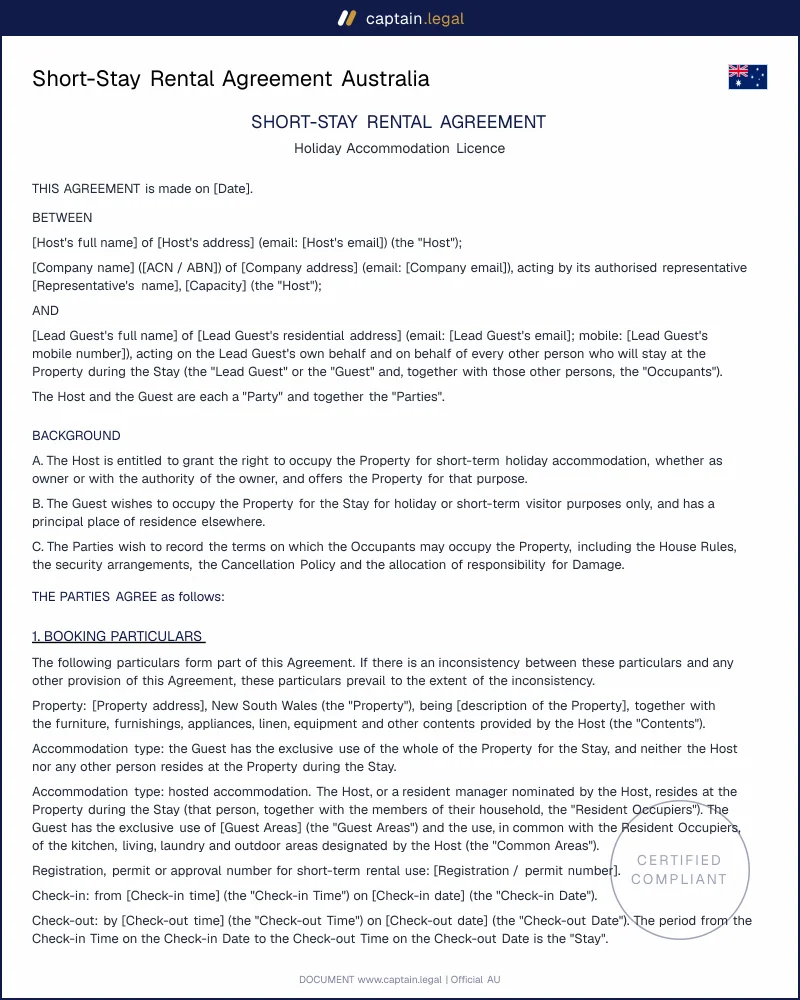
New South Wales has the most structured regime in the country. Every dwelling offered as short-term rental accommodation needs a registration number on the STRA Register, and that number should appear on the agreement. Non-hosted stays in Greater Sydney are capped at 180 nights in each 12-month period, bookings of 21 or more consecutive days do not count toward the cap, and Byron Shire applies a stricter 60-night limit in most of its area. Under section 137A of the Strata Schemes Management Act 2015 (NSW), an owners corporation can adopt a by-law by special resolution prohibiting short-term letting of lots that are not the owner's principal place of residence. Two strikes recorded under the Code of Conduct within two years can place a host or a guest on the exclusion register for five years.
Victoria combines a statewide levy with building-level control. The levy under the Short Stay Levy Act 2024 (Vic) applies to stays of fewer than 28 consecutive days, with an exemption for a host letting all or part of their own principal place of residence. Platforms collect it on their bookings, but a host taking direct bookings must register with the State Revenue Office and lodge returns. The same Act amended the Owners Corporations Act 2006 (Vic) so an owners corporation can ban short stays by special resolution, although the rule cannot reach a lot that is a principal place of residence, and councils keep the power to require permits or cap nights.
Queensland relies on section 31 of its tenancy Act for the holiday exclusion and leaves most regulation to local government. Several councils require a planning approval or permit for short-term letting, and Noosa Shire Council runs its own permit system. Body corporate by-laws under the Body Corporate and Community Management Act 1997 (Qld) generally cannot prohibit letting a lot outright, so building control works mostly through conduct by-laws on noise, parking and pool hours.
Western Australia requires every short-term rental property, hosted or unhosted, to be registered under the Short-Term Rental Accommodation Act 2024 (WA). In the Perth metropolitan area, unhosted properties let for more than 90 nights in a 12-month period need development approval, and since 1 January 2026 owners must show planning compliance to stay registered. A host who exceeds the exemption without approval risks enforcement action and loss of registration, so the agreement should record the registration number.