Real Estate

Notice of Entry | s.55 RTA NSW, s.86 Vic, Form 9 Qld

Entry notice drafted to s.55 RTA 2010 (NSW), ss.85-86 RTA 1997 (Vic), Form 9 (Qld) and s.46 RTA 1987 (WA). Correct grounds, notice periods and hours.
4.7/5— 14 reviews50 000+ downloadsInstant download
Share

A notice of entry is the written notice a landlord, property manager or other authorised person gives a tenant before entering a rented home. Without the tenant's consent, access during a tenancy is only lawful on a ground listed in the relevant Residential Tenancies Act, with the minimum notice for that ground, served by a permitted method and within the prescribed hours. This template is built for private landlords, property managers and agents organising routine inspections, repairs, valuations and viewings in New South Wales, Victoria, Queensland and Western Australia. It produces a landlord entry notice that states the ground, the date and the entry window in the terms each tribunal expects to see.

Compliant

2026 Legislation

50,000+ clients

trust us

Affordable

From $4.90 / doc

Secure payment

Instant download

Notice of Entry | s.55 RTA NSW, s.86 Vic, Form 9 Qld

Secure payment

Fill in the template

What is a notice of entry?

A notice of entry is the formal step that turns a landlord's statutory right of access into a lawful visit. Every residential tenancy carries a right to quiet enjoyment, set out in section 50 of the Residential Tenancies Act 2010 (NSW) and mirrored across the states, and entry without a valid notice breaches it. The notice identifies the tenant and the premises, states the ground, gives a date and a time or window, and is served within the minimum period. Terminology shifts at the border: Victoria speaks of the rental provider and the renter, Queensland of the lessor.

A notice of entry is not a breach notice or a termination notice. The access rules are built into the prescribed standard terms of a residential tenancy agreement, and a special term that tries to widen them, such as monthly inspections, has no effect. A tenant can always consent to a visit, but consent obtained on the doorstep by an agent who arrived unannounced rarely holds up, and Victoria only recognises agreement given in the 7 days before entry.

When do you need this document?

Routine inspections account for most notices served. Property managers usually run them quarterly in Queensland, where the Act allows one every three months, and far less often in Victoria, where no general inspection can occur in the first 3 months of the agreement or within 6 months of the last one. Each visit ties back to the ingoing condition report and tenancy application, so deterioration is caught before it becomes a bond dispute.

Repairs and maintenance are the second trigger, and tradespeople entering for the landlord need the same notice. Valuations for refinancing, photography before a listing and viewings once either party has given notice to end the tenancy each have their own ground.

Two edge cases come up regularly. The first is the follow-up visit after a notice to remedy a breach of the tenancy: Queensland has a specific ground for checking that a significant breach has been fixed, and Victoria allows entry on 24 hours notice where the rental provider reasonably believes the renter has not met their duties. The second is the owner living overseas who wants a relative to deal with the agent. That person needs written authority, often a general power of attorney covering property affairs.

Key clauses included in our template

  • The identification block names every tenant on the agreement and the full address, including unit or lot number. Naming only one of two co-tenants invites the argument that the other was never notified.
  • The ground for entry is chosen from the closed list for your state and worded in statutory language. A Victorian notice therefore cannot rely on the open "any other purpose" wording found only in the Western Australian Act.
  • The entry date and time window are set against the minimum notice and the permitted hours. For a Queensland general inspection the notice nominates a specific time or a window of no more than 2 hours, and entry has to begin inside it.
  • The service details record how and when the notice was given: by hand, by post or by email where the Act and the tenant's nomination allow it. The notice period runs from when the notice is taken to have been given, not from the date typed on the page, so postal service needs extra days.
  • The persons attending section names the agent, valuer, photographer or tradesperson. In New South Wales a person authorised by the landlord needs the written consent of the landlord or agent before entering under section 57(2).
  • The inspection history records the date of the last routine inspection, the quickest proof of compliance with the frequency cap.

State-specific considerations

New South Wales sets out its notice grounds in section 55(2) of the Residential Tenancies Act 2010. Routine inspections need at least 7 days written notice and are capped at 4 in any 12 months. Necessary repairs, maintenance and statutory health and safety work need 2 days, and a valuation needs 7 days, once in 12 months. Viewings for prospective tenants are confined to the last 14 days of the agreement, while buyer viewings, absent an agreement, are limited to twice a week on 48 hours notice. Under section 57, entry must fall between 8 am and 8 pm and never on a Sunday or public holiday without consent.

Victoria fixes notice by purpose under sections 85 and 86 of the Residential Tenancies Act 1997: 7 days for a general inspection, valuation or advertising photos, 48 hours for showing the property to renters, buyers or lenders, and 24 hours for repairs, other legal duties or a suspected breach. A 24 hour notice for a routine inspection is invalid. Entry is limited to 8 am to 6 pm on any day except a public holiday. Sales inspections are capped at twice a week for up to one hour, follow a notice of intention to sell served at least 14 days earlier, and attract prescribed compensation for the renter.

Queensland requires the approved Entry notice (Form 9) under sections 192 to 199 of the Residential Tenancies and Rooming Accommodation Act 2008. A routine inspection needs 7 days notice and can happen once every 3 months. Most other grounds now carry 48 hours notice, including repairs, smoke alarm work, valuations and viewings, so the 24 hour figures on older agency forms are out of date. Entry is lawful only between 8 am and 6 pm, Monday to Saturday, unless the tenant agrees. After a notice to leave or a notice of intention to leave, the lessor cannot enter more than twice in any 7 day period.

Western Australia requires written notice given at least 7 and no more than 14 days before a routine inspection under section 46 of the Residential Tenancies Act 1987, with no more than four inspections in 12 months. Repairs and maintenance need at least 72 hours written notice, and viewings for prospective tenants are restricted to the 21 days before the tenancy ends. Because WA also sets a 14 day maximum, a notice served three weeks ahead is as defective as one served three days ahead.

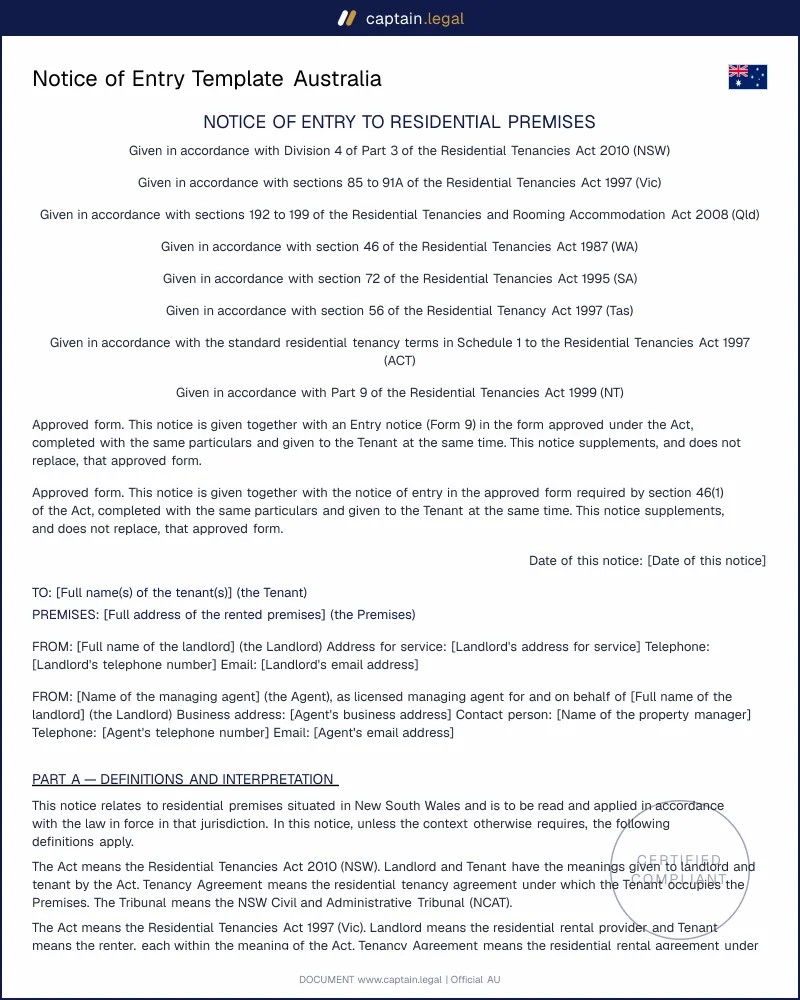
How to fill out this notice of entry

You start by choosing the state or territory where the property is located, because that answer changes the grounds, the minimum notice, the permitted hours and, in Queensland, the form itself. The questionnaire then asks for the tenants' names as they appear on the agreement, the address and the details of the person issuing the notice.

Next you select the ground, the service method and the date of service, which together determine the earliest lawful entry date. You then set the entry date and a time or window within the statutory hours, list anyone attending and add an optional message, such as a request to secure a dog. The notice downloads in Word and PDF, ready to sign and serve. Keep a copy with proof of service, and store it with your other state-aware real estate templates for landlords and tenants.

Common mistakes to avoid

The most expensive mistake is the wrong notice period for the ground. Agents working across borders carry habits from one state to another, serving 24 hours notice for a Victorian routine inspection or 48 hours for repairs in Western Australia, where the minimum is 72, and the tenant is entitled to refuse entry. The second is counting from the wrong day. A notice posted on Monday is not received on Monday, and a period that falls short by one day leaves the landlord with no right of entry. The third is dressing up a routine inspection as a maintenance visit to get around the frequency cap. Tribunals look at what actually happened during the visit.

The fourth error is conduct on site. The notice authorises entry for a stated purpose, and lingering, opening wardrobes or photographing belongings can support a claim for breach of quiet enjoyment; in New South Wales, section 55A requires written consent before interior photos showing the tenant's possessions are published. Finally, keep proof: at the tribunal the landlord must show the notice, the method and the date of service.

Key takeaways

Access right

Entry needs a lawful ground

A landlord or agent cannot enter just because they manage the property. Without tenant consent, the visit must fit a ground in the relevant state Residential Tenancies Act, such as section 55 in NSW or sections 85 to 86 in Victoria. The notice also needs the minimum notice period and entry during the prescribed hours, otherwise quiet enjoyment is at risk.

Notice form

The notice must say enough

The document should identify the tenant, the premises, the entry ground, the date and a clear time or entry window. Service also matters: Queensland requires the approved Form 9, and a casual text message may not be enough. In Victoria, tenant agreement to entry is only recognised if given in the 7 days before the visit.

Inspection limits

Routine inspections are capped

Inspection frequency is not open-ended. NSW allows four routine inspections in any 12 months, Queensland commonly permits one every three months, and Victoria bars a general inspection in the first 3 months or within 6 months of the last one. Invalid entry can lead to NCAT, VCAT, QCAT or court orders, including compensation or restrictions on future access.

Frequently Asked Questions

Yes, if it is valid. When the notice relies on a lawful ground, gives the minimum period for that ground, uses the approved form where one is required and nominates a time within the permitted hours, the tenant must allow access, and refusing is a breach of the agreement. A notice that falls short on any of those points gives no right of entry, and entering anyway exposes the landlord to a compensation claim.

It depends on the state and the reason. For a routine inspection the minimum is 7 days in New South Wales, Victoria and Queensland, and between 7 and 14 days in Western Australia. Repairs need 2 days in New South Wales, 24 hours in Victoria, 48 hours in Queensland and 72 hours in Western Australia. Entry without notice is limited to the situations each Act lists, such as an emergency.

Yes. A valid notice allows entry whether or not you are there, and the agent can use their own key. You are entitled to be present, and in Victoria a renter cannot be required to leave during an inspection or viewing. If the nominated time does not suit, ask in writing for another slot; most property managers agree to a reasonable alternative, and the agreed time replaces the original one.

Often, but only where email is an accepted method of service for that tenant. In New South Wales, section 223 of the Residential Tenancies Act 2010 allows service by email to an address the tenant has nominated for notices. Queensland accepts email where the tenant has agreed to electronic service. Victoria's official guidance on entry notices points to post or personal delivery between 8 am and 6 pm. If you are unsure the tenant has agreed to email, post the notice as well and count from the later delivery.

You receive the completed notice in Word and PDF. The PDF is the version to sign and serve, since its layout stays fixed however it is delivered. If the entry date changes after service, issue a fresh notice rather than editing the old one, because the minimum period starts again. Tenancy notices sit alongside business, employment and family documents in the complete catalogue of Australian legal templates.

The cap comes from the statute, and a lease clause cannot extend it. New South Wales and Western Australia each allow four inspections in any 12 month period, and Queensland permits one every 3 months. Victoria is the most restrictive: no general inspection in the first 3 months of the agreement, then no more than one every 6 months. Visits for genuine repairs or valuations do not count toward the cap.

4.7/5

14 verified reviews · 50 000+ downloads

Notice of Entry | s.55 RTA NSW, s.86 Vic, Form 9 Qld
  • Immediate access to the document
  • PDF + Word download
  • Compliant with 2026 legislation
  • Reviewed by lawyers
Fill in the template
Secure payment
Updated on September 16, 2026

You might also like

Sublease & Assignment of Lease Australia
Tenancy Application & Condition Report