A deed of gift is the document Australian families reach for when money changes hands permanently and everyone wants it on the record. In practice that usually means a parent transferring a home deposit to an adult child, paired with a gift letter for the lender confirming the funds are non-repayable. The deed binds donor and recipient. The gift letter satisfies the bank, the broker and the lenders mortgage insurer. Drafted properly, the two instruments close off the three arguments that surface years later: whether the money was really a loan, whether the donor kept a hidden interest in the property, and whether a former partner can claim a share of it. This template covers both, with execution rules for each state and territory and the duty and Centrelink consequences a donor should understand before signing.
Compliant
2026 Legislation
50,000+ clients
trust us
Affordable
From $4.90 / doc
Secure payment
Instant download
Deed of Gift Australia | s.38 Conveyancing Act 1919
Secure payment
What is a deed of gift in Australia?
A deed of gift records a voluntary, irrevocable transfer of property from one person to another with no consideration passing the other way. That absence of consideration is exactly why the instrument has to be a deed rather than an ordinary contract. A promise unsupported by consideration is unenforceable as a simple contract, but a deed draws its force from its form: it is signed, expressed to be a deed, attested by an independent witness, and delivered. Once delivered and once the gift itself is perfected, the donor cannot change their mind. Equity will not assist a volunteer, so the donor must have done everything necessary to vest the property in the recipient, the principle running from Milroy v Lord through to Corin v Patton. For a cash deposit that means the money actually leaves the donor's account.
The gift letter is a different animal and serves a different audience. It is a short confirmation addressed to the lender, frequently required in the form of a statutory declaration under the Statutory Declarations Act 1959, stating the amount, the relationship between the parties, the source of the funds, and the fact that no repayment is expected and no interest in the property is retained. Credit assessors will not accept a deed alone, and they will not accept a letter that hedges. A gift letter that says the money is "not expected to be repaid in the short term" will fail assessment, because the wording implies a contingent liability the lender must then treat as debt.
Legal framework
Deeds sit at the intersection of general law and state statute, and the formalities differ across the country. In New South Wales, section 38 of the Conveyancing Act 1919 requires a deed by an individual to be signed and attested by at least one witness who is not a party, with the old requirement for a physical seal deemed satisfied. Victoria reaches the same result through section 73A of the Property Law Act 1958, Western Australia through section 9 of the Property Law Act 1969, South Australia through section 41 of the Law of Property Act 1936, and Tasmania through the Conveyancing and Law of Property Act 1884. Queensland moved furthest: the Property Law Act 2023 commenced on 1 August 2025, replacing the 1974 Act, modernising how deeds are made, and cutting the limitation period for an action on a deed from twelve years to six. That shortened window matters, because a Queensland donor relying on a deed to enforce a condition now has half the time their counterpart in Sydney has under section 16 of the Limitation Act 1969 (NSW).
The tax position is simpler than most families expect. Australia abolished federal gift duty decades ago, and a genuine gift of money from natural love and affection is not assessable income in the hands of the recipient. Gifting an asset rather than cash is another matter, because the disposal triggers a capital gains event and the market value substitution rule in section 116-30 of the Income Tax Assessment Act 1997 applies as though the asset had been sold at full value. Money drawn from a private company account creates a further trap under Division 7A of the Income Tax Assessment Act 1936, where a payment to a shareholder's associate can be recharacterised as a deemed dividend.
Social security is where most deposit gifts go wrong. Sections 1123 and 1126AA to 1126AD of the Social Security Act 1991 treat a disposal for no consideration as deprivation once it exceeds the gifting free area, which runs to ten thousand dollars in a single financial year and thirty thousand dollars across any rolling five financial years, the same limits for a single person and for a couple combined. The excess stays on the assets test and is deemed under the income test for five years from the date of the gift, as set out in the Services Australia guidance on gifting free areas. Bankruptcy adds a final layer: section 120 of the Bankruptcy Act 1966 allows a trustee to unwind a transfer made for no consideration within a look-back period that can reach five years.
When do you need a deed of gift and a gift letter?
The dominant scenario is the first home deposit. A parent transfers funds, the lender's credit team asks for written confirmation, and the file stalls until a signed letter arrives. Lenders generally want the money sitting in the buyer's account for around three months before settlement, partly to satisfy genuine savings policies and partly because mortgage insurers assess the buyer's capacity on the assumption the deposit carries no obligation attached. Timing the transfer late in the process is the single most common cause of a delayed approval.
Blended and extended families produce the second cluster of cases. Parents helping one child often want the advance recorded so it can be brought back into account when the estate is divided, which is why a deed of gift is frequently prepared alongside an Australian will drafted to state succession law. Where the recipient is married or in a de facto relationship, the characterisation question becomes sharper still, and many families pair the deed with a binding financial agreement under section 90B of the Family Law Act 1975 so the contribution is treated consistently in both documents.
Two edge cases are worth flagging because they catch experienced people out. Donors living overseas trigger source of funds enquiries under anti-money-laundering obligations, and the bank will often want translated evidence of where the money originated before it releases the loan. And a donor who intends the gift to fund an investment purchase rather than an owner-occupied home should plan the paperwork further ahead, since the recipient will need a compliant residential tenancy agreement built to the prescribed standard terms before any tenant moves in.
Key clauses included in our template
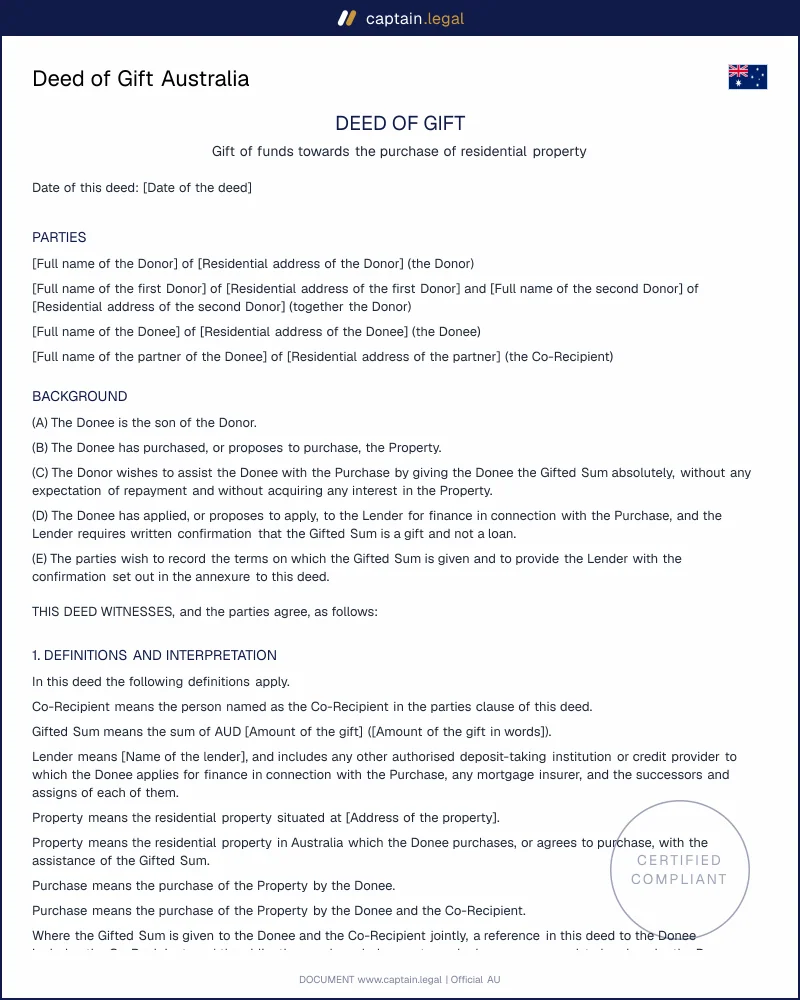
- The identification of the parties names every donor and every recipient in full, with residential addresses and the family relationship spelled out. Where two parents give jointly, the deed records whether they give as joint tenants of the funds or in defined shares, which becomes relevant if one of them later enters aged care and Services Australia apportions the deprived amount between them.
- The operative gift clause states the amount, the date of transfer, the account it came from and the account it went to. It declares the gift absolute and irrevocable, and it confirms the donor retains no legal or equitable interest in the funds or in any property acquired with them, which is the exact assurance a credit assessor is looking for.
- The non-repayment declaration goes further than the operative clause by negating any loan, any resulting trust, any charge over the property, and any expectation of repayment on sale, refinance or separation. Vague or conditional wording here is what turns a gift into a disputed debt.
- The donor solvency and capacity warranty confirms the donor can meet their own debts as they fall due after making the gift and understands the transaction. It exists because of the bankruptcy clawback provisions, and lenders increasingly ask for it where the donor is self-employed.
- The lender schedule reproduces the gift letter in the form banks and mortgage insurers accept, addressed to the credit provider, ready to sign and date separately from the deed itself.
- The execution block adapts to the state you select, with the correct attestation wording, the independent witness requirement, and a note on whether electronic signing is available in that jurisdiction.
State and territory considerations
New South Wales applies section 38 of the Conveyancing Act 1919 to the deed itself, and money is not dutiable property under section 11 of the Duties Act 1997, so a straight cash gift attracts no transfer duty. The position changes the moment the parent goes onto the title, because duty is then assessed on the market value of the interest acquired under section 21, and adding a non-qualifying adult can reduce or remove First Home Buyers Assistance. New South Wales also permits deeds to be created, signed and witnessed electronically under the Electronic Transactions Act 2000.
Victoria validates deeds through section 73A of the Property Law Act 1958 and allows electronic execution under the Electronic Transactions (Victoria) Act 2000. Under the Duties Act 2000, the exemption for transfers between spouses and domestic partners of a principal place of residence does not extend to parent and adult child. Where the recipient is not an Australian citizen or permanent resident, foreign purchaser additional duty applies to the purchase itself regardless of who funded the deposit.
Queensland now operates under the Property Law Act 2023. Beyond the shortened limitation period, the natural love and affection exemption in section 151 of the Duties Act 2001 is narrower than its reputation suggests: it covers transfers between spouses of a principal residence, not gifts from a parent to an adult child. A Queensland recipient claiming the first home concession should confirm eligibility before anyone is added to the contract.
Western Australia remains the most formal jurisdiction for execution. Section 9 of the Property Law Act 1969 requires signature and independent attestation, and practitioners should not assume the electronic deed provisions available in the eastern states apply here. Duty is governed by the Duties Act 2008, with the first home owner rate assessed on the buyer's circumstances rather than the source of the deposit.
South Australia relies on section 41 of the Law of Property Act 1936 for execution formalities. The state has removed duty for eligible first home buyers purchasing new homes or vacant land, which makes the composition of the title particularly sensitive: a parent joining as a co-owner to protect the gifted funds can cost the household the entire concession.
How to fill out your deed of gift and gift letter
You begin by selecting the state or territory where the donor will sign, and the form adjusts the execution block, the attestation wording and the guidance on electronic signing to match that jurisdiction. From there you enter the donor and recipient details, the amount, the date the funds were or will be transferred, and the account details on both sides so the paper trail matches the bank statements the lender will request. If the gift is being made by two parents, the form asks whether they give jointly or in shares, and it carries that answer through the recitals and the execution clauses.
The next stage builds the lender schedule. You nominate the credit provider, the property address if a contract has been signed, and whether the lender has asked for the confirmation in statutory declaration form, which adds the correct jurat and authorised witness wording. The final screen sets out signing instructions: who may witness, who must not, and the order in which the deed and the letter should be dated. You download the finished pack in editable Word and in print-ready PDF, so the deed can be adjusted if the settlement date moves and the letter can be reissued without redrafting the whole document.
Common mistakes to avoid
The most damaging mistake is telling two different stories. Parents sign a gift letter for the bank saying the funds are non-repayable, then separately tell the family the money is to be paid back when the house is sold. If the relationship later breaks down, both documents surface, and the court is asked to work out which one reflects the truth. Family courts already begin from the position that money advanced by a parent is a gift unless there is genuine evidence of an obligation to repay, a principle applied consistently since Kessey & Kessey, so an inconsistent paper trail almost always resolves against the donor. If you actually want the money back, use a loan agreement with a registered security interest, not a gift letter with a private understanding attached.
Execution errors run a close second. The witness must not be a party, and using the recipient or the recipient's spouse invites a challenge to the whole instrument. Backdating the deed to match a transfer that happened weeks earlier is worse, because the bank statements will not line up. Donors on a pension routinely transfer a full deposit without checking the gifting free area first, then discover the excess sits on their assets test for five years. Once the funds have left the account, that assessment cannot be reversed by tearing up the deed. And money moved out of a family company rather than a personal account can be recharacterised as a deemed dividend, producing a tax bill nobody budgeted for.
Frequently Asked Questions
11 verified reviews · 50 000+ downloads
- Immediate access to the document
- PDF + Word download
- Compliant with 2026 legislation
- Reviewed by lawyers
You might also like