Personal

Revocation of Power of Attorney | State POA Act Compliant

Revoke an enduring POA under the Powers of Attorney Acts (NSW, Vic, Qld) or WA law. Correct witnessing, notice to the attorney and registry lodgement.
4.8/5— 17 reviews50 000+ downloadsInstant download
Share

A revocation of power of attorney is the formal instrument an Australian principal signs to cancel the authority held by an attorney, whether it comes from a general power or an enduring power made under state or territory legislation. It suits any adult who still has decision-making capacity and wants to remove an attorney, replace one, or close an appointment that no longer fits their life. Our template pairs the instrument with a written notice to the attorney and separate notices for banks, super funds and the land titles office. Signing is only half the job. Until the people relying on the old document know it has been cancelled, the attorney can often keep acting.

Compliant

2026 Legislation

50,000+ clients

trust us

Affordable

From $4.90 / doc

Secure payment

Instant download

Revocation of Power of Attorney | State POA Act Compliant

Secure payment

Fill in the template

What is a revocation of power of attorney?

A power of attorney is a form of agency: the principal authorises another person to deal with money, property and legal affairs on their behalf. Revoking it ends that agency, in whole or in part. A general power of attorney lapses automatically if the principal loses capacity, and at common law it can be withdrawn by clear written notice. An enduring power of attorney is built to survive incapacity, so parliaments have attached formal requirements to its revocation that largely mirror the rules for making it. Whether you are cancelling an enduring power of attorney drafted to your state's legislation or a general power of attorney granting temporary financial authority, the instrument you sign has to match the document you are ending.

Revocation is not the same as resignation, which is the attorney's own decision to step down, or a tribunal order removing an attorney once the principal can no longer act personally. Executing a fresh enduring power does not always cancel the earlier one either, because in several jurisdictions the two documents can coexist. And revoking a financial power leaves your appointment of enduring guardian for health and lifestyle decisions untouched. That appointment needs its own revocation.

When do you need to revoke a power of attorney?

The most frequent trigger is relationship breakdown. Many couples appoint each other as attorneys and then separate without touching the document. While property and parenting arrangements are being settled through a separation agreement under the Family Law Act 1975, a former partner may still hold full authority over your bank accounts.

Loss of trust is the second big category. Unexplained withdrawals, a sibling who refuses to show statements, an attorney treating your savings as an early inheritance: financial elder abuse often begins with a validly appointed attorney, and revocation is the fastest lawful response while you still have capacity. Practical changes matter too. An attorney who has moved overseas or developed health problems of their own is a poor safety net.

Estate plan reviews produce the rest. A new will, a second marriage or a switch to attorneys acting jointly and severally all call for a clean slate. Two edge cases catch people out. A general power signed for a single transaction, such as a property settlement handled while you were overseas, stays alive if it has no end date. And an attorney who is also your Centrelink nominee holds a separate authority that must be cancelled with Services Australia directly.

Key clauses included in our template

  • The identification of the principal and the original instrument records your details together with the date, type and any registered dealing number of the power being revoked. Registries match revocations to the document on file, and a mismatch in dates or names is the usual reason a lodgement gets requisitioned.
  • The scope of revocation lets you cancel the entire power or only the appointment of a named attorney or alternative attorney. Partial revocation helps where one of two attorneys has fallen out of favour but the other is doing a good job.
  • The execution and witness certificate follows the formalities of your jurisdiction, including the two-witness rule and certification wording required in Victoria. The witness confirms that you signed freely and appeared to understand the document.
  • The effective date clause states when the revocation operates and confirms that it does not ratify acts done by the attorney beforehand. That wording matters if you later challenge a transaction.
  • The notice to the attorney tells them their authority has ended, directs them to stop acting and requires the return of the original and every certified copy. It also asks for an account of dealings made under the power.
  • The third-party notices go to banks, superannuation funds, share registries, property managers and the land titles office. If your attorney signed a residential tenancy agreement built on the prescribed standard terms for an investment property, the managing agent needs one too.

State-specific considerations

New South Wales does not require the revocation to be registered for it to take effect between you and your attorney. If the power was registered with NSW Land Registry Services, the register keeps showing a live authority until a revocation is recorded, and a purchaser or mortgagee searching the General Register of Deeds will generally proceed on what they see. Serve written notice on the attorney and keep proof of delivery, because s 47 turns on what the attorney knew. The Civil and Administrative Tribunal and the Supreme Court can both review an enduring power, and an attorney whose appointment has been purportedly revoked has standing to apply.

Victoria is the most prescriptive jurisdiction. Under ss 44 to 49 of the Powers of Attorney Act 2014 (Vic), revocation of an enduring power must use the prescribed instrument and be witnessed by two adults who sign in the presence of the principal and each other. At least one witness must be authorised to witness affidavits or be a registered medical practitioner, and both complete the certification. Section 50 then deals with notifying the attorney. Remote witnessing by audio visual link is available, provided everyone is physically in Victoria.

Queensland requires the revocation to be made in the approved form, and s 47 of the Powers of Attorney Act 1998 (Qld) sets the capacity threshold. If the enduring power was registered with the Titles Registry, the principal must also deregister it by lodging the revocation. Informing the attorneys is a statutory duty in Queensland, not a courtesy, so the notice in our pack is essential there. The Act also treats marriage, divorce and the end of a civil partnership as revocation events in defined circumstances.

Western Australia takes a different route. Part 9 of the Guardianship and Administration Act 1990 (WA) says little about revocation by the donor, so the common law fills the gap and a donor with capacity can revoke at any time. The Office of the Public Advocate still recommends written notice to the attorney and every relevant organisation. Where the power was lodged with Landgate, the revocation must be in writing and registered under s 143 of the Transfer of Land Act 1893.

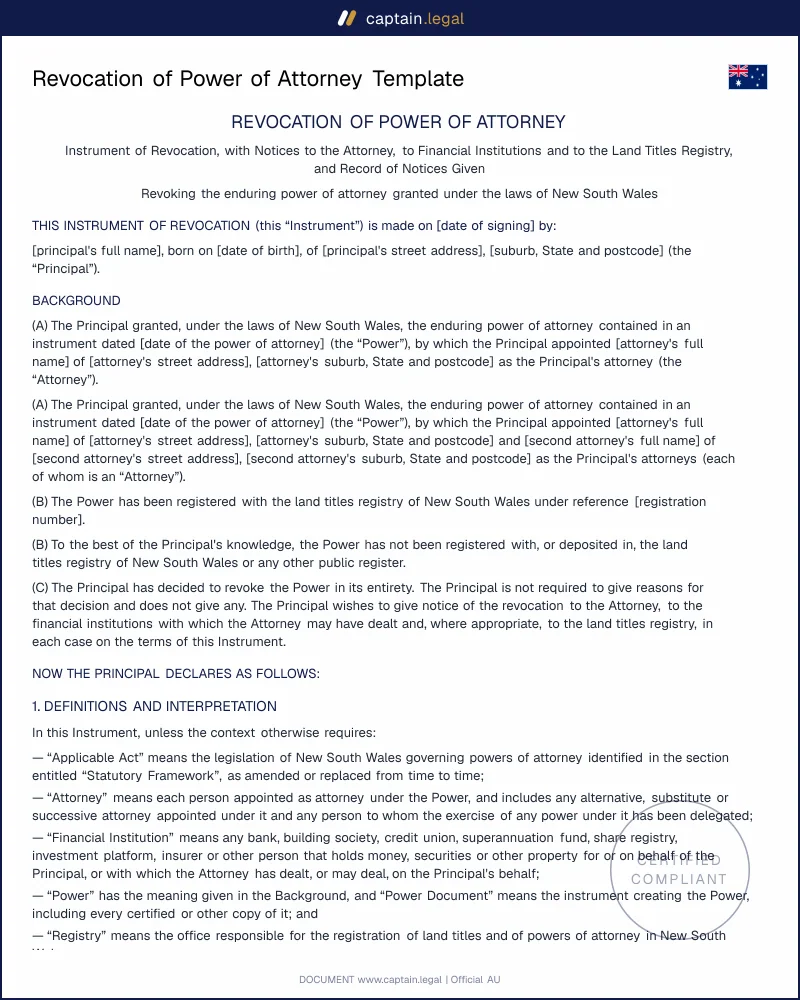
How to fill out this revocation of power of attorney

You start by choosing the state or territory where the original power was made, which is not always where you live now. The form then loads the matching statutory references, execution block and witness certificate. Next, you enter the details of the power being cancelled: its date, whether it is general or enduring, and the registered dealing number if it was lodged with a land titles office.

From there, you decide whether to revoke the whole instrument or only the appointment of a particular attorney. The questionnaire asks for each attorney's name and postal address so the notices reach the right people. You then add the banks, super funds, share registries and property managers holding a copy of the power, and the pack produces a tailored notice for each.

The final step is execution. The document tells you who may witness your signature in your jurisdiction and how many witnesses you need. Sign the revocation first, then serve the notices, and keep dated proof of every delivery. If the power was registered, lodge the revocation with the land titles office promptly, and consider having a replacement enduring power ready to sign at the same appointment.

Common mistakes to avoid

The error we see most often is treating a conversation as a revocation. Telling your attorney at a family lunch that you "don't need them anymore" satisfies no state's formal requirements for an enduring power, and it leaves no evidence. Close behind is the principal who signs a proper instrument and files it in a drawer. The bank never hears about it, the attorney keeps a certified copy, and months later a withdrawal goes through that the law may well protect. Retrieve the original and every certified copy you can trace, because an attorney holding paper looks authorised to anyone who does not check.

Registration gaps cause the next set of problems. A power lodged with NSW Land Registry Services, Titles Queensland or Landgate stays on the record until a revocation is lodged, and conveyancers search the record, not your filing cabinet. Using the wrong form is another trap, particularly in Victoria where the instrument is prescribed. Timing is the quiet risk: a revocation signed when capacity is already doubtful invites a tribunal challenge, and a contemporaneous medical opinion is cheap insurance. Last, many people revoke without replacing. If you later lose capacity with no enduring power in place, your family must apply to a tribunal for an administrator or financial manager, a slower and more intrusive process than the appointment you cancelled.

Key takeaways

STATE LAW

Match the document you are cancelling

Australia has no single powers of attorney statute. The revocation must follow the law that governed the original appointment, such as the Powers of Attorney Act 2003 (NSW), Powers of Attorney Act 2014 (Vic), Powers of Attorney Act 1998 (Qld) or WA guardianship legislation. For an enduring power, the principal needs decision-making capacity when signing.

NOTICE

Signing alone does not stop reliance

The attorney, banks, super funds and anyone holding the old authority need written notice. Until they know it has been revoked, an attorney may keep acting and third parties dealing in good faith can be protected. NSW s 47 is a clear example: acts done without notice of revocation may still stand.

REGISTRATION

Land dealings need the registry updated

If the power was registered or used for property, lodge the revocation with the relevant land titles registry. In NSW, s 52 of the Powers of Attorney Act 2003 and s 163 of the Conveyancing Act 1919 make registration central to land dealings. The same practical step applies with bodies such as Titles Queensland or Landgate.

Frequently Asked Questions

Yes, provided it is executed according to the law of the jurisdiction where the original power was made. The template applies the formalities of each state and territory, including the prescribed instrument and two-witness certificate in Victoria and the approved form in Queensland. You must also have the required capacity when you sign. A properly witnessed revocation ends the attorney's authority between you and the attorney, and serving the notices is what makes it effective against banks and registries.

The revocation operates once validly signed, but protection for people dealing with the attorney continues until they have notice. The attorney is covered until they receive your written notice, a bank until it processes the letter, and a purchaser of land until the land titles office records the revocation. Serve the attorney the same day if you can, send third-party notices by tracked post, and lodge any registry revocation within days rather than weeks.

You should in every state, and both the Victorian and Queensland Acts deal with notification expressly. Notice matters because the statutes protect attorneys who act without knowing their authority has ended. If you cannot prove the attorney was told, transactions made after you signed may stand. Our notice also demands the return of the original document and certified copies, and asks the attorney to account for dealings carried out under the power.

No. Only the principal can revoke a power of attorney, and only while they have the capacity their state's legislation requires. If the principal has lost capacity and relatives are worried about the attorney's conduct, the right path is an application to the relevant tribunal, such as NCAT in New South Wales, VCAT in Victoria, QCAT in Queensland or the State Administrative Tribunal in Western Australia. The tribunal can review the power, remove the attorney and appoint an administrator.

Yes, in most Australian jurisdictions, and our template supports it. Victoria's s 44 expressly allows a principal to revoke the appointment of a single attorney or alternative attorney without cancelling the whole enduring power. Check how your remaining attorneys were appointed first. If they were appointed to act jointly, removing one can leave the others unable to act alone, and a fresh enduring power is often the better option in that situation.

You receive the revocation instrument and notice pack in editable Word format and as a print-ready PDF. Word lets you adjust recipient details or add further third-party notices, while the PDF is the cleaner option for signing in front of your witnesses and lodging with a land titles office. If your estate plan needs more than one document, the complete catalogue of Australian legal documents covers replacement powers, wills and advance care directives drafted for each state.

4.8/5

17 verified reviews · 50 000+ downloads

Revocation of Power of Attorney | State POA Act Compliant
  • Immediate access to the document
  • PDF + Word download
  • Compliant with 2026 legislation
  • Reviewed by lawyers
Fill in the template
Secure payment
Updated on September 15, 2026

You might also like

Appointment of Enduring Guardian
Statutory Declaration Template