Employment

Deed of Release & Settlement | s.595 Fair Work Act

Deed of release drafted to the Fair Work Act 2009: s.368 conciliation outcomes, s.82-130 ETP, workers comp carve-out and Victorian NDA rules. Word & PDF.
4.5/5— 16 reviews50 000+ downloadsInstant download
Share

A deed of release is the document Australian employers and employees sign to close out an employment dispute for good: the employer pays an agreed sum, and the employee gives up the claims the deed describes. Our template is drafted for matters resolved at Fair Work Commission conciliation, including unfair dismissal applications and general protections disputes, as well as disputes settled before anyone files. It suits HR managers, business owners and employees once the conciliator suggests putting the agreement in writing. It covers the settlement payment and its tax treatment, the release, confidentiality, non-disparagement, an agreed reference and the withdrawal of the Commission application.

Compliant

2026 Legislation

50,000+ clients

trust us

Affordable

From $4.90 / doc

Secure payment

Instant download

Deed of Release & Settlement | s.595 Fair Work Act

Secure payment

Fill in the template

What is a deed of release and settlement?

A deed differs from an ordinary contract in one way that matters here: it binds the parties without consideration. A properly executed deed of release resists the later argument that the payment only covered entitlements already owed and, in most jurisdictions, carries a longer limitation period than a simple contract (twelve years for an action on a deed under s.16 of the Limitation Act 1969 (NSW)). Neither side concedes it was wrong, and a no admission of liability clause says so.

People often confuse the deed with the terms of settlement the Commission hands out at the end of a conference. Terms of settlement are short, signed on the day and usually adequate for a modest unfair dismissal matter. A deed of release goes further. It defines the released claims across every forum, deals with tax withholding and superannuation, carves out what the law does not allow the parties to release, and gives the employer a complete defence if the employee starts fresh proceedings. Where a general protections claim is on foot, civil penalty exposure and claims against individual managers make the fuller document the sensible choice.

When do you need this document?

The most common trigger is a conciliation conference that ends in agreement. The conciliator confirms the headline terms, the parties sign short terms on the day, and the employer prepares the full deed of release within the week. The second scenario arises before anything is filed. An employee raises a bullying or discrimination complaint, or disputes the reasons in a termination letter drafted to the s.117 notice rules, and the employer offers a payment for a release rather than waiting for a Form F8 to arrive. Negotiated senior exits belong here too, often with an agreed resignation replacing a dismissal.

A deed also resolves disputes where employment continues. An employee who alleges adverse action after a flexible work request, and stays in the role, can settle with a release limited to past conduct. Constructive dismissal claims after a restructure are another common source.

Two edge cases deserve care. Workers engaged under an independent contractor agreement that turns on s.15AA sometimes claim they were really employees, and their release must cover sham contracting allegations and unpaid superannuation. Claims involving workplace sexual harassment follow their own rules, particularly in Victoria, where a standard confidentiality clause may be unenforceable against the complainant.

Key clauses included in our template

  • The recitals identify the employment, the termination date (or confirm that employment continues), the Commission matter number and the claims in dispute. Courts read a release in light of its recitals, so vague background narrows its reach.
  • The settlement sum clause states the gross amount, the portion treated as an employment termination payment, PAYG withholding and a payment date fixed by reference to receipt of the signed deed. It also says whether the amount includes superannuation, the point most often argued about afterwards.
  • The release and discharge covers claims under the Fair Work Act 2009, federal and state anti-discrimination laws, contract and tort, with express carve-outs for workers compensation, accrued superannuation and rights under the deed itself. A release that purports to waive future NES entitlements is void to that extent, and a severance clause keeps the rest alive.
  • The withdrawal and bar clause obliges the employee to discontinue the application within a set period and prevents fresh proceedings on the same facts.
  • The confidentiality and non-disparagement clauses protect the settlement terms while preserving disclosures to lawyers, accountants, immediate family and regulators. A mutual non-disparagement obligation names the managers it binds.
  • The agreed reference fixes the wording both parties will use with future employers. If the settlement also changes continuing employment, record those changes in an employment contract variation letter so the release and the new terms stay in separate instruments. Restraints stop at confidentiality and non-solicitation, given the federal reform targeting non-compete clauses below the high income threshold.

State and territory considerations

New South Wales keeps a formal witnessing rule. Section 38 of the Conveyancing Act 1919 (NSW) requires an individual's deed to be attested by a witness who is not a party, although electronic execution and remote witnessing are permitted. Section 151A of the Workers Compensation Act 1987 (NSW) cuts off further compensation where a worker recovers damages from the employer for the same injury. In Gardiner v Laing O'Rourke Australia Construction Pty Ltd [2020] NSWCA 151, the Court of Appeal gave weight to the parties' intention, expressed in a recital preserving workers compensation rights. Our NSW version includes that recital by default.

Victoria has the most significant recent change. The Restricting Non-disclosure Agreements (Sexual Harassment at Work) Act 2025 (Vic) applies to NDAs entered into on or after 1 July 2026 and makes confidentiality about workplace sexual harassment enforceable against the complainant only where the complainant requests it. The complainant must receive a mandatory information statement and a 21-day review period, which they may shorten or waive. Disclosures to regulators, police and lawyers stay permitted, and the complainant can end the NDA after 12 months on seven days' notice.

Queensland modernised its deed rules when the Property Law Act 2023 (Qld) commenced on 1 August 2025. Under s.51, an individual may sign a deed with or without a witness, and s.50 confirms that deeds may be electronic. Actions on deeds made since then have a six-year limitation period. State and local government employees fall under the Industrial Relations Act 2016 (Qld), so their deeds refer to the Queensland Industrial Relations Commission.

Western Australia is where national templates most often misfire. Sole traders, partnerships and trusts that are not trading corporations sit in the state system under the Industrial Relations Act 1979 (WA), and unfair dismissal claims go to the Western Australian Industrial Relations Commission within 28 days. The Property Law Act 1969 (WA) still expects an individual's deed to be witnessed. Wet ink with an independent witness remains the safe course.

How to fill out this deed of release

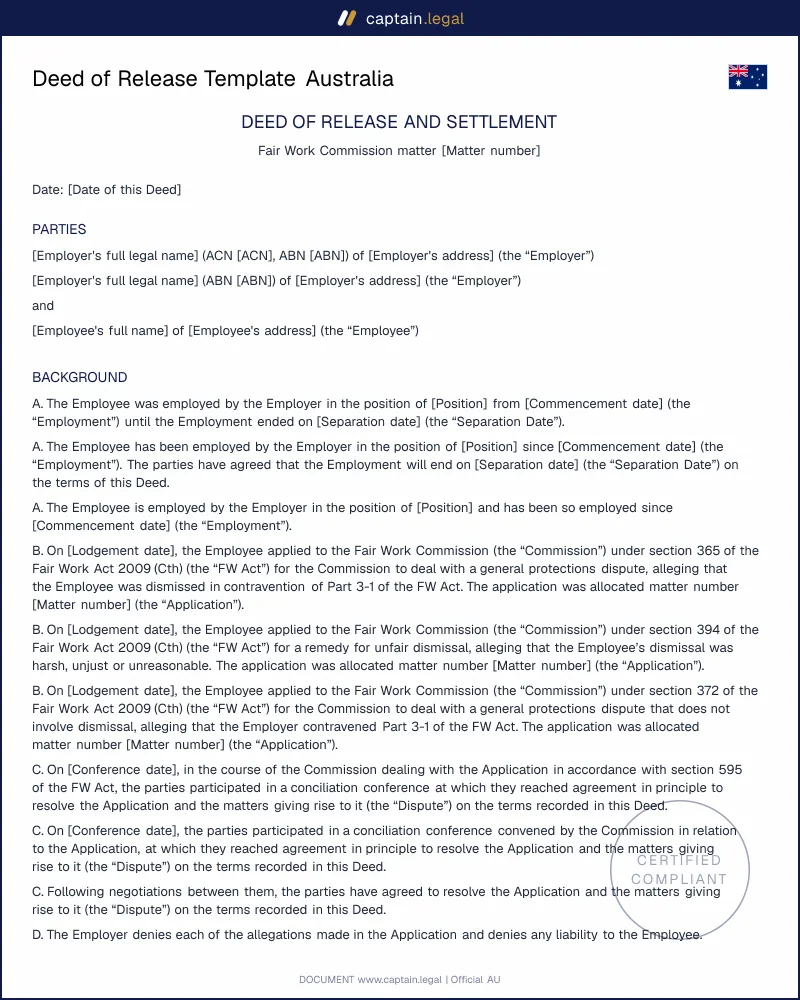
You start by selecting the forum: an unfair dismissal application, a general protections dismissal or non-dismissal dispute, a claim not yet filed, or a Western Australian state system matter. The questionnaire then asks where the employee usually works, which adjusts the execution blocks, the workers compensation carve-out and the confidentiality wording. Next come the parties, related entities and managers to be released, and any Commission matter number.

The settlement section asks for the gross amount, the split between the employment termination payment and other components, the superannuation treatment and the payment deadline. You then choose optional clauses such as mutual non-disparagement, an agreed reference and a resignation in place of dismissal. If the matter involves alleged sexual harassment and the employee works in Victoria, the form switches to the complainant request pathway and generates the information statement acknowledgement.

The finished deed downloads in Word and PDF. Send it with a written invitation to obtain independent legal advice and a reasonable period to consider it, then collect both executed counterparts before the payment clock starts.

Common mistakes to avoid

The most expensive error is paying first. Never transfer the settlement sum until you hold a deed signed by the employee, because a payment made on a handshake is hard to recover. The next is a release drafted too wide. Wording that sweeps workers compensation into "all claims of any kind" invites a court to strike it down under s.234 in NSW or its equivalent elsewhere. The opposite mistake, releasing only the employer entity, leaves managers exposed to accessorial liability under s.550.

Tax and confidentiality produce most of the remaining problems. Employers label the payment "ex gratia", skip PAYG withholding and hear from the ATO months later, or pay outside the 12-month window and lose the concessional rate. Clauses that forbid contact with the Fair Work Ombudsman are unenforceable to that extent. Pressure is the final trap: presenting a deed of release at 5pm with a next-morning deadline hands the employee an argument based on duress or unconscionable conduct. And where the dispute began with a rushed written warning and performance improvement plan, resist rewriting that history in the recitals.

Key takeaways

Fair Work

Conciliation drives the settlement timetable

The deed is built for Fair Work Commission outcomes under s.595 and s.368 of the Fair Work Act 2009. In general protections dismissal matters, the employee must apply within 21 days under s.366. If there is no settlement, a certificate issues and the employee has 14 days to go to court under s.371.

Release limits

Some claims cannot be signed away

A release can settle accrued employment claims in genuine dispute, but it cannot contract out of future National Employment Standards or modern award rights. Whistleblower protections under Part 9.4AAA of the Corporations Act 2001 survive confidentiality, and workers compensation schemes exclude contracting out. The deed should also cover officers and managers because s.550 accessorial liability can reach them.

Payment

Tax treatment depends on timing

A settlement linked to the end of employment is usually an employment termination payment under s.82-130 of the Income Tax Assessment Act 1997. To keep concessional tax treatment, payment must be made within 12 months of termination. The deed should also require withdrawal of the Commission application, often by Form F50 for certainty.

Frequently Asked Questions

Yes, provided it is properly executed and records the compromise of a genuine dispute. Courts routinely enforce deeds settling Fair Work Act claims, and the absence of consideration does not weaken them. The deed will not bind the employee to the extent it waives future NES entitlements, statutory workers compensation rights or protected whistleblower disclosures. The document must state that it is executed as a deed, companies sign under s.127 of the Corporations Act 2001, and individuals follow their state's witnessing rules.

No general statute fixes a signing period, but most deeds allow 7 to 14 days, longer where legal advice is being arranged. Victorian sexual harassment matters involving confidentiality are the exception, with a 21-day review period the complainant may shorten. Payment is usually due 7 to 14 days after the employer receives the signed deed. After a general protections certificate issues, the employee has only 14 days to file in court, and negotiations do not pause that clock.

Usually, yes. A payment made because employment ended is generally an employment termination payment under s.82-130 of the Income Tax Assessment Act 1997, with PAYG withheld at the rates for that category. Concessional treatment applies only if the payment is made within 12 months of termination. Compensation for personal injury can fall outside the ETP rules, but the label must reflect the real dispute, so confirm the split with an accountant before signing.

In most cases, yes. State schemes prohibit contracting out, so a deed cannot remove statutory rights to weekly payments or medical expenses. The real risk runs the other way: in New South Wales, s.151A of the Workers Compensation Act 1987 can end further compensation if the settlement amounts to damages for the same injury. Our template excludes workers compensation claims from the release and states that the settlement sum is not paid for any work injury.

Yes. Once the questionnaire is complete, the deed is generated as an editable Word file and a print-ready PDF. The Word version suits negotiation, since the other side's lawyer can mark up the draft with tracked changes, while the PDF is the one to circulate for signature. Both versions include execution blocks matching your state's witnessing rules and a counterparts clause. Related forms sit in the full catalogue of Australian legal documents.

No, and a clause that tries will not be enforced to that extent. Employees remain free to report suspected contraventions to the Fair Work Ombudsman, the ATO, ASIC, WorkSafe regulators or police, and disclosures protected under Part 9.4AAA of the Corporations Act 2001 cannot be restricted by contract. Our clause protects the amount and terms of the settlement and lists these permitted disclosures expressly. In Victorian sexual harassment matters, the complainant can also disclose the details of the harassment to permitted recipients.

4.5/5

16 verified reviews · 50 000+ downloads

Deed of Release & Settlement | s.595 Fair Work Act
  • Immediate access to the document
  • PDF + Word download
  • Compliant with 2026 legislation
  • Reviewed by lawyers
Fill in the template
Secure payment
Updated on September 16, 2026

You might also like

Fixed-Term Employment Contract AU
Employment Contract Australia