Employment

Restraint of Trade Deed | s.4 Restraints of Trade Act NSW

Deed drafted to s.4 Restraints of Trade Act 1976 (NSW) and common law: confidentiality, client non-dealing, single-tier or cascading restraint periods.
4.6/5— 14 reviews50 000+ downloadsInstant download
Share

A restraint of trade deed is a standalone instrument, signed as a deed, that limits what an employee can do once the job ends: approach clients, recruit colleagues, join a competitor or use confidential information. Employers use it for sales leads, account managers and senior engineers who hold relationships and pricing knowledge. Executed as a deed, it binds without fresh consideration, which matters when the restraint is signed after the start date. Our template combines post-employment restraints with a full confidentiality undertaking, drafts the restraint period for the Restraints of Trade Act 1976 (NSW) and for common law states, and isolates the terms affected by the federal non-compete reform.

Compliant

2026 Legislation

50,000+ clients

trust us

Affordable

From $4.90 / doc

Secure payment

Instant download

Restraint of Trade Deed | s.4 Restraints of Trade Act NSW

Secure payment

Fill in the template

What is a restraint of trade deed?

At common law, any term that restricts a person's freedom to work is a restraint of trade and is presumed void. It survives only if the employer proves the restraint is reasonably necessary to protect a legitimate interest, assessed at the date the parties entered into it (Lindner v Murdock's Garage (1950) 83 CLR 628). Courts recognise two such interests in employment: confidential information, such as pricing, margins and source code, and the customer connection an employee builds by dealing directly with clients. Shielding a business from ordinary competition is not one of them. A restraint of trade deed packages these protections in a separate document rather than burying them in clause 23 of a Fair Work compliant employment contract.

The deed format is a practical choice. A restraint introduced mid-employment, with no pay rise or promotion attached, is exposed to the argument that the employee received nothing in return; a deed needs no consideration, so that argument falls away. The limitation period is also longer: in New South Wales an action on a deed may be brought within 12 years under section 16 of the Limitation Act 1969 (NSW), against 6 years for a simple contract. A standalone confidentiality agreement protects information but does not restrict activity.

When do you need this document?

The classic trigger is hiring a salesperson or adviser who brings a book of business and will build another on your time. Signing the restraint of trade deed with the employment contract, before day one, gives the strongest position on reasonableness because the interests at stake can be described precisely. The second scenario is a mid-employment promotion into a key account or regional manager role, where the deed format earns its keep: the contract is already on foot, and a fresh promise without consideration would be fragile.

Exits generate their own demand. When a senior employee resigns or a role becomes redundant, employers often negotiate a separation payment in exchange for confirmed restraint and confidentiality obligations, documented alongside the termination letter and redundancy notice.

Two edge cases deserve attention. Employees who also hold equity usually give their restraints in a shareholders agreement for a Pty Ltd company, and the explanatory material for the draft Bill indicates that shareholder and sale of business arrangements sit outside the employee ban. Employees joining from a competitor may still be bound by a previous restraint, and you should review that document before they start, since inducing a breach creates its own exposure.

Key clauses included in our template

  • The recitals of legitimate interest describe the confidential information and client relationships the employee will access, as they stand at signing. This is the evidence a court looks for under the Lindner test, and a vague recital leaves the employer arguing from memory years later.
  • The confidentiality undertaking defines Confidential Information by category, carves out public domain material and disclosures compelled by law, and requires deletion of company data from personal devices. For genuine trade secrets the obligation has no end date.
  • The client non-solicitation and non-dealing clause is confined to clients the employee dealt with in the final 12 months of employment. Non-dealing is the stronger protection, because it catches the client who approaches the former employee unprompted.
  • The employee non-solicitation clause is a separate, severable module. It remains enforceable today if reasonable, and the template flags it for removal from new deeds once the federal ban on co-worker non-solicitation commences.
  • The non-compete clause is optional and limited to a defined competing activity rather than a whole industry. The form offers it only above the section 333 high income threshold, in line with the reform.
  • The restraint period and area come in two versions: a single justified period for NSW relying on section 4(1), and a limited cascading structure for other states with no more than three periods and three areas.

Regional considerations

New South Wales is the only state with a restraint statute, and it changes the drafting logic. Because section 4(1) lets the Supreme Court read a restraint down, one period and area that you can justify generally beats a cascading ladder. Cascading clauses remain valid in NSW, but they add little and may invite a section 4(3) argument if the outer tiers are plainly excessive. An individual executing a deed needs an attesting witness who is not a party under section 38 of the Conveyancing Act 1919 (NSW).

Victoria has no equivalent statute, so the blue pencil rule applies strictly: a court can delete words but cannot substitute a shorter period. That is why Victorian practitioners rely on cascading clauses. Victoria referred its industrial relations powers to the Commonwealth, so almost every private employer in the state is a national system employer and will be caught by the federal reform.

Queensland also applies the common law without a restraint statute. Cascading clauses are upheld where the combinations are limited and each tier is rational. Queensland likewise referred its private sector industrial relations powers, so national system coverage is the norm. Businesses operating across the NSW and Queensland border should choose the governing law deliberately, since it decides whether a court can read the restraint down or only sever it.

Western Australia needs separate treatment. The state did not refer its private sector powers, and unincorporated employers such as sole traders, partnerships and trusts with individual trustees remain under the Industrial Relations Act 1979 (WA). The draft Bill applies only to national system employers, so these businesses would stay under common law restraint principles after the ban. Confirm the employing entity's legal form first, and check it against your other Australian employment templates so the contract and the deed name the same employer.

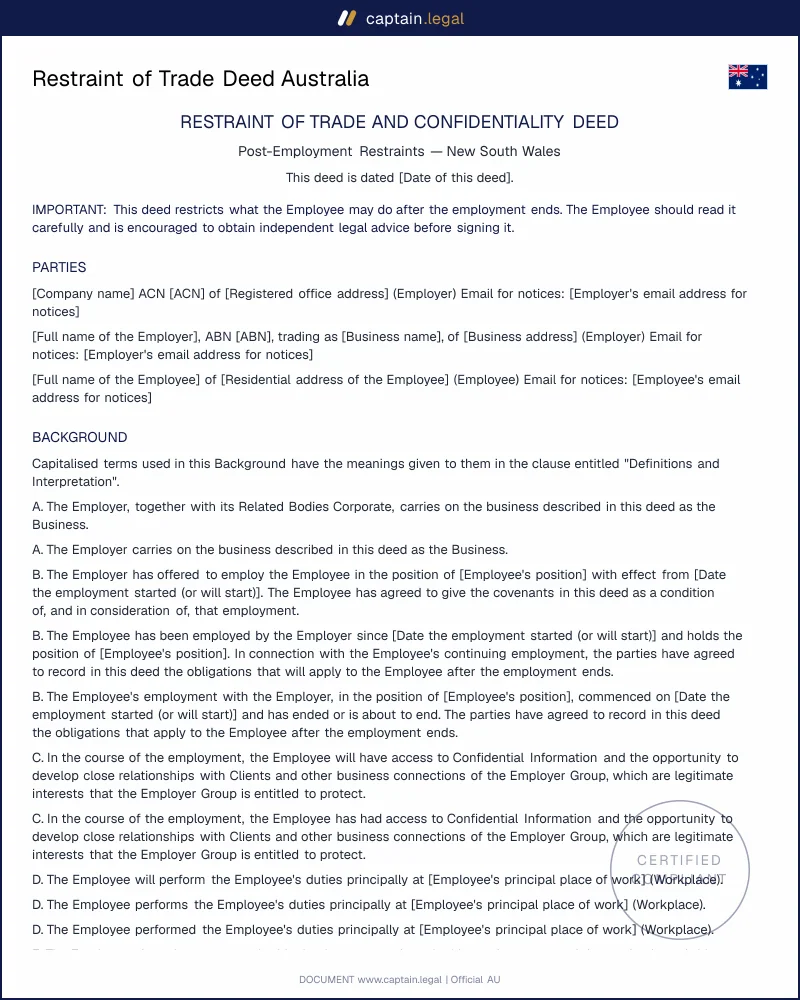
How to fill out this restraint of trade deed

You start by selecting the state where the employee works and the law that will govern the deed. Next, you enter the employee's role and whether their guaranteed earnings sit above the section 333 high income threshold, which decides whether the non-compete module appears. The step that matters most follows: describing the confidential information and client relationships in concrete terms. Name the client segments, systems and categories of commercial data, because these recitals are what a judge reads first.

From there you choose the restraint periods, the area and whether to include employee non-solicitation. The execution page adapts to the signatory, with a company block under section 127 of the Corporations Act and a witnessed block for the employee. Give the employee a genuine opportunity to obtain independent legal advice before signing, and record it in the acknowledgement clause.

Common mistakes to avoid

The most frequent error is copying a restraint written for a managing director into the restraint of trade deed of a junior coordinator. A 24 month, Australia-wide non-compete for someone with no client contact is exactly the manifest failure section 4(3) describes, and a Victorian court will simply strike it out. The second mistake is protecting "all clients of the group" when the employee handled a dozen accounts; courts protect the connection the employee actually formed.

Cascading clauses cause a quieter problem. Some templates stack five periods against six areas, producing thirty combinations, and Lloyd's Ships Holdings shows why that invites a finding of uncertainty. Employers also forget that reasonableness is fixed at signing, so a restraint given by a graduate does not grow with a later promotion; a new deed at each material change of role is the reliable fix. Finally, under the draft Bill, varying a pre-existing employment arrangement would end any banned non-compete or co-worker non-solicitation term, so check the restraint position before issuing an employment contract variation letter.

Key takeaways

Enforceability

Protect interests, not market share

A restraint starts from a tough position: at common law it is presumed void unless the employer can justify it. The protected interest must be real, such as confidential pricing, margins, source code or a direct client connection. Stopping an ex-employee from ordinary competition is not enough, even for a senior hire.

Deed format

Useful when signed after hiring

Using a deed matters where the restraint is introduced mid-employment without a pay rise, promotion or other fresh benefit. A deed does not need consideration, so that argument drops away. In New South Wales, proceedings on a deed may also be brought within 12 years under section 16 of the Limitation Act 1969 (NSW).

Drafting scope

NSW can read restraints down

Section 4 of the Restraints of Trade Act 1976 (NSW) lets the Supreme Court enforce a restraint to the extent it is not against public policy, even if the wording is not neatly severable. Outside NSW, courts generally strike out words rather than rewrite them, so cascading periods and areas need careful, restrained drafting.

Frequently Asked Questions

Yes, provided it is properly executed and each restraint is reasonable. As a deed, the document binds the employee without payment or other consideration. Enforceability still depends on whether the restraint goes no further than necessary to protect confidential information or client connection, judged at signing. In NSW, the Supreme Court can read down an excessive restraint under section 4(1) of the Restraints of Trade Act 1976; in other states, courts can only sever. Confidentiality obligations are the most reliably enforced part, because they also rest on equity and section 183 of the Corporations Act 2001.

Yes. Once the form is complete, you receive the restraint of trade deed as an editable Word document and a print-ready PDF. The Word file lets your adviser adjust the recitals or client definitions before execution, and the PDF is the version to circulate for signature. For matching onboarding or exit paperwork, the catalogue of Australian legal templates offers related employment and business documents in the same formats.

Periods of 3 to 6 months are common for client-facing staff, and 12 months is usually reserved for senior executives with strategic knowledge; anything longer is hard to defend for an employee. The best moment to sign is before employment starts or at a promotion. Allow several business days for the employee to review the deed and seek independent advice. A deed signed ten minutes after it is presented weakens the employer at any injunction hearing.

Not immediately. The exposure draft Bill would operate prospectively: arrangements entered into before commencement would continue to apply until varied, and the ban on new non-compete terms would take effect six months after the Act commences. The Bill must still pass Parliament and may change after consultation. Our template keeps the non-compete and employee non-solicitation modules separate from the confidentiality and client restraints, so you can remove the affected clauses from future deeds without redrafting the rest.

It works, but it is rarely the best tool there. Because section 4(1) lets the Supreme Court read a restraint down to a reasonable extent, a single well justified period and area achieves the same result with less risk. A ladder whose outer tiers are plainly excessive may support a section 4(3) argument of manifest failure to attempt a reasonable restraint. The draft federal Bill would go further and prohibit cascading drafting in employment restraints, another reason to favour one tier in a new restraint of trade deed.

The deed is drafted for employees. Contractor restraints face the same common law reasonableness test, but the draft Bill targets employment arrangements, so they would sit outside the proposed ban. A restraint that assumes an ongoing, controlled relationship can also support a finding that the contractor is really an employee under the Fair Work Act 2009. For a genuine contractor, place confidentiality and non-solicitation terms inside the services agreement rather than in a separate employment style deed.

4.6/5

14 verified reviews · 50 000+ downloads

Restraint of Trade Deed | s.4 Restraints of Trade Act NSW
  • Immediate access to the document
  • PDF + Word download
  • Compliant with 2026 legislation
  • Reviewed by lawyers
Fill in the template
Secure payment
Updated on September 16, 2026

You might also like

Employee Warning Letter & PIP Template
Casual Employment Contract Australia