Employment

Workplace Policy Pack | s.47C SDA & WHS Psychosocial Rules

Policy pack built to the s.47C Sex Discrimination Act positive duty, Fair Work Act and WHS regs 55A to 55D. NSW, VIC, QLD and WA versions.
4.5/5— 13 reviews50 000+ downloadsInstant download
Share

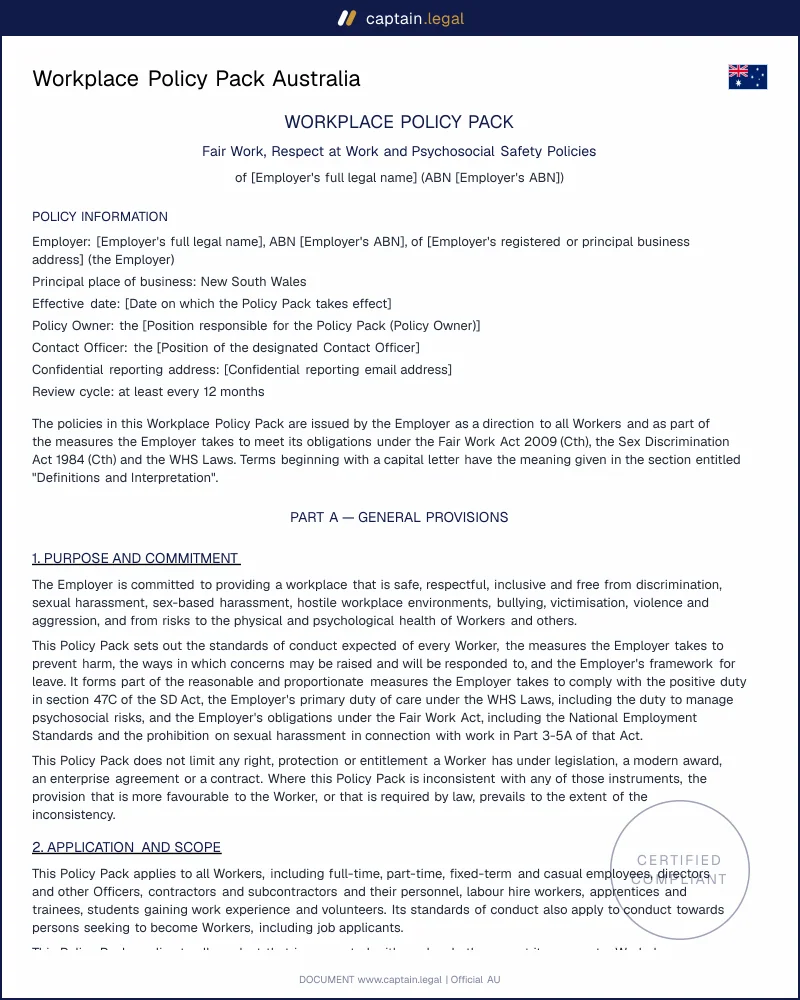
A workplace policy pack is the set of written rules that tells your people how the business expects them to behave, how concerns are raised and what happens when standards slip. This Australian workplace policies template is built for employers of every size who need to show a regulator, the Fair Work Commission or a court that they took reasonable and proportionate measures to prevent sexual harassment, bullying and psychosocial harm. The pack covers Respect at Work obligations, bullying, social media, drugs and alcohol, and the leave entitlements set by the National Employment Standards, each policy cross-referenced to the Fair Work Act 2009 (Cth), the Sex Discrimination Act 1984 (Cth) and the WHS psychosocial regulations.

Compliant

2026 Legislation

50,000+ clients

trust us

Affordable

From $4.90 / doc

Secure payment

Instant download

Workplace Policy Pack | s.47C SDA & WHS Psychosocial Rules

Secure payment

Fill in the template

What is a workplace policy pack?

In Australian practice, a workplace policy pack is a coordinated suite of non-contractual policies that sit alongside each employee's contract and any modern award or enterprise agreement. The contract fixes the core bargain: pay, hours, duties and notice. The policies govern conduct and process, and they can be updated as the law moves without renegotiating every full-time and part-time employment contract on the books. The employer's power to require compliance comes from the employee's implied duty to follow lawful and reasonable directions, so the drafting has to stay clearly on the policy side of the line. In Goldman Sachs JBWere Services Pty Ltd v Nikolich [2007] FCAFC 120, the Full Federal Court treated commitments in a policy document as contractual promises and held the employer to them in damages.

A workplace policy pack is also different from a single harassment policy downloaded in isolation. The Australian Human Rights Commission expects leadership commitment, a reporting pathway, training and a record of how complaints were handled, and WHS inspectors apply the same logic to psychosocial hazards such as bullying, poor workload design and exposure to aggression. One set of definitions, one complaints procedure and one set of disciplinary consequences is far easier to defend than six documents written by six people over ten years, each naming a different person to report to.

When do you need a workplace policy pack?

The most common trigger is headcount growth. A business hiring its fifth or sixth employee usually finds that the informal "come and talk to me" approach stops working, especially when the complaint concerns the owner's longest-serving manager. The second trigger is a complaint that has already landed. The employer's response is then judged against whatever process existed at the time, and "we didn't have one" is a hard answer to give the Commission or an AHRC investigator.

Audits and tenders account for a steady share of demand, since government panels, head contractors and corporate clients routinely ask suppliers for their workplace policies on bullying, drugs and alcohol and WHS before signing. Hybrid work is another driver. Once staff split the week between home and office, the right to disconnect under section 333M of the Fair Work Act and personal social media use need written answers, and your workplace policies should mirror any flexible work arrangement agreement under section 65 already in place.

One edge case worth flagging is the safety-critical site. Transport, mining, construction and warehousing operators who introduce drug and alcohol testing without a written policy, or without consulting workers first, regularly see the regime and the dismissals flowing from it challenged before the Fair Work Commission.

Key policies and clauses included in our workplace policy pack

  • The Respect at Work prevention and response policy defines sexual harassment, sex-based harassment and a hostile workplace environment in the language of the Sex Discrimination Act. It sets out the leadership commitments, training cycle and risk review the AHRC standards expect, and gives workers a choice of reporting channels rather than a single line manager.
  • The bullying and harassment policy tracks the section 789FD definition and separates bullying from reasonable management action with practical examples. Repeated performance issues move into a written warning and performance improvement plan template so the disciplinary record stays consistent.
  • The complaints and investigation procedure covers informal resolution, formal investigation, interim measures such as changed rosters, confidentiality and protection from victimisation. It is written in the person-centred, trauma-informed style regulators now expect.
  • The social media policy deals with work accounts and personal posts that identify the employer, colleagues or clients, and explains when out-of-hours conduct has a sufficient connection to employment to justify discipline. Its treatment of personal information lines up with your customer-facing Privacy Act 1988 compliant privacy policy.
  • The drugs and alcohol policy sets fitness-for-work standards, disclosure of medication that may affect safety, testing triggers and methods, and the consequences of a non-negative result or a refusal to test. An employee assistance pathway keeps it from reading as purely punitive.
  • The leave policy explains how to apply for and evidence annual, personal/carer's, compassionate, community service, parental, long service and family and domestic violence leave, with the confidentiality rules that apply to the last of these.
  • The acknowledgement and non-contractual status clause records that each employee received the workplace policy pack and states that the policies do not form part of the contract and may be varied after consultation.

State and territory considerations

New South Wales employers work under the Work Health and Safety Regulation 2025 (NSW), which replaced the 2017 Regulation and carries the psychosocial duties in sections 55A to 55D. Unlike the model regulations, the NSW version requires psychosocial risks to be managed through the full hierarchy of controls. Any monitoring clause in the social media policy must also comply with the Workplace Surveillance Act 2005 (NSW), which requires written notice at least 14 days before computer, camera or tracking surveillance begins.

Victoria sits outside the harmonised WHS scheme. Employers owe duties under the Occupational Health and Safety Act 2004 (Vic) and, since 1 December 2025, the Occupational Health and Safety (Psychological Health) Regulations 2025 (Vic). Information, instruction and training cannot be the only or predominant control for a psychosocial risk unless changes to work design or systems are not reasonably practicable. Victorian employers also carry a separate positive duty to eliminate discrimination, sexual harassment and victimisation under section 15 of the Equal Opportunity Act 2010 (Vic).

Queensland added its own layer through the Work Health and Safety Regulation 2011 (Qld). From 1 March 2025, a PCBU that identifies a risk of sexual harassment or sex or gender-based harassment must prepare and implement a written prevention plan, and our Respect at Work policy is structured to feed into it. The broader positive duty in the Respect at Work and Other Matters Amendment Act 2024 (Qld) was scheduled for 1 July 2025, but its commencement has been deferred, leaving the federal duty and the WHS prevention plan as the working benchmarks.

Western Australia needs separate treatment in any workplace policy pack. Psychosocial obligations sit in regulations 55A to 55D of the Work Health and Safety (General) Regulations 2022 (WA), supported by WA's own Code of Practice: Psychosocial hazards in the workplace rather than the Safe Work Australia model code. More significantly, sole traders, partnerships and other unincorporated employers remain in the state system under the Industrial Relations Act 1979 (WA), so the stop bullying references and parts of the leave policy are adjusted for those businesses.

How to fill out this workplace policy pack

You start by choosing the state or territory where most of your employees work and confirming whether your business is a national system employer. That answer changes the WHS citations, the long service leave statute (the Long Service Leave Act 1955 (NSW) or the Long Service Leave Act 2018 (Vic), for example) and, in Western Australia, the industrial relations references throughout the workplace policy pack. The form then asks for workforce size and industry, because the AHRC expects measures proportionate to both, and it switches on the testing provisions of the drugs and alcohol policy only where the work is safety-sensitive.

The next screens deal with people and channels. You nominate a primary and alternate contact for complaints, record whether you use an external hotline or employee assistance provider, and select a testing method if testing applies. You then choose optional wording such as the right to disconnect provisions, and the pack recompiles with consistent defined terms across every policy. The finished documents download in Word and PDF. Before rollout, consult your workers and any health and safety representatives on the draft, because consultation is a statutory obligation and a policy imposed without it is much harder to enforce.

Common mistakes to avoid

The mistake we see most often with workplace policies is the policy nobody was trained on. An employer files a well-drafted bullying policy on the intranet, never runs a session, then relies on it after a complaint. Tribunals give that very little weight, and the AHRC guidelines treat training as a core standard. A close second is making workplace policies contractual by accident, through a contract clause stating the employee is "bound by all company policies as amended from time to time" or policy wording that promises specific outcomes. After Nikolich, that drafting can turn a procedural slip in an investigation into a breach of contract claim.

Drug and alcohol policies generate their own errors. Switching from urine to oral fluid testing, or adding random testing, without consulting under the enterprise agreement or WHS provisions is the classic one. Another is treating a positive result as automatic grounds for summary dismissal without considering prescribed medication, the level detected or the employee's role, which invites an unfair dismissal claim assessed under section 387. Finally, many leave policies still demand detailed proof before approving family and domestic violence leave. Any evidence requested must be reasonable and information about the leave must be kept confidential, so the policy has to limit who sees it and how it appears in payroll records.

Key takeaways

Positive duty

Prevention must be built in

Section 47C of the Sex Discrimination Act 1984 (Cth) requires employers and PCBUs to take reasonable and proportionate measures to eliminate sex discrimination, sexual harassment, hostile workplace conduct and victimisation as far as possible. Since 12 December 2023, the Australian Human Rights Commission can inquire, issue compliance notices and accept enforceable undertakings against that duty.

Policy status

Keep policies off the contract

The pack is designed to sit beside employment contracts, modern awards and enterprise agreements, not become part of them. That distinction matters because policies can be updated as the law changes, while contracts cannot. In Goldman Sachs JBWere Services Pty Ltd v Nikolich, policy wording was treated as contractual, exposing the employer to damages.

Defence evidence

Training turns paper into protection

A policy only helps if staff know it, managers apply it and complaint records exist. Fair Work Act 2009 (Cth) provisions cover stop bullying orders and workplace sexual harassment civil remedies, while WHS psychosocial rules target hazards such as bullying and aggression. Under section 106 of the Sex Discrimination Act, an employer needs proof it took all reasonable steps to avoid vicarious liability.

Frequently Asked Questions

Policies bind employees through the obligation to follow lawful and reasonable directions, not as contract terms. An employee who breaches a properly communicated policy can be disciplined, and serious or repeated breaches can amount to a valid reason for dismissal under section 387 of the Fair Work Act. Our pack is drafted to stay non-contractual, so you can update it without each employee's agreement, subject to consultation. The policies still need to sit comfortably with written employment terms, which is why they cross-refer to our Australian employment contract and letter templates rather than repeating them.

Yes. The positive duty under section 47C applies to every employer regardless of size, including a sole trader with one employee. What changes with size is the level of measures considered reasonable and proportionate. A cafe with eight staff will not be expected to run the governance framework of a listed company, but it still needs a written policy, a clear way to report conduct, basic training and a record showing complaints were handled promptly and without victimisation.

Both. The workplace policy pack downloads as an editable Word document, so your HR adviser or lawyer can add company details, approval dates and site-specific rules, together with a PDF for distribution and signed acknowledgements. Keeping the Word master makes it easy to reissue a single policy after a legislative change without recirculating the whole pack. If you also need contracts, deeds or corporate documents, the full catalogue of Australian legal document templates follows the same drafting conventions.

No single statutory notice period applies to policies generally, but three rules shape the timeline. WHS and OHS laws require genuine consultation with workers and health and safety representatives before introducing measures that affect their health and safety. Many modern awards and enterprise agreements add their own consultation terms for major workplace change. In New South Wales, a policy authorising computer or camera surveillance must be notified in writing at least 14 days before monitoring starts under the Workplace Surveillance Act 2005 (NSW).

Neither the Fair Work Act nor the Sex Discrimination Act sets a fixed internal deadline, but delay is itself a risk factor. If the worker applies for a stop bullying order, section 789FE requires the Fair Work Commission to start dealing with the application within 14 days, so your internal process should be well underway by then. Good practice is to acknowledge the complaint within a few working days and put interim safety measures in place immediately where needed.

A direction to undergo testing can be lawful and reasonable where it is set out in a policy, linked to genuine safety risks and applied consistently, and refusing a valid direction to test can itself be misconduct. The Fair Work Commission looks closely at the testing method, cut-off levels and whether workers were consulted before the regime began. For roles with no real safety component, random testing is much harder to justify, and a for-cause approach based on observed impairment is usually the safer design.

4.5/5

13 verified reviews · 50 000+ downloads

Workplace Policy Pack | s.47C SDA & WHS Psychosocial Rules
  • Immediate access to the document
  • PDF + Word download
  • Compliant with 2026 legislation
  • Reviewed by lawyers
Fill in the template
Secure payment
Updated on September 16, 2026

You might also like

Fixed-Term Employment Contract AU
Casual Employment Contract Australia