Real Estate

Lodger Agreement AU | Outside the Residential Tenancies Act

Room rental agreement for lodgers excluded by s.8(1)(c) RTA 2010 (NSW) and state equivalents. QLD bond lodgement, VIC rooming house test covered.
4.7/5— 26 reviews50 000+ downloadsInstant download
Share

A room rental agreement is the written contract for renting a bedroom in a home where the kitchen, bathroom and living areas are shared and the occupant is a lodger rather than a tenant. This share house agreement suits owner-occupiers letting a spare room, householders who stay in control of the property, and anyone taking in a student, a FIFO worker or a long-stay guest outside the Residential Tenancies Act of their state or territory. It fixes the bond, the split of bills, the house rules, the exit notice and a bedroom condition report, so everyone knows what was agreed.

Compliant

2026 Legislation

50,000+ clients

trust us

Affordable

From $4.90 / doc

Secure payment

Instant download

Lodger Agreement AU | Outside the Residential Tenancies Act

Secure payment

Fill in the template

What is a room rental agreement in Australia?

In Australian law, a room rental agreement usually creates a contractual licence to occupy part of someone else's home. The occupant has the right to use a bedroom and the shared areas, but the householder keeps overall control of the premises. The householder lives there or appoints someone who does, sets the rules, holds keys to the common areas and can enter the room on agreed terms. That is the line between a lodger and a tenant. The High Court set the test in Radaich v Smith (1959) 101 CLR 209: exclusive possession decided whether a lease existed, not the label on the document. A boarder is a lodger who also receives meals or laundry.

Two similar arrangements are often confused with this one. A co-tenant signs the head lease with the other housemates under a residential tenancy agreement for the whole property. A sub-tenant rents a room from a head tenant and is generally protected by the same Act. Our template is drafted for genuine lodging arrangements only. Calling someone a lodger does not make them one. Where the householder has no real control, a tribunal will treat the paperwork as a tenancy.

When do you need a share house agreement?

The classic case is the owner-occupier with a spare room. Most householders start with a verbal deal that holds until the first late payment or the first argument over the electricity bill. A written agreement is just as useful for students who need a room for a semester and for FIFO workers who are away for weeks on roster. Changes in the household are another trigger. If you are going overseas and a relative will collect rent and deal with the lodger, pair the agreement with a general power of attorney for managing your affairs while away.

Two edge cases need attention. A relative who simply chips in for groceries and utilities is usually in a domestic arrangement, and the ATO treats that differently from a lodger paying market rent. A lodger's payments are assessable income and can reduce the main residence exemption when the home is later sold. The second edge case is headcount. Adding one more room can change the legal category of the whole house, turning it into a rooming house or registrable boarding house with licensing and registration duties.

Key clauses included in our template

  • The identification of the parties and the room names the householder, every adult occupant and the specific bedroom by its position in the house. It also lists the shared areas the occupant may use.
  • The licence clause states plainly that the occupant receives a right to occupy, not exclusive possession, and that the householder keeps control of the premises. It describes how your house actually operates, so the paperwork matches the facts.
  • The rent and bond clause sets the amount per week or fortnight, the payment method and receipts. It then covers the bond held as security, the grounds for deductions and a refund deadline. Where your state requires the bond to be lodged, the wording switches to the statutory process.
  • The bills and utilities clause chooses between all-inclusive rent and a usage share, and explains how each account is divided (per room, per person or by meter reading). Internet and shared supplies are covered expressly.
  • The house rules schedule deals with guests, quiet hours, cleaning rosters, smoking, pets, parking and kitchen use. A rule added mid-stay binds the occupant only if they agree to it in writing.
  • The exit notice clause fixes a notice period that applies to both parties, how notice is given, the return of keys and what happens to belongings left behind. It also sets grounds for immediate termination such as violence or serious damage.
  • The bedroom condition report records the state of the room and its furniture at move-in, with space for dated photos. It works the same way as the ingoing tenancy condition report used to protect a bond.

State and territory considerations

New South Wales excludes lodging from the tenancy regime through s.8(1)(c) of the Residential Tenancies Act 2010 (NSW), which covers agreements under which a person boards or lodges with another person. The position changes when the house provides beds for five or more residents, not counting the proprietor's family. The house is then a general boarding house that must be registered under the Boarding Houses Act 2012 (NSW). The occupancy principles in Schedule 1 then apply, including a security deposit capped at two weeks of occupancy fee and repaid within 14 days after the agreement ends. Below that threshold, a householder in business can face claims at NCAT under the Consumer Claims Act 1998 (NSW), while a claim against a private householder goes to the Local Court.

Victoria has no share house category in the Residential Tenancies Act 1997 (Vic), so the question is whether the property is a rooming house. Under s.3(1), a building with rooms available for rent becomes a rooming house when the total number of people who may occupy those rooms is four or more. Crossing that line brings council registration under the Public Health and Wellbeing Act 2008 (Vic), an operator licence under the Rooming House Operators Act 2016 (Vic) and minimum room standards. A double room let to a couple can push the count over the limit.

Queensland takes a hybrid approach under the Residential Tenancies and Rooming Accommodation Act 2008 (Qld). Where the provider lives on the premises and no more than three rooms are available, the arrangement is not rooming accommodation and the occupant is a boarder or lodger. The bond is the exception: any bond paid by a boarder or lodger must be lodged with the Residential Tenancies Authority within 10 days of receipt, and failing to lodge it is an offence. Other disputes about the agreement go to the Magistrates Court.

Western Australia leaves boarders and lodgers entirely outside the Residential Tenancies Act 1987 (WA). Bonds Administration does not hold lodger bonds, so the householder keeps the money and the agreement must say exactly when and how it is refunded. If there is no notice clause, a lodger can be asked to leave on reasonable notice with no reason given, and disputes go before a Magistrate.

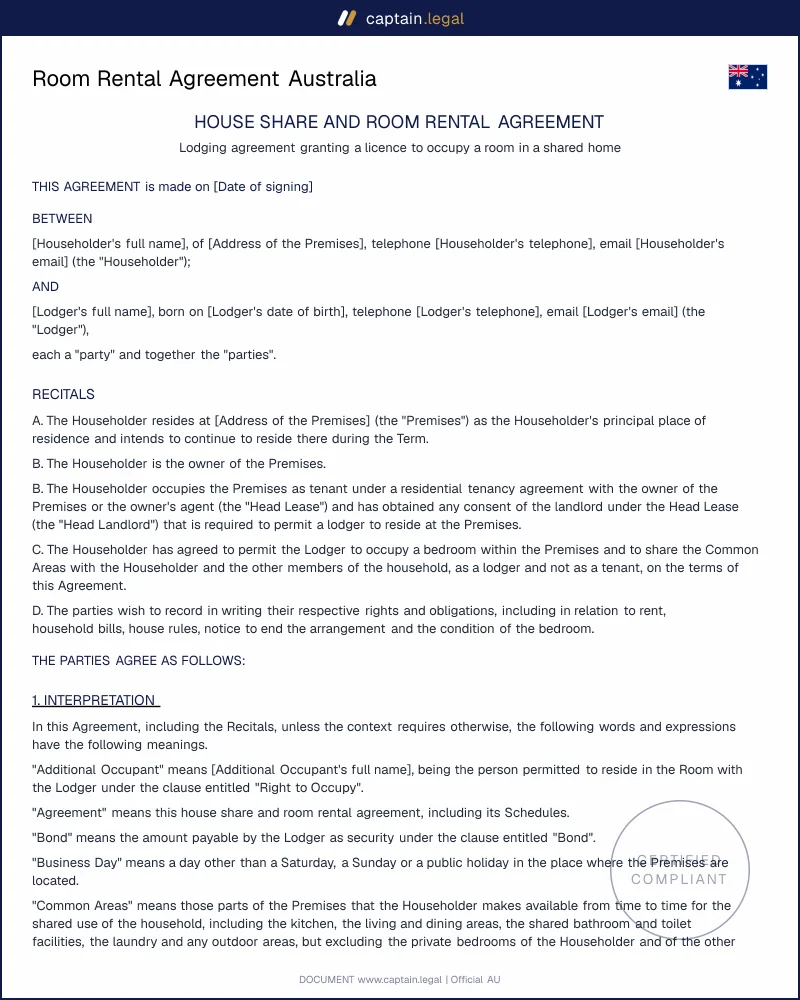
How to fill out this room rental agreement

You begin by selecting the state or territory where the house is located. The questionnaire uses that answer to set the bond wording, any lodgement instructions and the warnings about rooming house and boarding house thresholds. Next you enter the parties: the householder's details, each occupant's full legal name, and a description of the room clear enough that nobody can later argue about which bedroom was let.

Then you set the money. You enter the rent, the payment cycle, the bond and the refund timeframe, and pick the bills model that matches how your household actually pays. The house rules step offers standard wording you can edit rule by rule, followed by the notice period.

The final step generates the bedroom condition report from the furniture list you entered. Walk through the room with the occupant, note every mark, take dated photos and have both parties sign before handing over the keys. If your answers show the arrangement is really a full tenancy, go back to our residential tenancy documents for landlords and renters and use the correct form.

Common mistakes to avoid

The most expensive mistake is using a lodging agreement for what is really a tenancy. A householder who moves out, hands over every key and stops visiting has given up the control that defines a licence. A tribunal will then apply the full tenancy Act, including its notice periods and bond rules. The second mistake is the unwritten bills arrangement. "We'll just split it" works until a winter quarter doubles the gas bill, and without a stated method the householder has no contractual basis to recover the difference. The third is taking a bond with no receipt and no refund terms or, in Queensland, keeping it instead of lodging it with the RTA.

The fourth is changing the locks or packing up belongings the day after an argument. A lodger has fewer rights than a tenant, but the licence still has to be ended on the notice the agreement provides or, if it says nothing, on reasonable notice. Evicting a lodger without notice exposes the householder to a damages claim and, where force is used, to police involvement. Finally, many households rely on a condition report with no photos and no signatures, which proves nothing at the end of the stay.

Key takeaways

LEGAL STATUS

Control decides lodger status

A room agreement works only where the householder keeps overall control: they live there, control common areas, set house rules and allow bedroom use on agreed terms. Under Radaich v Smith (1959) 101 CLR 209, exclusive possession decides whether a lease exists. If control is missing, a tribunal may treat the arrangement as a tenancy under the relevant Residential Tenancies Act.

WRITTEN TERMS

Write down money and house rules

Because pure lodging arrangements rely mainly on contract and licence law, the written terms do the heavy lifting. Record the bond, bill split, shared area rules, access to the bedroom, exit notice and a bedroom condition report before move-in. That paper trail is what resolves the common late-payment, damage or electricity bill argument.

DISPUTES

Tenancy tribunals may not help

Once the arrangement is outside the tenancy Acts, NCAT, VCAT and QCAT generally cannot decide it as a residential tenancy dispute. Claims may need the Local or Magistrates Court, unless a consumer claim is available against a householder operating in trade or commerce under the Australian Consumer Law. Queensland bond lodgement rules can still bite.

Frequently Asked Questions

Yes. A signed room rental agreement is an enforceable contract under the general law of every state and territory, even though the Residential Tenancies Acts do not govern it. Courts enforce its terms on rent, bond, bills and notice, provided those terms are clear, lawful and not unfair under the Australian Consumer Law. The document cannot change the true nature of the arrangement, though. If the occupant has exclusive possession and the householder has no ongoing control, a tribunal may treat it as a residential tenancy.

It depends on the agreement. Outside the tenancy Acts and boarding house laws there is no statutory minimum, so the contract sets the period. Two weeks for a weekly arrangement or four weeks for longer stays are common choices. If the agreement is silent, the common law requires reasonable notice, judged by how long the occupant has lived there and how often rent is paid. Our template applies the same period to both sides.

It depends on the state. In Queensland, a bond paid by a boarder or lodger must be lodged with the Residential Tenancies Authority within 10 days, even though the rest of the Act does not apply. In Western Australia, Bonds Administration does not hold lodger bonds, so the householder keeps the money under the contract. In every state, the agreement should record the amount, who holds it and the permitted deductions.

Only on the terms the agreement allows. A lodger does not have exclusive possession, but the householder still does not have unlimited access to the bedroom. Our template sets a default of 24 hours' notice for routine entry, which you can change. It limits entry to inspections, repairs and showing the room once notice to leave has been given. Emergencies are the exception.

Usually not. A flatmate renting a bedroom from a head tenant is often a sub-tenant with rights under the residential tenancies legislation, including bond lodgement and statutory notice periods. The lodging model fits when the person letting the room keeps genuine control of the whole home, typically an owner living on site. A head tenant should first check the lease for a subletting clause and get the landlord's written consent.

Yes. Once you complete the questionnaire, the agreement and the bedroom condition report are generated as an editable Word file and a print-ready PDF. Edit the Word version, then sign the PDF. Keep the signed copy with the move-in photos, because together they are your evidence at the end of the stay. Related notices and personal documents are listed in the full catalogue of Australian legal templates.

4.7/5

26 verified reviews · 50 000+ downloads

Lodger Agreement AU | Outside the Residential Tenancies Act
  • Immediate access to the document
  • PDF + Word download
  • Compliant with 2026 legislation
  • Reviewed by lawyers
Fill in the template
Secure payment
Updated on September 15, 2026

You might also like

Tenancy Application & Condition Report
Residential Tenancy Agreement Template