Real Estate

Get Your Rental Bond Back | Bond Refund Demand Letter AU

Drafted to the Residential Tenancies Acts of NSW, Vic, Qld and WA: 14-day notice of claim, landlord evidence duties, fair wear and tear. Word and PDF.
4.6/5— 11 reviews50 000+ downloadsInstant download
Share

A bond refund demand letter is the formal written request a tenant sends to the landlord or managing agent after moving out, asking for the full rental bond to be released and answering each proposed deduction. In most states the bond is held by a government authority, so the letter does not move the money on its own. It fixes your position in writing, calls for the evidence behind every claimed deduction, and sets a deadline before you lodge your own bond refund claim or apply to the tribunal. When a bond dispute reaches a hearing, it is often the document that shows who tried to resolve the matter first.

Compliant

2026 Legislation

50,000+ clients

trust us

Affordable

From $4.90 / doc

Secure payment

Instant download

Get Your Rental Bond Back | Bond Refund Demand Letter AU

Secure payment

Fill in the template

What is a bond refund demand letter?

The rental bond is security for the landlord against unpaid rent and damage beyond fair wear and tear. It stays the tenant's money until a valid claim is proven, and in most jurisdictions it must be lodged with a government custodian: NSW Fair Trading through Rental Bonds Online, the Residential Tenancies Bond Authority (RTBA) in Victoria, the Residential Tenancies Authority (RTA) in Queensland and the Bond Administrator in Western Australia. The demand letter is a pre-action letter, the kind of correspondence a solicitor sends before issuing proceedings. It identifies the tenancy and the bond number, records the date the keys were returned and states the amount owed back to you. It then answers each deduction the agent has raised, accepting what is justified and contesting the rest.

The letter is not the refund form. The form (an online claim through Rental Bonds Online or RTBA Online, Form 4 in Queensland, the Security Bond Release Application in Western Australia) is an administrative instruction to the custodian. The letter is the reasoned argument behind that instruction. A form lodged with no covering letter leaves the tribunal with no record of what the tenant disputed, or when. The letter draws on the terms of the residential tenancy agreement drafted to each state's prescribed standard terms and on the condition reports.

When do you need this document?

The most common trigger is an email from the agent a few days after the final inspection proposing to keep part of the bond for cleaning, carpet steaming, garden work or small repairs. A demand letter answers that proposal before anything is lodged, and a written position is far easier to defend than a phone call nobody minuted. If the agent has instead gone quiet, a dated demand with a deadline creates the record you need before lodging your own claim.

Share houses raise a different issue. Where co-tenants contributed unequal amounts, the letter sets out each person's share, which matters because the custodian only pays as instructed. A demand also fits when you gave a valid notice of intention to leave under your state's tenancy legislation and the landlord now claims rent for a period after the keys were returned.

Two edge cases deserve a mention. Some landlords never lodge the bond and simply keep it, an offence in every jurisdiction that runs a bond authority; the letter then demands direct repayment and warns that the failure will be reported to the regulator. Lodgers living in the owner's home usually sit outside the tenancy legislation, so there is no notice of claim process and the letter becomes their main recovery tool. Queensland differs, because residents of rooming accommodation are covered by the same Act and their bond goes to the RTA.

Key clauses included in our template

  • The identification block records the property address, every tenant named on the bond, the bond number, the tenancy dates and the date the keys were handed back. A wrong bond number alone can delay the claim the letter supports.
  • The statement of the amount demanded sets out the total bond held and the sum due to each tenant. Where you accept a deduction, the letter says so expressly and narrows the dispute, which tribunal members tend to read as good faith.
  • The response to deductions treats each claimed item in its own paragraph. It compares the ingoing and outgoing condition report entries for the rental property, flags fair wear and tear, and challenges any figure not backed by a quote or invoice.
  • The request for evidence calls on the landlord or agent to produce invoices, quotes and dated photographs for every amount claimed, citing the statutory evidence obligation where your state imposes one. A photo shown on the agent's tablet at the inspection is not something you can answer, or put before the tribunal, until a copy is in your hands.
  • The deadline and next steps clause fixes a date for a response and states that, failing agreement, you will lodge your own claim and dispute any counter-claim through the tribunal or dispute resolution body.
  • The without prejudice proposal sits in a separate letter, so a compromise offer cannot be read as an admission if the matter goes to a hearing.

State-specific considerations

New South Wales caps the bond at four weeks' rent under s.159 Residential Tenancies Act 2010 (NSW), and the money is lodged with NSW Fair Trading, usually through Rental Bonds Online. If the tenant claims first, the landlord receives a 14-day notice of claim and must apply to NCAT within that window and tell Fair Trading, otherwise the bond is paid as claimed. If the landlord claims without agreement, the tenant has 14 days to apply to NCAT and freeze the bond. The landlord must also hand over estimates, quotes, invoices or receipts within 7 days of making that claim.

Victoria uses its own vocabulary, renter and rental provider. Bonds sit with the RTBA, and a rental provider cannot lodge a claim keeping part of the bond unless the renter accepts it; without that agreement, the matter goes to Rental Dispute Resolution Victoria (RDRV) or VCAT. Section 411AB Residential Tenancies Act 1997 (Vic) limits what a bond claim may cover, and section 411AD governs disputed claims. Renters can claim directly, after which the rental provider has 14 days to contest with evidence of an RDRV or VCAT application.

Queensland runs the process through the RTA under the Residential Tenancies and Rooming Accommodation Act 2008 (Qld). Either side can submit Form 4 once the tenancy has ended. A party who did not sign receives a notice of claim and has 14 days to dispute with a Form 16 dispute resolution request. RTA conciliation comes first for non-urgent matters; if it fails, the RTA issues a notice of unresolved dispute and the disputing party has 7 days to apply to QCAT, failing which the bond is paid as the first form directed. A Queensland letter should cite the lessor's 14-day evidence obligation.

Western Australia keeps bonds with the Bond Administrator under the Residential Tenancies Act 1987 (WA). Under the release process introduced by the Residential Tenancies Amendment Act 2024, any party can submit a Security Bond Release Application once the tenancy ends, and the others have 14 days to agree or dispute. A dispute, or silence, sends the application to the Commissioner for Consumer Protection, and either party may appeal to the Magistrates Court within 7 days of the determination. Once the bond is paid out under a determination and the appeal window closes, it cannot be recovered through the bond system.

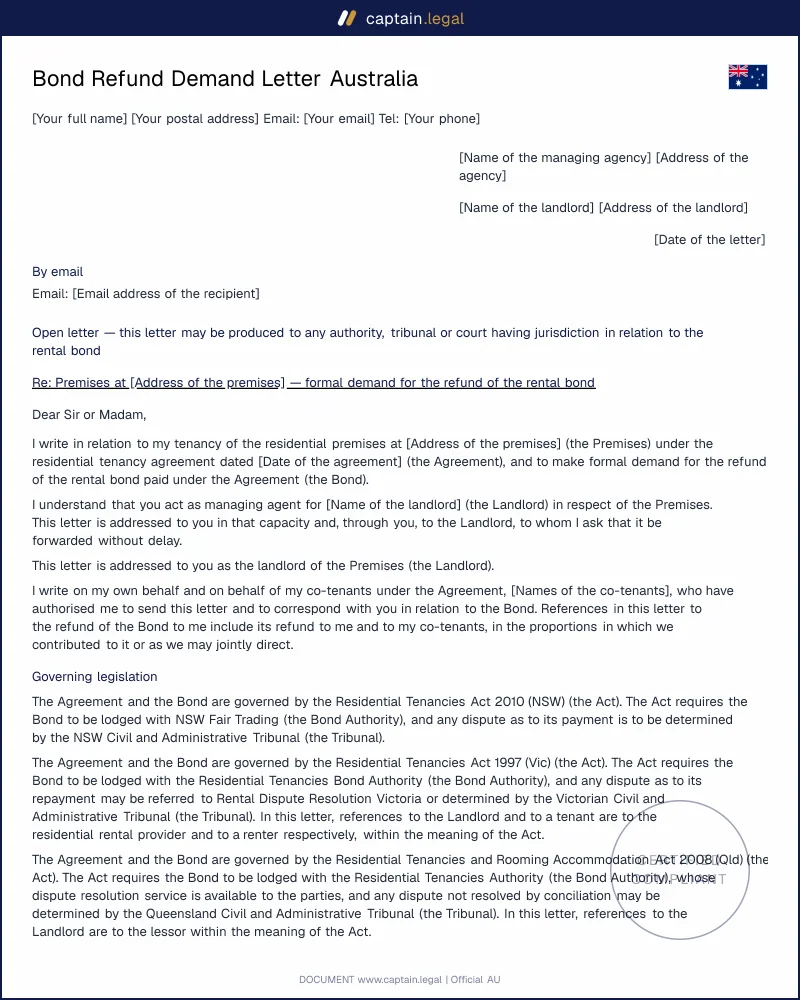
How to fill out this bond refund demand letter

You start by selecting the state or territory where the property is located. That choice sets the custodian, the tribunal and the statutory references used throughout the letter. The form then asks for the tenancy details: the address, every tenant on the bond, the bond number, the total held, the lease dates and the date the keys went back. Keep the ingoing condition report, the agent's outgoing report and your move-out photographs open while you complete this part.

Next comes the deduction schedule. For each item the agent has proposed, you accept it, accept part of it or reject it, and give a short reason: fair wear and tear, a defect already recorded in the ingoing report, no evidence supplied, or a cost out of proportion to the work. Those choices become reasoned paragraphs in the register of a solicitor's letter rather than an angry email. You then set the response deadline, usually seven to ten days, and a delivery method matching the service clause in your agreement. If a friend helped with the final clean, a statutory declaration from our Australian personal legal documents, including statutory declarations, adds weight to the file.

Common mistakes to avoid

The most expensive mistake is signing a refund form that already shows the agent's deductions, just to get the rest of the money moving. Once every party has signed the same form, the custodian pays out within days and nothing is left to dispute. The second is responding by phone. An agent who agrees to drop the carpet claim on a call can deny it later, whereas a letter confirming that conversation is evidence. Tenants also lose track of the deadline that matters. The 14-day period runs from the custodian's notice of claim, not from the date the agent emailed its invoice, and missing it hands the bond to whoever lodged first.

On substance, the weakest letters argue fairness instead of evidence. Saying the property was "left spotless" achieves little; pointing to the ingoing report showing the same carpet stain usually ends the argument. Another frequent error is disputing everything. A tenant who contests a genuine water usage charge alongside a weak claim for a professional garden tidy loses credibility on both. Concede the legitimate items, contest the rest, and keep reports, receipts and photographs in one file. The same discipline pays off at the next address, and the Australian tenancy and property templates in our real estate section cover the paperwork you will need from day one of the new lease.

Key takeaways

Paper trail

The letter frames your refund claim

A bond refund demand letter is not the refund form. It records your position before you lodge through NSW Fair Trading, RTBA Online, the Queensland RTA or the WA Bond Administrator. By naming the tenancy, bond number, key return date and disputed deductions, it gives the tribunal a clear record of what was challenged and when.

14 days

Silence can cost the bond

When a bond claim is lodged without agreement, the custodian issues a notice of claim. If the other party does not dispute it within 14 days, the bond can be paid out as claimed. A tenant who misses that window may lose money even where the landlord's deductions were weak or unsupported.

Evidence

Landlords must prove every deduction

Under the state Residential Tenancies Acts, the bond is returned unless the landlord proves a tenant breach caused a loss. Fair wear and tear, such as faded paint or worn carpet in walkways, is not chargeable. NSW landlords claiming without consent must provide quotes, invoices or receipts within 7 days; Queensland lessors must give supporting evidence within 14 days.

Frequently Asked Questions

No letter obliges the other party to pay. What the letter does is create clear evidence of your position, your dates and your requests from the moment the dispute began. Tribunals read the correspondence between the parties, and an early, reasoned letter often decides who looks reasonable. Settlement attempts are also expected, and in Queensland they are formal, because RTA conciliation must come before a QCAT application on a non-urgent bond dispute.

In New South Wales, Victoria and Queensland, the party receiving a notice of claim has 14 days to dispute it: through NCAT in New South Wales, through RDRV or VCAT in Victoria, and through an RTA Form 16 in Queensland. Western Australia also allows 14 days, after which a disputed or unanswered application goes to the Commissioner for Consumer Protection. Your own letter sets a shorter deadline, usually seven to ten days. Watch for emails and texts from the bond authority once a claim is in.

Only where the property was returned less clean than at the start of the tenancy, allowing for fair wear and tear. Reasonably clean is the usual standard, not professionally cleaned. A clause demanding a professional clean or carpet steam regardless of condition is open to challenge, particularly where no pet was kept. The deciding evidence is the comparison between the ingoing and outgoing condition reports, supported by dated photographs. The landlord must prove both the problem and its cost.

The letter downloads in Word and PDF. The Word version lets you adjust individual deduction responses or add an item the agent raised after the inspection. The PDF is the version you sign and send, by email or post, as the service clause in your agreement allows. Supporting documents are listed in a schedule at the end, so a tribunal member can match each attachment to the paragraph relying on it.

Failing to lodge a bond is an offence in every jurisdiction that runs a bond authority. Your letter then demands repayment directly within a set period and records that the bond was never lodged. If the landlord does not pay, you can report the failure to the regulator (NSW Fair Trading, Consumer Affairs Victoria, the RTA or Consumer Protection WA) and apply to the tribunal for a repayment order. Keep the bank transfer record or receipt showing what you paid.

This template is drafted from the tenant's side and argues for the release of the bond. Landlords and property managers responding to a claim need a different structure, built around evidence of loss, repair quotes and a line-by-line comparison of the ingoing and outgoing condition reports, which is a separate exercise from arguing for a refund. You can browse the full catalogue of Australian legal templates for landlord notices, tenancy agreements and other property documents covering every state and territory.

4.6/5

11 verified reviews · 50 000+ downloads

Get Your Rental Bond Back | Bond Refund Demand Letter AU
  • Immediate access to the document
  • PDF + Word download
  • Compliant with 2026 legislation
  • Reviewed by lawyers
Fill in the template
Secure payment
Updated on October 14, 2026

You might also like

Residential Lease Renewal
Notice to Remedy Breach Template