Family property law is federal, so the Family Law Act 1975 governs married couples everywhere and most de facto couples who separated after their state referred power to the Commonwealth, generally from 1 March 2009 and from 1 July 2010 in South Australia. What varies is the referral history and state revenue law, both of which affect how the schedule is prepared.
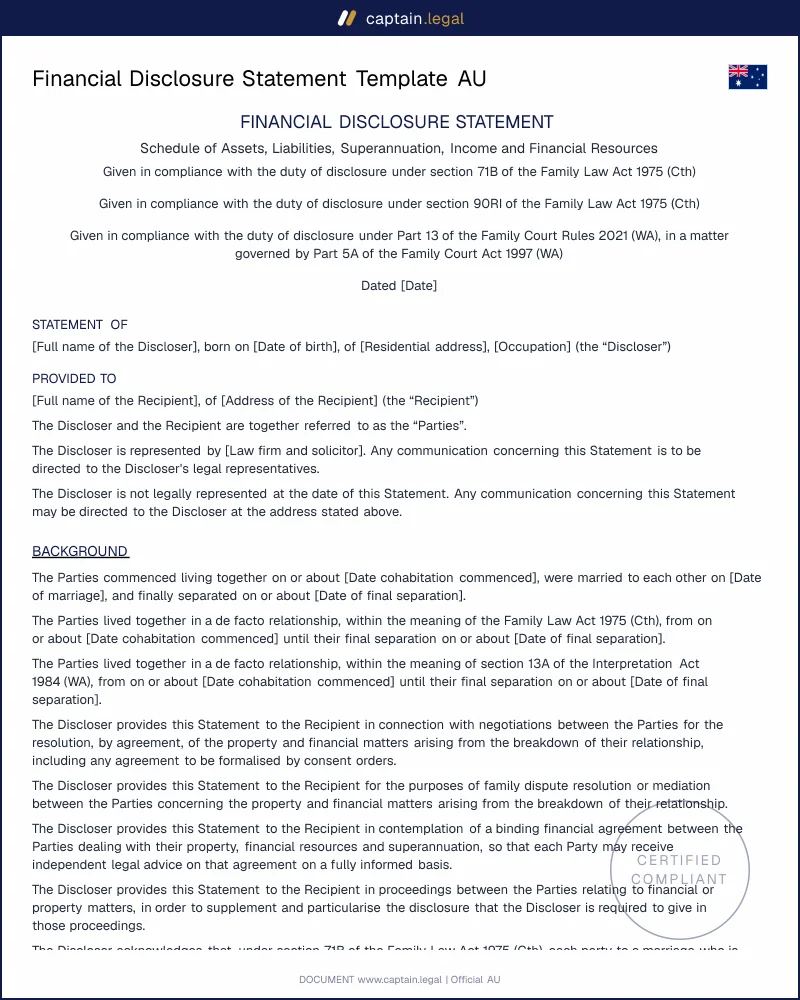
The major exception is Western Australia, which never referred its de facto property powers. De facto couples there proceed under Part 5A of the Family Court Act 1997 (WA) in the Family Court of Western Australia, under the Family Court Rules 2021 (WA) and the state's prescribed forms. Disclosure obligations are substantially similar, and since 1 July 2022 WA de facto partners can also split superannuation. Married couples in WA remain under the federal Act, heard by the same court exercising federal jurisdiction. A schedule for a WA de facto matter should therefore cite the state legislation rather than section 90RI.
Separating couples in New South Wales face a practical revenue question. Land transfers made under family law orders or a financial agreement can qualify for a duty exemption under the Duties Act 1997 (NSW), so the schedule should identify which property will change hands and in whose favour. De facto separations before 1 March 2009 remain under the Property (Relationships) Act 1984 (NSW) unless the parties opted into the federal regime.
Victoria follows a similar pattern, with relief for qualifying relationship breakdown transfers under the Duties Act 2000 (Vic). Valuation is the recurring trap there, because council rates notices often trail the market by a wide margin and are a poor basis for negotiation.
Further north, Queensland separations before 1 March 2009 fall under the de facto provisions of the Property Law Act 1974 (Qld). Duty relief sits in the Duties Act 2001 (Qld), and rural or primary production land usually needs a specialist valuer rather than a residential agent's appraisal.