Non-Profit

MoU Template Australia | Ermogenous & Privacy Act 1988

MoU drafted to the Ermogenous test on intention, s 127 Corporations Act execution, APP 6 and APP 11 privacy and state council rules. Word and PDF.
4.7/5— 14 reviews50 000+ downloadsInstant download
Share

A memorandum of understanding is the document Australian charities, councils and businesses sign when they want to collaborate on a shared program without creating a new entity or locking every detail into a commercial contract. It records the shared goals, what each organisation contributes, how joint decisions are made and how either side can step away. Our MoU template is drafted for collaborations between not-for-profits, local government and private organisations, and it separates the non-binding statement of intent from the few terms that must bind, such as confidentiality and privacy. Typical users include a consortium preparing a joint grant bid, a council partnering with a community organisation, and a company formalising a corporate partnership with a charity.

Compliant

2026 Legislation

50,000+ clients

trust us

Affordable

From $4.90 / doc

Secure payment

Instant download

MoU Template Australia | Ermogenous & Privacy Act 1988

Secure payment

Fill in the template

What is a memorandum of understanding between organisations?

In Australian practice, a memorandum of understanding sits somewhere between a handshake and a contract. It documents a collaboration framework: the purpose of the partnership, each party's contribution (staff time, premises, data, funding, in-kind support), the governance structure and the exit route. Nothing in Australian law makes an MoU automatically non-binding. Whether it creates enforceable obligations depends on what the parties wrote and how they behaved, assessed objectively by a court. Judges have enforced documents titled "Memorandum of Understanding" and refused to enforce documents titled "Agreement", so the heading carries very little weight.

The line between an MoU and its neighbours matters. A funding agreement creates binding payment and performance obligations, usually with acquittal and reporting duties. A joint venture pools assets and shares risk, often through a special purpose entity. A partnership is different again: under s 1(1) of the Partnership Act 1892 (NSW) and its state equivalents, it arises automatically wherever persons carry on business in common with a view of profit, so two businesses sharing revenue from a joint product can become partners without ever signing a partnership agreement for Australian businesses. An MoU deliberately stops short of all three, then points to separate contracts for money, services or assets.

When do you need this document?

The most common trigger is a consortium grant application. Funders increasingly want a lead applicant backed by partner organisations, and assessment panels ask how the consortium makes decisions before releasing any money. A signed memorandum of understanding answers that question in two pages. The second frequent scenario is a council working with a community organisation to run a program from council premises, such as a youth drop-in service or a food relief hub, where each side contributes something different and neither wants a landlord and tenant relationship.

Corporate partnerships with charities follow close behind. A company offering volunteering days, pro bono expertise and use of its logo needs clear rules on brand approval, and the charity needs comfort that it keeps control of its program. Research collaborations between universities and service providers use the same structure with a stronger data clause. Partnerships with Aboriginal community controlled organisations deserve particular care, because Priority Reform One of the National Agreement on Closing the Gap expects genuine shared decision making, not a token advisory role.

One edge case worth flagging: an unincorporated community group cannot sign in its own name. It needs an auspice organisation or individual members who accept personal responsibility, and the MoU should say which.

Key clauses included in our template

Every clause in the template is labelled binding or non-binding in the operative wording itself, because a court reads the document as a whole. The non-binding core sets out the shared objectives, the scope of the collaboration and a plain statement that nothing creates a partnership, agency or employment relationship. Around that core sit the provisions that do the real work:

  • Most collaborations stall over who decides what, so the template creates a joint steering committee with named representatives, a quorum rule and a deadlock path that escalates to chief executives before formal dispute resolution starts.
  • Contributions are recorded party by party, separating cash, staff time, premises and in-kind support. Each is expressed as an intention rather than a debt unless a separate funding agreement is signed.
  • Even a party outside the Privacy Act must handle shared information as if bound by APP 6 and APP 11, consistent with its privacy policy obligations under the Privacy Act 1988, and give prompt notice of any data breach.
  • Intellectual property stays with its creator. Jointly developed material is licensed back to each party for non-commercial use, which avoids a frozen asset when the collaboration ends.

The closing clauses deal with exit and integrity. Either party can terminate on written notice, with a shorter path for unremedied breach or insolvency, and a wind-down clause protects clients mid-program. Where staff work on shared premises, a site clause names the party controlling the workplace. Committee members declare interests before steering decisions, which ties in with a conflict of interest register for charities, and a governing law clause fixes the state or territory whose courts hear any dispute.

Regional considerations

New South Wales councils work within the Local Government Act 1993 (NSW), and the tendering rule in s 55 applies above the threshold set by the Local Government (General) Regulation 2021 whenever the arrangement is really a purchase of services. An MoU cannot be used to sidestep that obligation. Councils are also bound by the Privacy and Personal Information Protection Act 1998 (NSW), and the Government Information (Public Access) Act 2009 (NSW) can require disclosure of contracts with private sector partners. Community partners should assume that anything they put in writing to a council may become public.

Collaborations with councils in Victoria run into a different set of rules. Councils must adopt and comply with a procurement policy under ss 108 and 109 of the Local Government Act 2020 (Vic), and they are public authorities under s 38 of the Charter of Human Rights and Responsibilities Act 2006 (Vic), so joint programs must be delivered compatibly with Charter rights. Personal information held by a council falls under the Privacy and Data Protection Act 2014 (Vic). Victoria never adopted the model WHS laws, so shared-site safety duties come from the Occupational Health and Safety Act 2004 (Vic).

Data obligations have tightened most noticeably in Queensland. The Information Privacy and Other Legislation Amendment Act 2023 (Qld) introduced the Queensland Privacy Principles from 1 July 2025, and the mandatory data breach notification scheme reached local government on 1 July 2026. Councils contract under chapter 6 of the Local Government Regulation 2012 (Qld) and must act compatibly with human rights under s 58 of the Human Rights Act 2019 (Qld). A data clause written for a Queensland council should name a breach contact and a response time on both sides.

Western Australia was long the outlier, with no privacy statute for its public sector. That changed when most of the Privacy and Responsible Information Sharing Act 2024 (WA) commenced on 1 July 2026, covering local governments and some contracted service providers. A charity or business delivering services for a WA council can therefore carry privacy obligations of its own, with the notifiable breach scheme commencing on 1 January 2027. Tendering rules under s 3.57 of the Local Government Act 1995 (WA) operate much like the NSW rule.

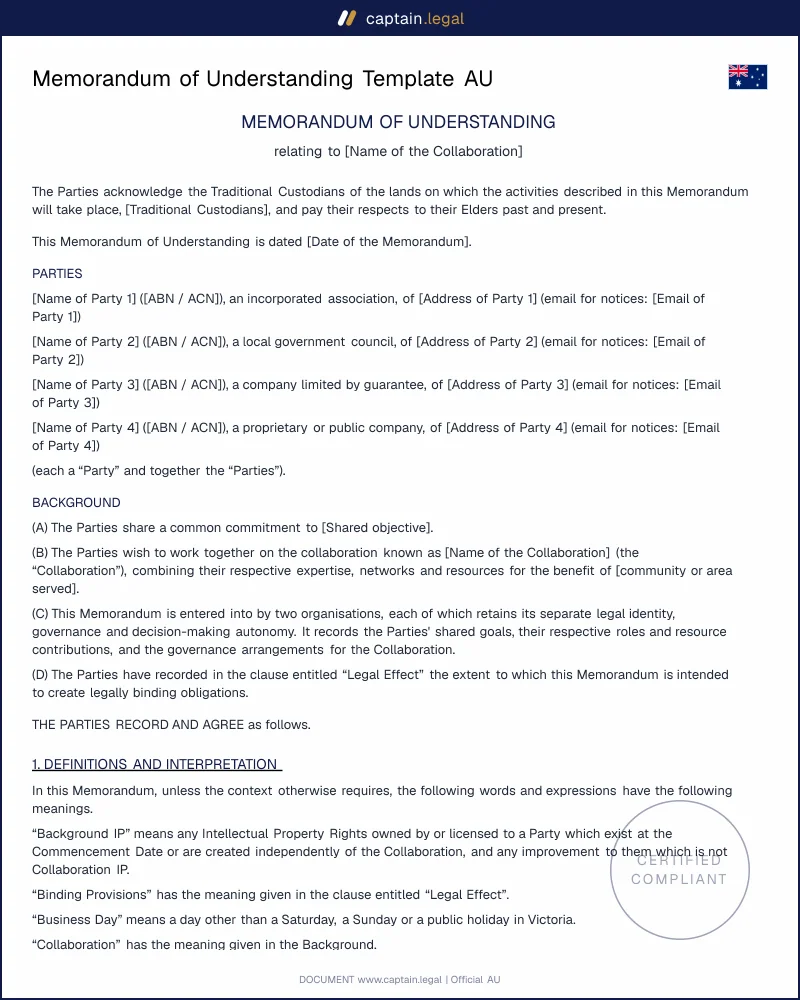
How to fill out this memorandum of understanding

You start by naming each party exactly as it appears on the Australian Business Register or the ACNC Charity Register, together with its legal form. The template then adjusts the execution block, offering s 127 wording for companies, a committee format for incorporated associations and a delegated officer block for councils. From there, you describe the shared purpose in a few plain sentences and list the outcomes the collaboration should deliver, ideally with a measure for each.

The contribution schedule comes next. Each party records what it brings and when, distinguishing cash from in-kind support, and the form flags any cash commitment so you can decide whether a separate funding agreement is needed. You then nominate steering committee representatives, a meeting frequency and escalation contacts. The data section asks whether personal or health information will be shared; answering yes switches on the binding privacy and breach notification clauses.

Finally, you choose the term, the termination notice period and the governing state or territory. If your organisation is still building its governance documents, the wider Australian non-profit governance templates cover constitutions, AGM minutes and policies.

Common mistakes to avoid

The mistake we see most often is the missing intention clause. Parties write "this MoU is not legally binding" in the recitals, then draft the body in the language of firm obligation, with deadlines, payment amounts and indemnities. A court reading that document objectively may well find a contract. The opposite error is just as common: a document declared wholly non-binding, so the confidentiality promises everyone relied on turn out to be unenforceable. Name the binding clauses expressly and keep them short.

Signing authority causes the next round of problems, as when one committee member signs for an association whose constitution requires two. Corporate money creates another trap. Payments tied to logo exposure are sponsorship, not gifts, so they are not deductible under Division 30 of the Income Tax Assessment Act 1997 and may attract GST; calling them donations misleads both sides. Open-ended MoUs drift too: without a term or review date, the document falls out of step with the program. Finally, two organisations bidding against each other should never use an MoU to share pricing or divide up regions. Competitors who coordinate bids under cover of a collaboration risk cartel liability under the Competition and Consumer Act 2010 (Cth), whatever the document is called.

Key takeaways

INTENTION

Labels do not decide enforceability

An MoU is not automatically non-binding in Australia. Under Ermogenous v Greek Orthodox Community of SA Inc, a court looks objectively at the words and conduct, not the heading on the document. The template should separate the broad statement of intent from clauses meant to bind, such as confidentiality, privacy and dispute steps.

SIGNING

Authority must match the signer

Execution can make or break the arrangement. A company may sign under s 127 of the Corporations Act 2001, with others relying on the s 129 statutory assumptions, or through an authorised agent under s 126. Associations and councils need their own authority path, including constitutional rules or a valid delegation to the chief executive or general manager.

DATA

Privacy promises should still bind

Collaboration often involves client lists, participant records, grant data or council-held information. The MoU should keep privacy obligations binding even if the wider program remains flexible. APP 6 controls use and disclosure of personal information, while APP 11 deals with security, so both sides need clear handling rules before information is shared.

Frequently Asked Questions

It depends on the wording and the conduct of the parties, not on the title. Following Ermogenous v Greek Orthodox Community of SA Inc (2002) 209 CLR 95, courts ask objectively whether the parties intended legal consequences. Our template treats the collaboration terms as a statement of intent, while confidentiality, privacy, intellectual property, dispute resolution and governing law are expressly binding, supported by mutual promises as consideration. If you want every term enforceable, you need a contract such as a funding or service agreement.

Witnessing is not required for an MoU signed as an ordinary document rather than a deed. Authority is what counts. Companies may sign under s 127 of the Corporations Act 2001 (Cth), including electronically under s 110A, associations follow their constitution and councils act through their delegations. A lawyer is not mandatory, although large data sharing arrangements or collaborations between competitors justify a review before signing.

Yes, provided the MoU is a genuine collaboration and not a disguised purchase. Once a council is buying goods or services, its procurement rules apply: s 55 of the Local Government Act 1993 (NSW), ss 108 and 109 of the Local Government Act 2020 (Vic), chapter 6 of the Local Government Regulation 2012 (Qld) or s 3.57 of the Local Government Act 1995 (WA). Council officers usually check this before signing, and partners should expect the question.

You receive an editable Word file and a print-ready PDF. Word lets you adjust contribution schedules, add partners or attach a project plan, while the PDF suits circulation to boards for approval before execution. Both keep the binding and non-binding labels intact, so the structure survives later edits. Related agreements are listed in the full Australian legal document library.

Whatever the MoU says, since no statute fixes a period. The template leaves it editable, and most collaborations settle on one to three months without cause, with a shorter period for unremedied breach. A wind-down clause then requires the parties to cooperate on transferring clients, returning data and settling publicity before the end date. Grant-funded programs often need a period aligned with the funder's reporting cycle, so check the grant terms first.

Not in its own name, because it has no separate legal personality. The usual solution is an auspice arrangement, where an incorporated organisation signs and takes responsibility for the group's participation. Alternatively, named office bearers can sign personally, accepting that obligations fall on them. Many groups use the collaboration as the moment to incorporate under their state Associations Incorporation Act.

4.7/5

14 verified reviews · 50 000+ downloads

MoU Template Australia | Ermogenous & Privacy Act 1988
  • Immediate access to the document
  • PDF + Word download
  • Compliant with 2026 legislation
  • Reviewed by lawyers
Fill in the template
Secure payment
Updated on October 16, 2026

You might also like

Donation Receipt Template AU
AGM Minutes & Resolutions Pack