Non-Profit

NFP Sponsorship Agreement | GST Act s 9-5 & ACNC Ready

Sponsorship is a taxable supply, not a gift. Template drafted to the GST Act, ACNC Governance Standards and Australian Consumer Law. Word & PDF.
4.7/5— 15 reviews50 000+ downloadsInstant download
Share

A sponsorship agreement for non-profits is the contract that records what a business pays or provides to a charity, club or community organisation, and exactly what it gets back: logo placement, naming rights, hospitality, social media mentions or event access. Our template is drafted for Australian incorporated associations, companies limited by guarantee and ACNC-registered charities that want a corporate partner on paper before the first invoice goes out. It covers the benefits package, the logo licence, the payment schedule, category exclusivity, GST treatment and termination rights, in plain English a committee can follow and a sponsor's in-house counsel will recognise. It works equally for a single gala dinner, a season of community sport or a multi-year program partnership.

Compliant

2026 Legislation

50,000+ clients

trust us

Affordable

From $4.90 / doc

Secure payment

Instant download

NFP Sponsorship Agreement | GST Act s 9-5 & ACNC Ready

Secure payment

Fill in the template

What is a sponsorship agreement for non-profits?

At law, sponsorship is an exchange, not a gift. The sponsor provides money or in-kind support (goods, services, a venue, media space) and receives commercial value in return, usually exposure to the organisation's members and audience. Because the sponsor gets something back, the payment is consideration for a supply, and a sponsorship agreement is an ordinary contract enforceable under general contract law. That is the line separating sponsorship from a donation, which by definition carries no material benefit to the giver. When a business wants to support your cause and expects nothing back, a deed of gift for unconditional donations is the better instrument.

A sponsorship agreement also differs from a grant agreement, which funds a project and imposes acquittal obligations but rarely gives the funder promotional rights, and from a memorandum of understanding, which most parties intend to be non-binding. In practice a sponsorship agreement sits between a services contract and an intellectual property licence: the organisation lets the sponsor use its name, and displays the sponsor's brand in return. Two licences run in opposite directions, and each needs its own controls.

When do you need this document?

The classic trigger is an event. A fun run with a naming partner involves promises about signage, tickets and announcements, and each needs a date. Community clubs selling jersey sponsorship and ground signage need every package signed before the uniforms go to print.

In-kind deals get forgotten most often. A hotel donating a function room in exchange for logo placement is still a sponsorship, and if both parties are GST-registered, each makes a taxable supply to the other. Multi-year program partnerships sit at the larger end. A bank funding a three-year program will expect reporting, and you will want staged payments that survive a cut to its marketing budget.

Two edge cases deserve attention. Where the sponsor is owned or run by a board member or their family, the deal is a related party transaction, and your conflict of interest declarations and register should be completed before anyone signs. Sponsors from restricted industries also need screening: tobacco and e-cigarette sponsorship is prohibited under the Public Health (Tobacco and Other Products) Act 2023 (Cth), and many state sporting bodies limit alcohol and gambling branding on junior uniforms.

Key clauses included in our template

The sponsorship agreement opens with the parties, their ABNs and GST status, the sponsored event or program, and the term, including any renewal option. The operational core follows:

  • Most friction starts with the benefits schedule, so the template lists each deliverable separately (signage size and position, social posts, tickets, speaking slots) with a delivery date against each.
  • Payment can be a lump sum or staged instalments tied to milestones, expressed exclusive of GST, and late payment suspends the sponsor's benefits rather than ending the deal.
  • Your logo is an asset. A mutual licence grants each party a non-exclusive, revocable right to use the other's marks in approved formats, with prior written approval of artwork and a takedown obligation on termination.
  • Exclusivity is granted by category only, never across the whole program.
  • Should either party's reputation turn, a morality clause allows termination on notice with recovery of the unearned fee.

Around that core sit the protective clauses. The template states that the organisation does not endorse the sponsor's products, which keeps public messaging consistent with s 29 Australian Consumer Law. It bars the sponsor from receiving member data without each person's consent, a restriction that sits comfortably beside an Australian Privacy Principles compliant privacy policy. A short post-event report gives the sponsor evidence of delivery. Insurance, a capped indemnity, force majeure and mediation complete the document.

Regional considerations

New South Wales regulates "fundraising appeals" under the Charitable Fundraising Act 1991 (NSW). The commercial sponsorship payment is not itself an appeal, but a sponsored event that asks the public for money for a charitable purpose usually is, and an authority is generally required before it runs. NSW has also brought the National Fundraising Principles into force for authority holders, so public statements about how event income will be used must be accurate and documented.

Victoria takes a different route. Under the Fundraising Act 1998 (Vic), ACNC-registered charities are deemed registered fundraisers, and the National Fundraising Principles apply to them directly. Associations under the Associations Incorporation Reform Act 2012 (Vic) should confirm the committee may sign without a general meeting.

Organisations in Queensland still work under the Collections Act 1966 (Qld), which regulates any "appeal for support" for a charitable purpose. The government has announced its intention to adopt the National Fundraising Principles, but they do not yet apply. Associations incorporated under the Associations Incorporation Act 1981 (Qld) should confirm that the sponsorship sits within their stated objects.

South Australian collectors need a licence under the Collections for Charitable Purposes Act 1939 (SA), and the state applies the National Fundraising Principles through its Charities Code of Practice, which binds every licence holder whether or not it is registered with the ACNC.

At the other end of the country, Western Australia remains licence-based. The Charitable Collections Act 1946 (WA) requires a licence for charitable collections, and recent amending legislation allows a binding code of conduct for licence holders. Organisations fundraising across borders must satisfy the rules of every state where the appeal reaches the public, not only their home state.

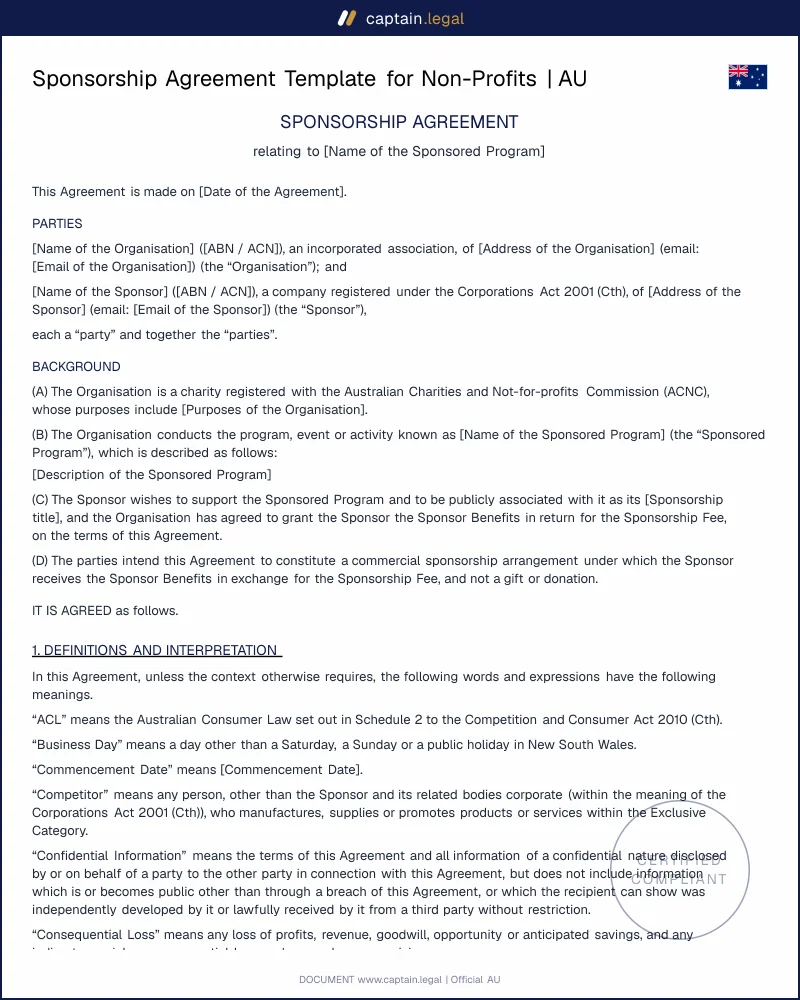
How to fill out this sponsorship agreement

You start by choosing your organisation's structure, which sets the signing block and the authority wording. The form then asks for both parties' legal names, ABNs and GST status, the event or program being sponsored and the term. Each benefit is entered as its own line with a quantity, a specification and a delivery date. Precision here pays off: "appropriate recognition" is unenforceable, whereas "logo on the finish arch, minimum one metre wide" is not.

Payment comes next: a single payment or instalments, each attached to a date or milestone. If you grant exclusivity, you name the protected category and the excluded competitors. The termination section sets the cure period, the notice period and the refund rule for cancelled events.

Before the sponsorship agreement is signed, the proposal should go to whoever holds authority under your board charter and delegations framework, with any conflict declared and minuted. A company limited by guarantee can execute under s 127 Corporations Act 2001 (Cth), which lets the sponsor rely on the assumption in s 129(5), and s 110A permits electronic signature. Associations follow the execution rules in their constitution.

Common mistakes to avoid

The most expensive error is treating sponsorship as a donation. A treasurer who issues a tax-deductible receipt to a sponsor, or banks the payment into the gift fund, creates a compliance problem for the organisation and a false deduction for the sponsor. Close behind is the vague benefits clause: a minimum size and a named position settle arguments that "prominent placement" never will. Never promise exclusivity across your whole organisation, because one category deal with a bank should not stop you from signing a supermarket next season.

Logo control is the quiet risk. Without an approval right and a takedown obligation, a former sponsor can keep using your name on packaging, and you will struggle to show control under the Trade Marks Act. Committees also hand over the mailing list as a goodwill gesture. For an organisation covered by the Privacy Act 1988 (Cth), disclosing personal information for a sponsor's marketing without consent breaches the Australian Privacy Principles, and bulk emails add exposure under the Spam Act 2003 (Cth).

Key takeaways

GST treatment

Sponsorship is not a tax-deductible gift

A sponsor receives commercial value, such as logo placement, naming rights or event access, so the payment is consideration for a taxable supply under s 9-5 of the GST Act. If the organisation is GST-registered, it must account for GST. The receipt should not be treated as a donation or credited to a gift fund.

Deal terms

Write the benefits before invoicing

The agreement should spell out exactly what the sponsor gets: the benefits package, payment schedule, logo licence, category exclusivity, hospitality and termination rights. This matters for a one-off gala, a sports season or a multi-year partnership because both sides need clear limits before the first invoice, public announcement or brand use.

Charity duties

Avoid private benefit and misleading claims

ACNC-registered charities must keep the deal aligned with their charitable purpose and Governance Standard 5, including acting in the charity's best interests. A sponsor getting more than market value, or steering program content, can create private benefit concerns. In trade or commerce, Australian Consumer Law ss 18 and 29 also make accurate promotion and representations non-negotiable.

Frequently Asked Questions

It is, provided the usual elements of an Australian contract are present: offer, acceptance, consideration and an intention to create legal relations. The template states expressly that the parties intend to be bound, so the sponsorship agreement can be enforced like any commercial contract. Signatories also need authority: execution under s 127 Corporations Act 2001 (Cth) for a company limited by guarantee, or the signing rules in an association's constitution. Electronic signatures are valid under the Electronic Transactions Act 1999 (Cth).

If your organisation is registered for GST, or required to be, the answer is almost always yes. The ATO treats signage, naming rights and advertising as a supply made in return for the payment, so GST is payable and goes on your BAS. The sponsor usually claims a matching input tax credit, so the template states every amount exclusive of GST and requires a tax invoice. Unregistered organisations do not charge GST but must count sponsorship income towards their GST turnover.

You receive the completed agreement in both Word and PDF, generated from the answers you give in the questionnaire. The Word version is fully editable. The PDF is formatted for signature in wet ink or through an electronic signing platform, and both versions keep the clause numbering so cross-references survive edits. If you are also preparing the governance documents sponsors ask to see, the full Australian legal document catalogue groups them by category.

That is set by the cure period you choose in the questionnaire, and 14 days from written notice of the breach is a common market position. Within that window you can deliver the missing benefit or an agreed equivalent. If the breach is not remedied, the sponsor may terminate and recover the unearned portion of the fee. Termination for convenience, where offered, usually requires 30 to 90 days' written notice, while serious reputational breaches justify immediate termination under the morality clause.

Only with consent. Under APP 6 and APP 7 of the Privacy Act 1988 (Cth), an APP entity cannot disclose personal information for a sponsor's direct marketing unless the individual has agreed, and commercial emails need consent under the Spam Act 2003 (Cth). The template prohibits disclosure of member data by default and offers an alternative: your organisation sends the sponsor's offer itself, so the list never leaves your hands. Organisations outside the Privacy Act should do the same, because funders expect it.

It depends on the cause. Where it sits outside both parties' control, such as extreme weather, a public health order or the loss of a venue, the force majeure clause applies. Your organisation first offers a new date or substitute benefits, and if the sponsor declines, refunds the fee pro rata to the benefits not yet delivered. A cancellation for the organisation's own reasons entitles the sponsor to a full refund of unearned amounts.

4.7/5

15 verified reviews · 50 000+ downloads

NFP Sponsorship Agreement | GST Act s 9-5 & ACNC Ready
  • Immediate access to the document
  • PDF + Word download
  • Compliant with 2026 legislation
  • Reviewed by lawyers
Fill in the template
Secure payment
Updated on October 15, 2026

You might also like

Incorporated Association Constitution
Membership Application Form & Register Template