Non-Profit

Admit Members the Right Way: Application & Register

Membership form and register drafted to the Associations Incorporation Acts (NSW, Vic, Qld, WA), s 169 Corporations Act and ACNC rules. Word & PDF.
4.6/5— 14 reviewsAustralian law 2026Instant download
Share

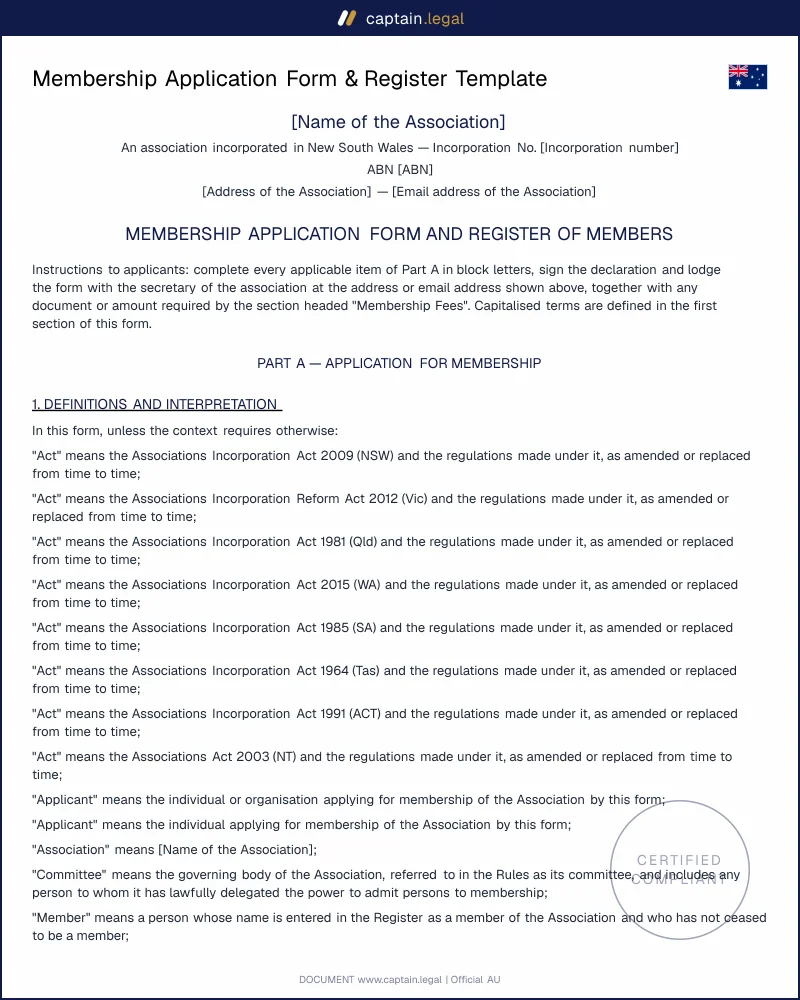
A membership application form and register gives an incorporated association, club or not-for-profit company a clean paper trail for every person who joins, from the signed application through committee approval and payment of the entrance fee to the entry that makes someone a member. Secretaries and committee members use it to admit people exactly as their constitution requires, and to keep the register of members that every state and territory associations statute expects. Because both documents sit in one pack, the declaration a new member signs and the register entry that later proves their voting rights tell the same story.

Compliant

2026 Legislation

50,000+ clients

trust us

Affordable

From $4.90 / doc

Secure payment

Instant download

Admit Members the Right Way: Application & Register

Secure payment

Fill in the template

What is a membership application form and register?

Nobody becomes a member of an incorporated association by turning up or paying a subscription. Membership is a legal status created by the rules, and most constitutions make it depend on a written application, a committee decision and an entry in the register. The NSW model constitution is blunt about it: the applicant becomes a member once their name is entered. The membership application form is the evidence of consent. The register is the evidence of status. It decides who votes, who counts towards a quorum and who can requisition a meeting.

Secretaries often confuse the register of members with neighbouring records. It is not the record of office holders, nor the list of responsible persons a charity reports to the ACNC, nor a newsletter list. A company limited by guarantee keeps a register too, but under the Corporations Act 2001 (Cth), with its own content and inspection rules.

When do you need this document?

The obvious trigger is incorporation itself. An association applying to register needs founding members on record, and Queensland will not incorporate a group of fewer than seven members under s 5 of the Associations Incorporation Act 1981 (Qld). Informal clubs usually discover the gap when a grant officer or bank asks for the register and the only list sits in a former treasurer's inbox.

Structural change is the second trigger. Adopting associate, life or junior classes means mapping every existing member to a class. Growth creates a similar need: once an association coordinates volunteers as well as members, the two relationships must stay separate, and a volunteer agreement and handbook handles that far better than a membership application form.

Contested elections come third, and dated committee decisions settle challenges to who was properly admitted. Two edge cases deserve attention. Applicants under 18 need a guardian's consent and a clear rule on voting. Licensed clubs in New South Wales also answer to the Registered Clubs Act 1976 (NSW), whose admission and record rules are stricter than the general association regime.

Key clauses included in our template

The membership application form opens with the applicant's identity and contact details, then asks them to choose a membership class taken directly from your constitution. Its core is the declaration: the applicant applies to join, supports the association's purposes and agrees to be bound by the rules. Optional sections cover a nominator and seconder, and a guardian where the applicant is a minor. A fee acknowledgement refers to the entrance fee and annual subscription for the chosen class without hard-coding any figure.

Privacy is handled at the point of collection. A short collection notice, required by Australian Privacy Principle 5 for associations covered by the Act, explains who can see the register. Smaller associations below the small business threshold are often exempt, yet funders increasingly expect the notice anyway. Pair it with a privacy policy written for the Privacy Act 1988 and the APPs. Extra details, such as a date of birth, go on a separate optional panel.

The office use section records the committee decision, meeting date, payment date and date of entry, plus a short refusal notice for rejected applicants. The register lists full name, a residential, postal or email address, class, date of entry and date of cessation. Never merge the optional panel into the inspectable register, because anything recorded there can be seen by any member who asks.

State and territory considerations

New South Wales associations using the model constitution enter an applicant's name as soon as practicable after the entrance fee and annual subscription are paid, and membership starts on entry. The register records the member's full name, a residential, postal or email address, the start date and, later, the date membership ended. Members may inspect it free of charge, but may not use the details for purposes unconnected with the association.

Victoria is the most prescriptive jurisdiction. Under s 56 of the Associations Incorporation Reform Act 2012 (Vic) the secretary maintains the register, s 57 gives members access and s 58 makes improper use an offence. A member with safety concerns can ask for access to their personal information to be restricted under ss 59 to 59B, and some refusals are reviewable at VCAT. The Victorian model rules also recognise associate members who cannot vote, so the class choice on the form must be explicit.

Associations in Queensland that adopt the model rules apply rules 9, 13 and 14 of Schedule 4 to the Associations Incorporation Regulation 1999 (Qld), covering admission and rejection, the register, and the ban on using register information for unrelated purposes. Associations with their own rules still need equivalent provisions, because the regulation lists membership among the matters every set of rules must address. The Office of Fair Trading supervises compliance.

Over in Western Australia, s 53 of the Associations Incorporation Act 2015 (WA) requires an up to date register, s 54 grants inspection and s 56 a copy, which the Associations Incorporation Regulations 2016 (WA) allow by electronic transmission. The Associations and Co-operatives Legislation Amendment Act 2025 (WA) amends the register provisions, so confirm which changes have commenced before relying on an older set of rules.

South Australia, Tasmania, the ACT and the Northern Territory leave more to each association's rules, which the register columns follow.


How to fill out this membership application form and register

You start by selecting the state or territory of incorporation and the structure, either incorporated association or company limited by guarantee. The questionnaire then inserts the matching statutory references and sets the register columns the relevant Act or model rules require. Next you list your membership classes as the constitution names them, mark which ones vote and switch on nominator or junior sections if needed.

The admission pathway comes next. The office use section adapts whether the secretary admits applicants on payment or the committee decides each one. You then choose how applications arrive (paper, email or online) and confirm the privacy notice wording.

The finished pack downloads as an editable Word file and a PDF. Have the committee adopt the form by resolution before using it, and record that decision in properly kept minutes, which our AGM minutes and resolutions pack is built for.

Common mistakes to avoid

The most damaging mistake is entering a name before the conditions are met. Secretaries add newcomers on the day they hand over their details, before approval or payment, and those people then vote at the AGM. Equally common are long-lapsed members left on the list, inflating the quorum. Record the date of cessation rather than deleting the line, because that history matters once a dispute reaches the regulator.

Privacy causes the next set of errors. Committees store dates of birth, medical notes or bank details in the same spreadsheet as the statutory register, then either expose that data to any member who inspects it or refuse inspection altogether on privacy grounds. Forms copied from another club often offer classes your constitution does not recognise. A register kept on one volunteer's personal laptop, with no backup and no handover, is the most common reason associations lose their membership records.

Key takeaways

Admission

Membership starts with the register

A person does not become a member just by attending meetings or paying a subscription. Most constitutions require a written application, committee approval and then entry in the register. That entry is what proves voting rights, quorum numbers and the right to requisition a meeting, so the form and register need to match.

Legal register

Keep the right statutory record

The register is a legal record, not a mailing list or a list of office holders. Incorporated associations must follow their state legislation and constitution, while companies limited by guarantee keep registers under ss 168 and 169 of the Corporations Act 2001. For companies, former member details stay on the register for seven years.

Access rules

Inspection rights override privacy habits

Member information must be collected and secured under the Privacy Act 1988, but privacy practices do not cancel statutory inspection rights. For example, members of companies limited by guarantee can inspect the register free of charge under s 173 of the Corporations Act 2001. No witnessing, notarisation or regulator lodgement is needed for the application itself.

Frequently Asked Questions

The signed form records a binding request to join and an agreement to be bound by the rules. Once the committee approves the application and the name is entered, the constitution binds the association and the member, as s 26 of the Associations Incorporation Act 2009 (NSW) provides for NSW associations and s 140 of the Corporations Act 2001 (Cth) provides for companies. The register is also a statutory record, for instance under s 56 of the Associations Incorporation Reform Act 2012 (Vic), which is why the template dates every step.

An unincorporated group has no statutory obligation, although keeping one makes a later incorporation application far easier. Once incorporated, every association must keep a register whatever its size or turnover, and a tier one association with modest revenue carries the same duty as a large state body. The small business exemption in the Privacy Act 1988 (Cth) does not remove that duty, because it comes from the state Act.

Usually, if you provide one, because members have a statutory right to inspect the register in most states. You can limit exposure by giving a postal or email address instead, which the NSW model constitution and the WA Act both accept. In Victoria, a member can ask for access to personal information to be restricted under ss 59 to 59B of the Associations Incorporation Reform Act 2012 (Vic), and misusing register details is an offence under s 58.

Your constitution sets the timeframe, so read the admission clause before promising applicants a date. Most rules have the committee consider applications at its next meeting, and the NSW model constitution requires the name to be entered as soon as practicable once fees are paid. Rejected applicants should receive written notice promptly, and the template includes a refusal letter for that step. Entering approved members within days, rather than at the next AGM, avoids arguments about who could vote.

You get an editable Microsoft Word file and a print-ready PDF. Word lets you adjust class names, add your logo and adapt the privacy notice, while the PDF suits printing for a club night or attaching to an email. Many associations also rebuild the form online and keep the register in a secure spreadsheet that mirrors the template's columns. For wider paperwork, browse the full catalogue of Australian legal templates.

Most constitutions provide that membership ceases if the subscription stays unpaid beyond a grace period set in the rules, and some require the committee to send a reminder first. The template records the cessation date and reason instead of deleting the entry, which preserves a clean history if the former member later disputes their status. A lapsed member who wants to return completes a fresh application and goes through the same approval process as anyone else.

The layout is similar, but the legal source differs. A company limited by guarantee keeps its register under ss 168 and 169 of the Corporations Act 2001 (Cth), including former members for seven years, and must allow inspection under s 173, free of charge for members. Selecting that structure adjusts the register columns and swaps the state references for the Corporations Act provisions, so one pack serves both structures.

4.6/5

14 verified reviews · Australian law 2026

Admit Members the Right Way: Application & Register
  • Immediate access to the document
  • PDF + Word download
  • Compliant with 2026 legislation
  • Reviewed by lawyers
Fill in the template
Secure payment
Updated on October 16, 2026

You might also like

AGM Minutes & Resolutions Pack
Charity Governance Pack Australia