Business

Board Decisions Without a Meeting | Circular Resolution AU

Directors' circular resolution drafted to s.248A and s.248B Corporations Act 2001. Includes s.201D consents, s.254D share issue and ASIC steps.
4.5/5— 23 reviews50 000+ downloadsInstant download
Share

A directors' circular resolution lets the board of an Australian company make a binding decision without convening a meeting. The resolution is set out in writing, circulated to the board, and takes effect once every director entitled to vote has signed it. This pack is built for proprietary companies and smaller public companies that need to document routine but consequential decisions, from changing bank signatories to approving a share issue or appointing a new director. Each resolution is drafted to section 248A and section 248B of the Corporations Act 2001 (Cth).

Compliant

2026 Legislation

50,000+ clients

trust us

Affordable

From $4.90 / doc

Secure payment

Instant download

Board Decisions Without a Meeting | Circular Resolution AU

Secure payment

Fill in the template

What is a directors' circular resolution?

The Act calls the mechanism a circulating resolution, while practitioners, banks and registered agents usually speak of a circular resolution or a flying minute. For a company with two or more directors, s 248A(1) allows the board to pass a resolution if every director entitled to vote signs a document containing a statement that they are in favour of the resolution set out in it. Separate copies may be signed under s 248A(2) provided the wording of the resolution and statement is identical in each, and the resolution is passed when the last director signs. A sole director company relies on s 248B instead, which only requires the director to record the resolution and sign the record.

A circular resolution must not be confused with a members' resolution without a meeting under s 249A, signed by shareholders. That is the correct instrument whenever the Act or the constitution reserves a decision to members, such as changing the company name, removing a director or confirming a director appointed by the board. Because s 248A is a replaceable rule, a company constitution drafted to displace the replaceable rules can lower the unanimity threshold to a majority or exclude the mechanism entirely. Reading the constitution first is the step most boards skip.

When do you need this document?

The most frequent trigger is a change of bank signatories. Banks will not act on an email from a director; they want a signed resolution naming who may operate the account and in what combination, often on their own form and with a certified extract. Issuing shares is the second common use. An incoming investor, an employee share allocation or a capital injection by existing members needs a board decision fixing the number, class, issue price and date of the allotment.

Director changes come next. The board can appoint a director under the replaceable rule in s 201H, supported by a signed consent and, where the new director also takes an executive role, by a separate executive employment contract under the Fair Work Act. Removal is different: the board cannot remove a director, because s 203C gives that power to members of a proprietary company and s 203D does the same in a public company. Boards also use circular resolutions to approve financial statements, determine a dividend under s 254U after applying the s 254T test, or authorise a lease. One edge case worth flagging is the corporate trustee, where the resolution must state that the company acts as trustee of a named trust and within the powers of the trust deed, or its right of indemnity from trust assets can be put at risk.

Key clauses included in our template

  • The company identification block sets out the full company name, ACN and the capacity in which the company acts. For a trustee company, the trust and deed are identified.
  • The statement of entitlement to vote confirms that each signatory is a director entitled to vote on the matter. A director with a material personal interest gives notice under s 191; in a public company that director is excluded by s 195, while s 194 lets a proprietary company director vote after disclosure.
  • The operative resolutions cover bank signatories, share issues and director appointments, each in its own schedule. The bank schedule includes a secretary's certificate most banks request.
  • The share issue schedule records the allottee, number and class of shares, issue price, payment terms and how the s 254D pre-emption rule has been satisfied, displaced by the constitution or set aside with member approval.
  • The director appointment schedule attaches the s 201D consent, the director ID declaration and a members' confirmation resolution under s 201H(2). It also reminds the board that a proprietary company must have at least one director ordinarily resident in Australia under s 201A(1).
  • The counterparts and electronic signature clause confirms that separate copies form one document under s 248A(2), with a signing block recording the date each director signed.

Regional considerations

The Corporations Act 2001 (Cth) governs the resolution itself identically in every state and territory. State law re-enters through landholder duty when a share issue shifts control of a company that owns land, and through the rules for executing the deeds a resolution authorises.

New South Wales applies landholder duty under Chapter 4 of the Duties Act 1997 (NSW). Duty is triggered when a person acquires a significant interest, 50 per cent or more for a private company, in a landholder whose NSW land exceeds the statutory value threshold. An issue of new shares counts as an acquisition, and interests held by associated persons are aggregated. The resolution approving a significant allotment should record that the directors considered the company's NSW landholdings.

Victoria imposes a comparable regime under the landholder provisions of the Duties Act 2000 (Vic), administered by the State Revenue Office. The private company threshold is also a 50 per cent interest, and the Act separately catches economic entitlements that mimic ownership without any transfer of shares. Where the incoming shareholder is a foreign person and the company holds residential land, foreign purchaser additional duty can apply on top.

Queensland treats the same transactions as relevant acquisitions in a landholder under the Duties Act 2001 (Qld), with additional foreign acquirer duty where a foreign person acquires an interest in a company holding residential land. The Property Law Act 2023 (Qld) modernised the law of deeds, including electronic execution. The resolution should name the approved signatories and execution method for any Queensland deed it authorises.

Western Australia applies landholder duty under the Duties Act 2008 (WA), with rules that differ from the eastern states on several points. Land is defined broadly and includes mining tenements, and goods of a landholder can also enter the calculation. A company holding tenements or pastoral leases should treat any capital raising as a potential dutiable event and record the board's consideration of that risk in the resolution.

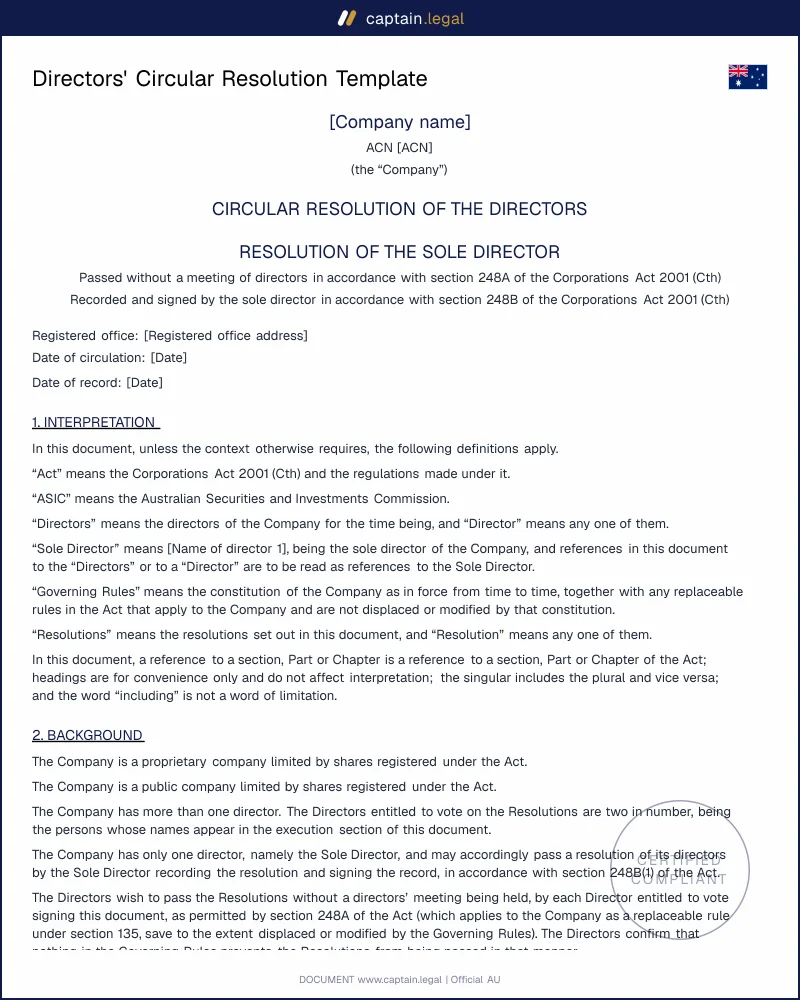
How to fill out this directors' circular resolution

You start by entering the company details and indicating whether the company has one director or several, since that choice determines whether the pack is built on s 248A or s 248B. The form then asks whether the company has adopted a constitution and whether it modifies the circular resolution rule, so the printed signing threshold matches your governance.

Next, you select the decisions you want to record. A bank signatory change opens fields for the account and signing combination, a share issue asks for the allottee, class, number and price of shares, and a director appointment generates the consent, the director ID declaration and the members' confirmation.

For companies limited by guarantee and charities, the questionnaire flags where a board charter and delegations pack may already set rules for written decisions. The template then adds a checklist of minute book, ASIC and register steps. Directors sign on paper or electronically, and the company secretary files the signed copies together.

Common mistakes to avoid

The error we see most often is a resolution signed by every director except one who was "travelling" or "would have agreed anyway". Under the default rule, a single missing signature means the resolution has not been passed, whatever the other directors intended. A close second is the board that issues shares in a proprietary company without dealing with the s 254D pre-emption rule, leaving the allotment open to challenge by an existing member. Another is the director appointed without a signed consent or a director ID, or a board that purports to remove a director when only members hold that power.

Timing errors are just as common. Companies record the resolution months later, file the ASIC notice late, or forget that the members of a proprietary company must confirm a board appointment within two months, failing which the director ceases to hold office. Finally, a resolution cannot fix a constitution that is silent on share classes or a cap table that was never documented. Our Australian company and commercial templates cover those foundations, and each resolution should be read against them before anyone signs.

Key takeaways

Board authority

All voting directors must sign

For companies with two or more directors, a circular resolution under s 248A of the Corporations Act 2001 only passes when every director entitled to vote signs the same resolution wording, even if they sign separate copies. A sole director uses s 248B. Check the constitution first, because it may change or exclude the replaceable rule.

Records

Minute it within one month

Once the last required signature is in, the company must record the resolution in its minute books within one month under s 251A(1). A director must then sign that record within a reasonable time. Done properly, the minute becomes evidence of the decision under s 251A(6), which helps with banks, auditors and later disputes.

Follow-up steps

Some approvals trigger ASIC filings

The resolution is often only the first step. A share issue can bring in s 254A, pre-emption rights under s 254D, ASIC notice under s 254X and share certificate timing under s 1071H. A director appointment needs written consent under s 201D, a director identification number, member confirmation in some proprietary companies and ASIC notice under s 205B.

Frequently Asked Questions

Yes. A circular resolution passed in accordance with s 248A or s 248B of the Corporations Act 2001 (Cth) has the same legal effect as a resolution passed at a directors' meeting. Its validity depends on the right people signing: every director entitled to vote under the replaceable rule, or the threshold set by your constitution if it modifies that rule. Once recorded in the minute book and signed by a director, the record is evidence of the decision under s 251A(6).

Under the replaceable rule in s 248A(1), yes: every director entitled to vote on the matter must sign a statement that they are in favour. A director who is not entitled to vote, for example a public company director with a material personal interest excluded by s 195, does not sign. The company's constitution can change this, allowing a majority or a set proportion of directors to pass a written resolution instead. If your constitution is silent, assume unanimity is required.

Yes. The Corporations Amendment (Meetings and Documents) Act 2022 permanently allows company documents, including circular resolutions, to be signed electronically. Any method is acceptable if it identifies the director and reliably indicates their intention to sign. Directors may each sign a separate copy under s 248A(2), and the resolution passes when the last one signs. Keep the signing audit trail with the minute book, because a bank or auditor will usually ask to see it.

The company must record a circular resolution in its minute books within one month of it being passed, under s 251A(1). Separate ASIC deadlines then run depending on the decision. A share issue must be notified within 28 days under s 254X, and share certificates are generally due within two months under s 1071H. A new director's appointment, or a resignation, must be notified within 28 days under s 205B. Late lodgement attracts ASIC late fees.

The default rule does not bend for travel. Electronic signing usually solves the practical problem, since a director can sign from any location. If the constitution or the replaceable rule in s 201K applies, a director can appoint an alternate with the approval of the other directors, by written notice to the company, and the alternate may then sign in that director's place. Failing that, the board can meet using technology consented to by all directors under s 248D, where a quorum suffices.

You receive the complete pack as an editable Word document and a print-ready PDF. The Word version lets your adviser adjust schedules, while the PDF is ready to sign on paper or electronically. The pack includes the resolution, the selected schedules, director consent forms, the members' confirmation and a post-signing compliance checklist. If you need related documents for the same transaction, the full catalogue of Australian legal templates groups them by category.

4.5/5

23 verified reviews · 50 000+ downloads

Board Decisions Without a Meeting | Circular Resolution AU
  • Immediate access to the document
  • PDF + Word download
  • Compliant with 2026 legislation
  • Reviewed by lawyers
Fill in the template
Secure payment
Updated on October 14, 2026

You might also like

Partnership Agreement AU
Privacy Policy Template Australia