Business

Selling Your Business? Agreement for Goodwill, Staff & Stock

Business sale contract drafted to s.38-325 GST Act, Part 2-8 Fair Work Act and state duty and retail lease rules (NSW, Vic, Qld, WA). Editable Word & PDF.
4.8/5— 12 reviews50 000+ downloadsInstant download
Share

A sale of business agreement is the contract that transfers an Australian business from vendor to purchaser as a going concern: its goodwill, trading stock, plant and equipment, business name, customer records and, in most cases, the premises lease. It fixes the price and its apportionment, the conditions to be met before completion, the fate of existing staff and the restraint that stops the vendor reopening around the corner. Our template is built for owners of cafes, trades businesses, clinics, retail stores and online shops who are selling or buying through an asset sale. It reflects the Commonwealth tax and employment rules and the state regimes that catch unrepresented parties.

Compliant

2026 Legislation

50,000+ clients

trust us

Affordable

From $4.90 / doc

Secure payment

Instant download

Selling Your Business? Agreement for Goodwill, Staff & Stock

Secure payment

Fill in the template

What is a sale of business agreement?

In Australian practice, a sale of business agreement (also called a business sale contract) documents an asset sale. The entity that owns the business, whether a sole trader, partnership, trust or Pty Ltd company, stays with the vendor. What changes hands are the assets listed in the schedules, and liabilities do not follow them unless the contract says so. Each asset moves by its own mechanism: equipment by delivery, the lease by assignment with landlord consent, a registered business name through ASIC, and some licences only by fresh application.

The alternative is a share sale, where the purchaser acquires the shares in the company and inherits everything inside it, good and bad. Share sales are governed by the Corporations Act 2001 (Cth), the constitution and any existing shareholders agreement for a Pty Ltd company, and they call for heavier due diligence. A heads of agreement is different again: it is usually non-binding, whereas the sale of business agreement is the binding instrument on which settlement depends.

When do you need this document?

The classic scenario is the retirement sale: an owner who has run a cafe or plumbing business for fifteen years hands it to an employee, a competitor or a purchaser found through a broker. Goodwill is usually the main asset, so the restraint and handover period carry the deal. The mirror image is the first-time purchaser who agreed a price over coffee and now needs a sale of business agreement tying it to verified accounts, a stocktake and the landlord's consent.

Franchise resales come next, with the franchisor's consent as a condition and the Franchising Code of Conduct, now in the Competition and Consumer (Industry Codes—Franchising) Regulation 2024, adding its own disclosure steps. Restructures are often overlooked: a sole trader moving the business into a new Pty Ltd company is still making a sale that must be documented at arm's length.

Two edge cases deserve a mention. A vendor selling one division of a larger enterprise can still qualify for the going concern exemption if that part is capable of separate operation, provided the asset list is complete. Executors selling out of a deceased estate need limited warranties that reflect their authority under the grant of probate.

Key clauses included in our template

  • The sale assets and excluded assets schedules list exactly what passes, from the business name and domain to phone numbers and customer databases. Cash at bank and debtors are excluded by default.
  • The purchase price and apportionment clause splits the price between goodwill, equipment and stock. That split drives each party's tax position and any duty assessment.
  • The GST clause records the going concern agreement in writing and adds a gross-up, so the purchaser pays any GST later assessed if a condition turns out to be unmet.
  • The stocktake clause provides for a joint count the day before completion, valued at the lower of cost and net realisable value, with a cap so neither side faces an inflated figure.
  • The conditions precedent cover landlord consent, finance, franchisor approval and licence transfers, each with a sunset date after which either party may terminate and recover the deposit.
  • The employees clause identifies transferring staff, records whether service is recognised and credits the purchaser for accrued leave it takes over.
  • The restraint of trade uses cascading periods and areas so a court can enforce the widest reasonable combination. For managers bound personally, it pairs with a separate restraint of trade deed for key employees.
  • The settlement adjustments clause apportions rent, outgoings, utilities and customer deposits at the completion date.

State and territory considerations

New South Wales has charged no duty on non-land business assets since 1 July 2016, so the friction lies with the premises. Under s 39 of the Retail Leases Act 1994 (NSW), a landlord may refuse consent to an assignment only on limited grounds. Under ss 41 and 41A, the landlord must supply an updated disclosure statement within 14 days of the tenant's request, and the outgoing tenant must hand its assignor's disclosure statement to the incoming tenant at least seven days before assignment to be released from ongoing liability. Our lease assignment and landlord consent document handles that step. NSW is also the only state with a restraint statute, the Restraints of Trade Act 1976 (NSW), which lets a court read down an excessive restraint under s 4.

Victoria imposes one of the strictest disclosure rules in the country. Under s 52 of the Estate Agents Act 1980 (Vic), the vendor of a small business below the prescribed threshold for goodwill, plant, equipment and fittings must give the purchaser a signed Statement by a vendor of a small business, covering the last two accounting periods, before the purchaser becomes bound. Without that statement the purchaser can avoid the contract and recover the money paid. Where a retail lease is assigned, s 61 of the Retail Leases Act 2003 (Vic) governs consent and disclosure. Victoria charges no duty on business assets other than land, and continuity of long service leave on a transfer is preserved by the Long Service Leave Act 2018 (Vic).

Queensland still charges transfer duty under the Duties Act 2001 (Qld) on Queensland business assets, including goodwill, business names, intellectual property and statutory licences. Duty is calculated on the greater of the price and the asset value, on the GST-inclusive amount where GST applies, so losing going concern status costs twice. The agreement must be lodged with the Queensland Revenue Office for assessment. Accrued long service leave carries over under the Industrial Relations Act 2016 (Qld) when staff stay on.

Western Australia also levies duty on business assets, goodwill included, under the Duties Act 2008 (WA). The bigger trap is employment. Sole traders, partnerships and some trusts remain in the state system under the Industrial Relations Act 1979 (WA), so the Fair Work transfer rules may not apply at all, and leave continuity follows the Long Service Leave Act 1958 (WA).

How to fill out this sale of business agreement

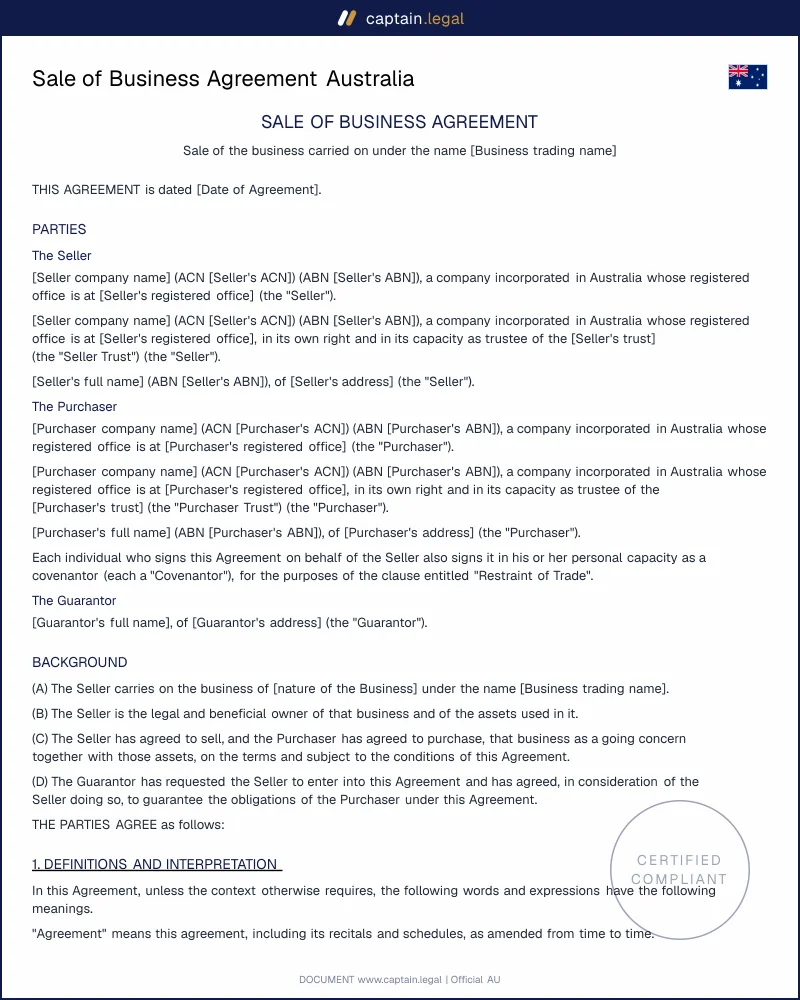
You start by naming the parties exactly as they appear on the ABN register, including any trustee capacity, and by adding guarantors such as the directors of a vendor company. The form then asks for the state or territory where the business operates and adjusts the duty wording, lease mechanics and disclosure references to match. You then enter the price, its apportionment and the deposit with the stakeholder holding it.

Next come the conditions that apply to your deal, each with its own deadline. The employee section lets you list transferring staff and choose whether service is recognised, which drives the leave adjustment at settlement. Once the questionnaire is complete, the agreement is generated with every schedule populated, ready for signature. Other Australian business contract templates, such as a supply agreement with a key supplier, often complete the same transaction.

Common mistakes to avoid

The most expensive error is a price that is silent on GST. A sale of business agreement stating the price is "plus GST if applicable" without a written going concern statement leaves both sides exposed, because the ATO reads the agreement as written, not as intended. Close behind is the vendor who closes for a week of painting before handover, because an enterprise that stops trading before the day of supply is no longer a going concern. Purchasers err on stock: "stock at valuation" invites a fight over obsolete items.

Employee entitlements are the next blind spot. A purchaser who recognises service without a matching price credit ends up funding years of leave accrued under the previous owner. Restraints fail the other way when a ten year, Australia wide clause is drafted for a single site bakery: no court will enforce it. And many purchasers forget that an ABN cannot be transferred. The purchaser must hold its own GST registration, or be required to hold one, by settlement, or the going concern exemption fails.

Key takeaways

GST

Going concern status must be written

A business sale is GST-free only if the conditions in s 38-325 of the GST Act are met, including a written agreement that the sale is a going concern. The purchaser must be registered or required to be registered, and the vendor must supply everything needed to keep trading until supply. If not, the vendor may lose one eleventh of the price to the ATO.

ASSET SALE

Assets transfer, liabilities usually do not

This agreement is for an asset sale, not a share sale under the Corporations Act 2001. The business owner keeps the selling entity, while goodwill, stock, equipment, customer records and the business name move under the contract and schedules. Liabilities stay behind unless the agreement says otherwise, and some assets need separate steps, such as landlord consent for a lease assignment.

STAFF

Employee transfers carry real cost

Part 2-8 of the Fair Work Act 2009 can apply when the purchaser employs the vendor's staff within three months to do substantially the same work. If prior service is recognised, annual leave can transfer under s 91. The vendor may avoid redundancy pay under s 122 where an employee rejects a substantially similar offer recognising prior service.

Frequently Asked Questions

Yes. Once both parties sign, the sale of business agreement is an enforceable contract, subject to the conditions written into it. Electronic signatures are valid under the Electronic Transactions Act 1999 (Cth), and a company can sign under s 127 of the Corporations Act 2001 (Cth) with two directors, or a director and secretary. No court registration is needed, although in Queensland and Western Australia the agreement must be lodged for duty assessment. What can undo it is a statutory breach, such as a missing Victorian s 52 statement or misleading figures under the Australian Consumer Law.

No. In an asset sale, employment with the vendor ends at completion and the purchaser decides whom to hire. If it employs former staff within three months for substantially the same work, the Fair Work Act 2009 (Cth) treats it as a transfer of business, and prior service may count for leave and future redundancy. Employees who receive no offer remain the vendor's responsibility, including notice and any redundancy pay.

Most contracts set completion 30 to 60 days after exchange, driven by the conditions rather than the paperwork. Landlord consent usually takes longest, particularly in NSW where disclosure statements must reach the incoming tenant at least seven days before assignment. The sunset date in the template gives both parties a clean exit, with the deposit refunded, if a condition is still unmet when that period ends.

Not if the sale qualifies as a GST-free supply of a going concern under s 38-325 of the GST Act. The sale must be for consideration, the purchaser must be registered or required to be registered for GST, the vendor must supply everything needed to keep the business running and trade until the day of sale, and both parties must agree in writing. If one condition fails, GST applies to the full price.

No statute sets a fixed limit. Courts enforce a restraint that protects the goodwill the purchaser paid for and nothing more (wider restraints are accepted against a vendor than an employee). In small business sales, two to five years over a radius tied to the customer base is commonly upheld. Cascading clauses let the court choose the widest reasonable option instead of voiding the restraint, and in NSW the Restraints of Trade Act 1976 (NSW) allows reading down.

Yes. The agreement is available as an editable Word file and as a PDF ready for signature. The Word version lets your accountant or broker insert detailed asset and employee schedules, while the PDF keeps the signed version locked. If the deal also needs a lease assignment or new employment contracts, the full catalogue of Australian legal templates covers those companion documents.

4.8/5

12 verified reviews · 50 000+ downloads

Selling Your Business? Agreement for Goodwill, Staff & Stock
  • Immediate access to the document
  • PDF + Word download
  • Compliant with 2026 legislation
  • Reviewed by lawyers
Fill in the template
Secure payment
Updated on October 14, 2026

You might also like

Shareholders Agreement Template Australia
Employment Contract Variation Letter