Real Estate

Non-Retail Commercial Lease | Options & Make-Good Covered

Lease drafted to s.133E Conveyancing Act (NSW), Property Law Act 2023 (Qld), PLA 1958 (Vic) and PLA 1969 (WA). Options, outgoings, make-good. Word and PDF.
4.7/5— 14 reviews50 000+ downloadsInstant download
Share

A commercial lease agreement for non-retail premises sets the terms on which an owner grants a business exclusive possession of an office suite, warehouse, factory unit or industrial yard that falls outside the state Retail Leases Acts. No disclosure statement, minimum term or statutory rent review regime protects either side, so the written lease carries almost the whole bargain. This template is built for landlords, tenants and property managers who need an office lease or industrial lease of the standard an Australian property practice would issue, with enforceable options, a complete outgoings regime, bank guarantee security and a make-good clause that still works when the keys come back.

Compliant

2026 Legislation

50,000+ clients

trust us

Affordable

From $4.90 / doc

Secure payment

Instant download

Non-Retail Commercial Lease | Options & Make-Good Covered

Secure payment

Fill in the template

What is a commercial lease agreement for non-retail premises?

In Australian law a lease is both a contract and a grant of an estate in land. The tenant receives exclusive possession for a term in return for rent, and that possession separates a lease from a licence, which is only a personal permission to occupy. The High Court drew the line in Radaich v Smith (1959) 101 CLR 209. A non-retail lease covers premises the retail legislation does not catch: professional offices, warehouses, factories, depots, laboratories and large premises above the statutory thresholds. Outside the retail regime, the parties are largely free to allocate risk, subject to the general law, each state's property statutes and the unfair contract terms rules in the Australian Consumer Law.

The boundary between retail and non-retail is where most drafting errors begin. A hair salon, a dry cleaner or a café in an office tower lobby may be a retail shop under the schedules to the NSW or Queensland Acts. If your premises qualify, use our retail lease agreement drafted to the Retail Leases Acts instead. A non-retail lease does not escape the statute, and clauses the landlord relied on, such as land tax recovery in Victoria, can fall away.

When do you need this document?

The most common use is a professional office: an accounting firm, an engineering consultancy or a software business taking a suite in a CBD tower or a suburban office park. The second is industrial and logistics space. A warehouse with hardstand, a cold store or a manufacturing unit brings racking, plant and three-phase power, and the lease must say who installs, maintains and removes each item. Owners of a single strata office who let it to a local business make up much of the rest of the market, alongside family trusts that lease a factory to an operating company in the same group.

Two edge cases deserve care. In CB Cold Storage Pty Ltd v IMCC Group (Australia) Pty Ltd [2017] VSC 23, the Supreme Court of Victoria treated a refrigerated storage warehouse as retail premises because its services were retail in character. The reverse also happens: a shop leased to a listed corporation sits outside the Victorian and Western Australian retail Acts, so a non-retail lease is correct even for a shopfront. For residential lettings and tenancy notices, see our state-specific property and tenancy documents.

Key clauses included in our template

  • The parties and execution clause names landlord and tenant with ABN or ACN and provides for signature under s.127 of the Corporations Act 2001. Before anyone signs, check that the tenant's company constitution setting out who may bind a Pty Ltd imposes no extra approval step.
  • The term and option to renew clause fixes the commencement date, initial term, further terms and exercise window. The no-breach condition is drafted to work with the statutory notice procedures in NSW and Queensland, not against them.
  • The rent review clause supports fixed increases, CPI reviews and market reviews by a valuer nominated by the Australian Property Institute.
  • The outgoings clause lists recoverable costs (rates, land tax, insurance, building services, common area cleaning) with the tenant's share by lettable area, an annual estimate and a reconciliation. Land tax is calculated on a single holding basis so the tenant never funds the landlord's other properties.
  • The security clause provides for a bank guarantee or cash bond equal to a stated number of months' rent plus GST, with an optional director's guarantee and indemnity.
  • The make-good clause requires removal of fitout, signage and cabling and return of the premises in the condition recorded at commencement, fair wear and tear excepted. Since Tabcorp Holdings Ltd v Bowen Investments Pty Ltd (2009) 236 CLR 272, a landlord can recover the cost of reinstating unauthorised works where reinstatement is a reasonable course.
  • The essential terms clause makes payment of rent and outgoings essential, so a landlord who terminates can claim loss of bargain damages for the balance of the term, subject to its duty to mitigate by reletting.

State-specific considerations

New South Wales applies the Retail Leases Act 1994 to businesses in its first schedule and to premises in retail shopping centres, excluding shops with a lettable area of 1,000 square metres or more. Under s.133E of the Conveyancing Act 1919, a landlord relying on a breach to defeat an option must serve a prescribed notice within 14 days after the tenant exercises it, and the tenant then has one month to seek relief under s.133F. A landlord who misses that 14-day window cannot later rely on the breach to refuse the renewal. Land tax is recoverable from a non-retail tenant only if the lease says so expressly.

Victoria defines retail premises broadly in s.4 of the Retail Leases Act 2003, but excludes leases to listed corporations and their subsidiaries and premises above the Act's annual occupancy cost threshold. Non-retail leases fall under the Property Law Act 1958, with s.146 requiring a breach notice before forfeiture. The sharpest difference is land tax, which s.50 of the Retail Leases Act 2003 bars a landlord from recovering from a retail tenant but which a properly drafted non-retail lease can pass on.

Queensland has the newest framework. The Property Law Act 2023 imposes a consent procedure under s.142: the tenant gives a proposal notice and the landlord must answer with a decision notice, with any conditions and reasons, within one month. The parties cannot contract out of that procedure, whatever the lease says. Breach notices must use the prescribed form and be copied to designated persons such as the tenant's mortgagee, and relief against refusal to renew sits in ss.163 to 167. For leases signed from 1 August 2025, the original tenant and its guarantor are released on a subsequent assignment by the incoming tenant. The Retail Shop Leases Act 1994 excludes shops past the 1,000 square metre threshold.

Western Australia applies the Commercial Tenancy (Retail Shops) Agreements Act 1985 to retail shops but excludes listed corporations and their subsidiaries, and shops above 1,000 square metres unless the regulations prescribe them. Non-retail leases fall under the Property Law Act 1969, where s.81 requires a notice specifying the breach before forfeiture for most breaches.

How to fill out this commercial lease agreement

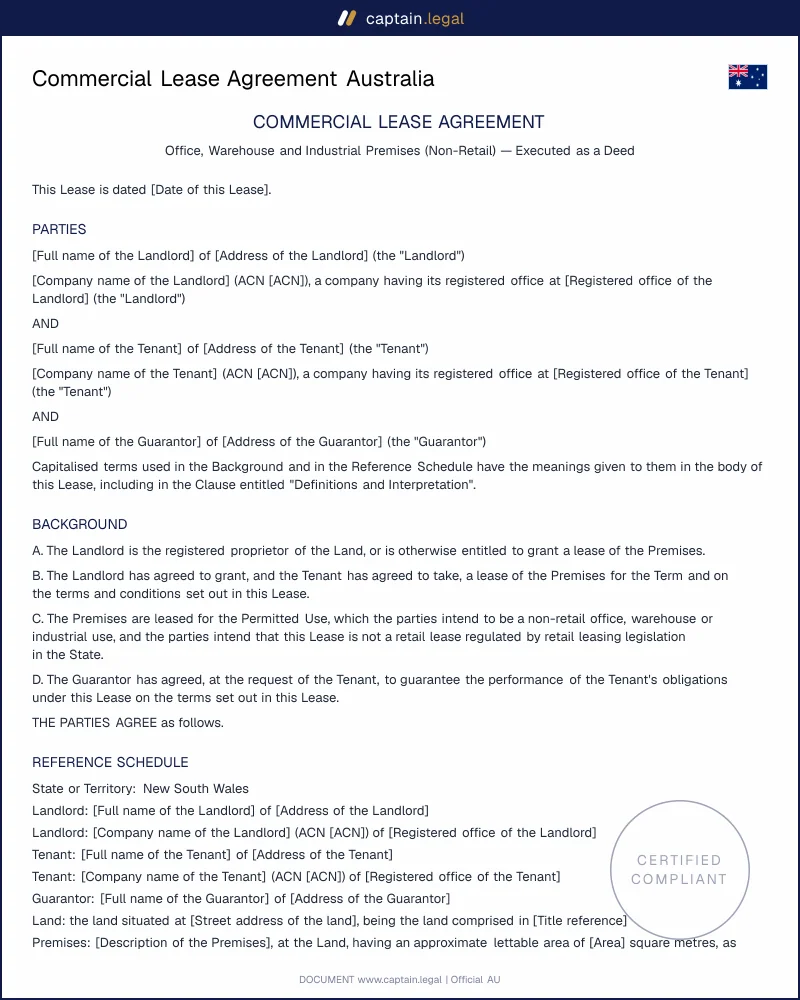
You start with a short eligibility check covering the state, the intended use, the lettable area and whether the tenant is a listed corporation. If the answers point to retail premises, the form says so before you draft the wrong document. From there you complete the reference schedule, the heart of any Australian commercial lease: parties, premises by reference to a plan, commencement date, term and options, starting rent, review method, share of outgoings and security. Where the tenant is a firm, every partner is named and signs, and a partnership agreement for businesses sharing premises and liability settles who bears the rent internally.

The next screen covers optional terms: a director's guarantee, a rent-free period or fitout contribution, car parking and signage. You then download the lease, attach the plan, condition report and fitout specification as annexures, and circulate it for signature.

Common mistakes to avoid

The mistake we see most often is a tenant missing its option window. Courts treat options strictly: a notice served one day late, sent to the wrong address or signed without authority is usually ineffective. Diarise the opening and closing dates of the option window on the day the lease is signed. The second mistake is starting without a condition report and dated photographs, which turns make-good into a contest of memories. A third is naming a trading name or a trust as tenant instead of the company or trustee that holds the lease, which leaves the landlord chasing the wrong party.

Execution causes its own problems. An owner signing through an attorney should confirm the power covers dealings with land and, in New South Wales, that it is registered with NSW Land Registry Services before the lease is lodged; our enduring power of attorney template for property and financial decisions is built for that use. Finally, watch the GST wording. A rent figure stated without "plus GST" is generally read as GST-inclusive, and the landlord loses one eleventh of every payment for the whole term.

Key takeaways

Retail status

Check retail status first

This template is for offices, warehouses, factories, depots, laboratories and other premises outside the state Retail Leases Acts. The boundary matters: a hair salon, dry cleaner or cafe in an office tower lobby may still be a retail shop. If retail legislation applies, the no-disclosure, no-minimum-term assumption can be wrong and key clauses may fail.

State rules

State Acts still control remedies

A non-retail lease is still controlled by state property statutes. In NSW, s.23C of the Conveyancing Act 1919 requires a land interest to be in writing, s.129 requires a breach notice before forfeiture except for unpaid rent, and s.133B limits refusal of assignment consent. Victoria, WA and Queensland have equivalent regimes.

Compliance

Standard forms now carry penalties

Since the 2023 amendments to Part 2-3 of the Australian Consumer Law, unfair terms in standard form small business leases are prohibited and can attract civil penalties. Check tenant size, bank guarantees, outgoings, options and make-good wording. GST treatment, energy disclosure for offices of 1,000 square metres or more, and registration of longer NSW or Queensland leases also need attention.

Frequently Asked Questions

Yes. A signed lease is enforceable as a contract and creates an interest in land. Writing is mandatory for leases longer than three years under s.23C of the Conveyancing Act 1919 (NSW) and s.53 of the Property Law Act 1958 (Vic), and advisable for every lease. A company signs under s.127 of the Corporations Act 2001, and s.129(5) lets the other side assume proper execution. Once completed and signed, the template is a binding lease, not a heads of agreement.

Yes. You receive an editable Word file for negotiated mark-ups and a print-ready PDF for signing and record keeping, both with the reference schedule and clause numbering intact. Companies can sign electronically, since s.127 of the Corporations Act 2001 now permanently allows electronic execution. For related paperwork, browse the complete catalogue of Australian legal templates.

It depends on the state. In New South Wales, a landlord treating a breach as defeating an option must serve the prescribed notice within 14 days after the tenant exercises it, under s.133E of the Conveyancing Act 1919. In Queensland, a landlord receiving a proposal notice for an assignment, sublease or alterations must give a decision notice within one month under s.142 of the Property Law Act 2023. Elsewhere, the lease sets the period, and our template fixes one for every consent.

Check the use, the size and the tenant. NSW and Queensland list retail businesses in schedules, while Victoria asks whether premises are used wholly or predominantly for retail sale or services. NSW, Queensland and Western Australia exclude shops around the 1,000 square metre mark, Victoria uses an occupancy cost threshold instead, and Victoria and Western Australia exclude listed corporations and their subsidiaries. If any answer is uncertain, treat the lease as retail until advice confirms otherwise.

Under a non-retail lease, yes, if an express clause makes land tax a recoverable outgoing; without it, land tax stays with the owner. Because land tax is assessed on the owner's total holdings, a tenant should insist on a single holding calculation, limited to the tax payable if the premises were the owner's only land. The landlord, for its part, should make sure the clause also covers any change in rate during the term.

A tenant who remains with the landlord's consent becomes a monthly tenant, a position known as holding over and, in New South Wales, confirmed by s.127 of the Conveyancing Act 1919. Our template continues the lease terms so far as they apply and lets either party end the tenancy by one month's written notice. Holding over is no substitute for an option, because the tenant's security never extends past the next month.

4.7/5

14 verified reviews · 50 000+ downloads

Non-Retail Commercial Lease | Options & Make-Good Covered
  • Immediate access to the document
  • PDF + Word download
  • Compliant with 2026 legislation
  • Reviewed by lawyers
Fill in the template
Secure payment
Updated on October 14, 2026

You might also like

Repair Request Letter Australia
Rent Increase Notice Australia