Real Estate

Landlord Won't Fix It? Repair Request Letter (AU)

Repair request drafted to the Residential Tenancies Acts: s.64 NSW, s.72 VIC, s.214 QLD, s.43 WA. Urgent repair caps, deadlines and reimbursement.
4.8/5— 21 reviews50 000+ downloadsInstant download
Share

A repair request letter is the written notice a tenant sends to a landlord or managing agent to report a defect in a rented home and require it to be fixed within the timeframe set by the Residential Tenancies Act of the relevant state or territory. The Captain.Legal template separates urgent repairs (a burst water service, a gas leak, failed hot water, a dangerous electrical fault) from non-urgent repairs and applies the correct statutory pathway to each. Sent properly, it preserves your right to reimbursement or a repair order later. It is drafted for tenants (renters, in Victoria), for attorneys acting on a tenant's behalf and for property managers who want a clean maintenance record.

Compliant

2026 Legislation

50,000+ clients

trust us

Affordable

From $4.90 / doc

Secure payment

Instant download

Landlord Won't Fix It? Repair Request Letter (AU)

Secure payment

Fill in the template

What is a repair request letter?

In Australian tenancy law, a repair request letter is a formal written notice that records three facts: what is broken, when the landlord was told, and what the tenant expects to happen next. Every state imposes a statutory duty on the landlord to keep the premises in a reasonable state of repair, and in practice that duty is activated by notice. A phone call proves nothing six weeks later at the tribunal. Victoria says renter, Queensland says lessor, but the rule is identical: written notice first, remedies second.

The letter is often confused with a notice to remedy breach. A repair request is the first, cooperative step. A breach notice is the escalation, served once the request has been ignored, with a formal deadline that opens the door to the tribunal. In Queensland the line blurs, since the prescribed Form 11 can itself be used to request routine repairs. Our template is drafted so that a repair request letter stands on its own as the written request the law requires before a NSW rectification order, a Consumer Affairs Victoria inspection or a QCAT repair order.

When do you need this document?

The textbook case is a hot water system that dies on a Friday evening. The tenant gets the agent's voicemail and needs a written record before ringing a plumber, because reimbursement depends on a reasonable attempt to notify the landlord first. The same letter, sent after the work is done, becomes the written notice of costs with receipts attached, which starts the statutory repayment clock. Non-urgent defects then make up the bulk of requests: a dishwasher that has stopped working, a loose bathroom tile, a window that no longer locks, persistent mould in a bedroom. Each deserves a dated letter rather than a mention at a routine inspection, and mould especially, because by the time it reaches the tribunal the landlord argues nobody reported it.

Tenants also send a repair request letter when management changes, so the new agent inherits a documented list. An adult child managing an elderly parent's rental can sign on the parent's behalf under an enduring power of attorney for financial matters, and should state that capacity in the letter. One edge case catches people out. Residents of rooming accommodation in Queensland have no emergency repair pathway at all, and lodgers excluded from the Act elsewhere depend on their occupancy agreement, so the letter there asks for repairs as a contractual matter.

Key clauses included in our template

  • The parties and premises are identified with the names and address for service exactly as they appear in the residential tenancy agreement for your state. Any nominated repairer in that agreement is also recorded, since NSW and Queensland expect the tenant to try that tradesperson first.
  • A classification paragraph states whether the defect is urgent or non-urgent and quotes the relevant limb of the statutory definition. That sentence settles most later arguments about which pathway applied.
  • The description of the defect gives the date it was first noticed, its location and its effect on the use of the home. It refers to dated photographs annexed to the letter.
  • A requested completion date asks for immediate action on urgent work and a firm deadline for non-urgent work. The deadline follows the 14-day period in Victoria and the "reasonable time" standard elsewhere.
  • Access arrangements set out the tenant's availability. They remind the landlord that entry for repairs still requires a statutory notice of entry for repairs and inspections unless the matter is an emergency.
  • Where the tenant has arranged urgent work, a reimbursement schedule itemises each cost, identifies the licensed tradesperson and attaches receipts. The total is checked against your state's cap.
  • A short reservation of rights notes, without threatening, that the tenant may escalate to the regulator or tribunal. A measured tone reads far better in a tribunal file.

State and territory considerations

New South Wales defines urgent repairs in section 62 of the Residential Tenancies Act 2010 (NSW). Under section 64, a tenant who notified or tried to notify the landlord, and who tried any nominated tradesperson, may arrange the work through a properly qualified person. The landlord must reimburse reasonable costs within 14 days of written notice with receipts, up to a cap of 1,000 dollars. For non-urgent repairs, the written request comes first, then a landlord rectification order from NSW Fair Trading under section 65C or an application to NCAT under section 65.

Victoria gives renters a high fixed ceiling. Section 72 of the Residential Tenancies Act 1997 (Vic) lets the renter pay for urgent work up to 2,500 dollars including GST, and the rental provider must reimburse within 7 days of written notice. Section 73 also allows an urgent VCAT application, heard within two business days. Non-urgent repairs must be done within 14 days of a written request; after that the renter may seek a free inspection report from Consumer Affairs Victoria under section 74 or apply to VCAT under section 75.

Queensland uses the term emergency repairs, defined in section 214 of the Residential Tenancies and Rooming Accommodation Act 2008 (Qld). After trying the lessor, agent or nominated repairer, the tenant may engage a suitably qualified person up to four weeks' rent, which can exceed the Victorian cap on higher rents. The lessor has 7 days from written notice to reimburse. Routine repairs go through a Form 11 notice, RTA dispute resolution on Form 16, then a QCAT repair order, although section 191 allows a direct application where health or safety is at stake.

Western Australia splits urgent work into essential services and other urgent repairs under section 43 of the Residential Tenancies Act 1987 (WA) and the Residential Tenancies Regulations 1989. The landlord has 24 hours to arrange repairs to an essential service such as water, gas, electricity or sewerage, and 48 hours for any other urgent repair. If nothing happens, the tenant may have the work done to the minimum extent necessary and recover the reasonable expense, through the Magistrates Court if required. The Act sets no dollar cap, so receipts and a contact log carry even more weight.

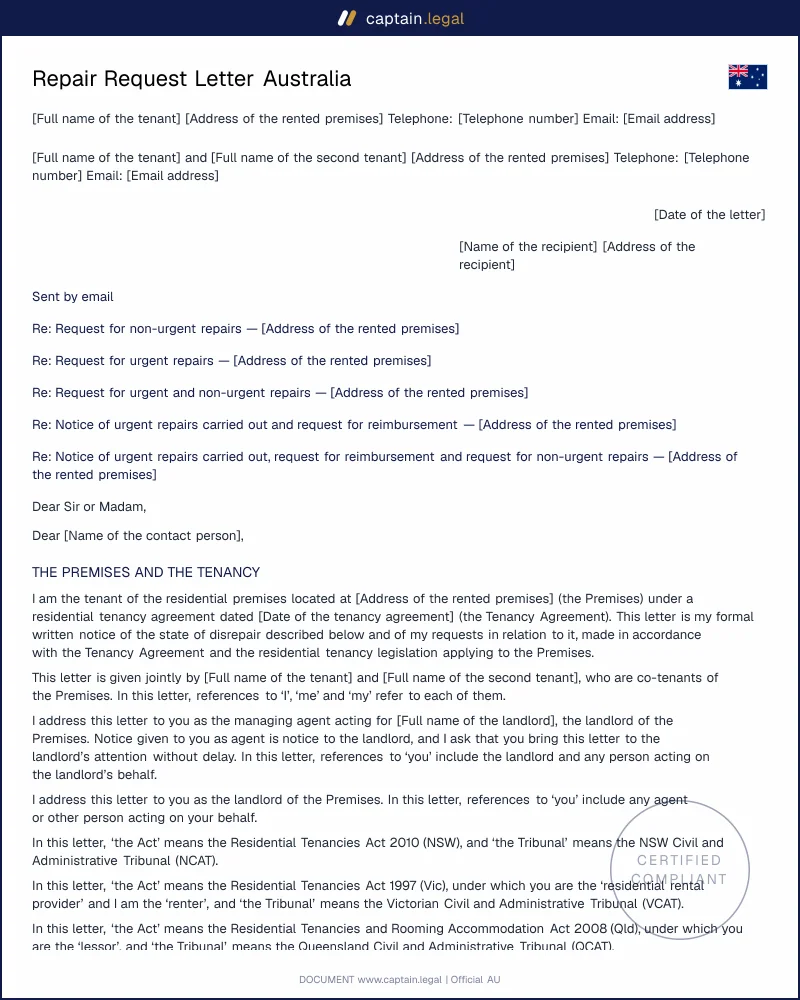
How to fill out this repair request letter

You start by choosing the state or territory where the property is located, which sets the statutory references, the terminology (tenant or renter, landlord or lessor) and the timeframes printed in the letter. The form then asks you to classify the problem, and the template either places your request on the urgent pathway or drafts it as a non-urgent request with a deadline. Next, describe the defect as you would to a tradesperson: where it is, when it started and what it stops you doing. "Hot water unit in the laundry stopped heating on the evening of the 12th; no hot water for showers or dishes" is far stronger than "hot water not working".

If you have already paid for urgent work, an extra step opens for the reimbursement schedule, with each invoice and the tradesperson's licence number. Finally, you confirm the method of service using the address in your tenancy agreement. Keep a signed copy with proof of sending.

Common mistakes to avoid

The most expensive mistake is treating a non-urgent defect as an emergency. A tenant who pays a plumber for a dripping tap cannot force the landlord to reimburse the bill. The second is overspending: tenants who exceed the cap often lose the excess, so a high quote calls for an urgent tribunal application instead. A third trap is ignoring the nominated repairer in the agreement and calling a favourite tradesperson; in NSW and Queensland that alone can defeat a reimbursement claim.

The other errors are about paper. A request mentioned in passing during an inspection, or sent to an inbox that is not the address for service, is hard to prove later. Many tenants also stop paying rent in frustration, which hands the landlord a breach of their own. When a repair request letter is ignored, escalate through a formal notice to remedy breach under your state's Act, not a rent strike. Keep every receipt, photo and email in one folder from the first day the defect appears.

Key takeaways

NOTICE

Put every defect in writing

Under state Residential Tenancies Acts, the landlord's duty to keep premises in reasonable repair is triggered by notice. A letter records what broke, when notice was given and what fix is requested. That paper trail matters if you later seek a NSW rectification order, Consumer Affairs Victoria inspection or QCAT repair order.

URGENT REPAIRS

Classify repairs before booking trades

The template separates urgent repairs from routine work because the pathway changes. Burst water, gas leaks, failed hot water, dangerous electrical faults and unsafe premises usually sit in the urgent category. Only then may a tenant follow the statutory process to arrange work directly and claim reimbursement up to the applicable cap. For other defects, get written consent first.

ESCALATION

Keep paying rent while escalating

A repair request is the cooperative first step, not the breach notice itself. If the landlord ignores it, the next move may be a formal notice or a tribunal application. Rent must still be paid while repairs are disputed. Tribunals can order the work, reduce rent, or direct rent into a tribunal account or Victoria's Rent Special Account.

Frequently Asked Questions

The letter does not create new obligations, because the landlord's repair duty already exists under the Residential Tenancies Act of your state. Written notice starts statutory timeframes, such as the 14 days for non-urgent repairs in Victoria, and it is a precondition for most remedies, including NSW rectification orders and QCAT repair orders. A letter that names the parties correctly, describes the defect precisely and is served at the address for service is strong evidence that the landlord was informed, and tribunals treat it that way.

Urgent repairs must be attended to as soon as possible, and Western Australia sets hard limits of 24 hours for essential services and 48 hours for other urgent work. Non-urgent repairs must be completed within 14 days of a written request in Victoria and within a reasonable time elsewhere, judged against the nature of the defect. Reimbursement deadlines are separate: 14 days in NSW, and 7 days in Victoria and Queensland once the landlord receives your notice and receipts.

No. Withholding rent is not a lawful remedy anywhere in Australia, and a tenant who stops paying is exposed to a termination notice for arrears, however justified the complaint. The proper route is a tribunal application, where you can ask for an order requiring the repairs, a rent reduction for the period the home was affected, or compensation. Tribunals in NSW and Victoria can also redirect rent away from the landlord until the work is finished.

A notice given in retaliation for a legitimate repair request is open to challenge. NSW, Victoria, Queensland and Western Australia all allow the tribunal or court to set aside a termination notice, or refuse to act on it, where it was motivated by the tenant exercising their rights. A calm, dated repair request letter is the best evidence you have that the complaint came first. If a notice to vacate follows soon after, contact your state's tenant advocacy service quickly.

Once the questionnaire is complete, the letter is available immediately as an editable Word file and a print-ready PDF. The Word version lets you adjust the wording before sending, while the PDF keeps its layout on any device and is the version to email or post. Both versions carry the statutory references for your state, and the other forms you may need later sit in the full catalogue of Australian legal templates.

For urgent repairs, apply straight to the tribunal: VCAT, QCAT and NCAT list urgent repair matters quickly, and in WA the Magistrates Court hears tenancy disputes. For non-urgent repairs, the usual escalation is a notice to remedy breach, then the regulator's dispute or inspection service, then a tribunal application. Keep copies of everything you send. Your original request becomes exhibit one, and the related notices sit in our Australian tenancy and real estate documents category.

4.8/5

21 verified reviews · 50 000+ downloads

Landlord Won't Fix It? Repair Request Letter (AU)
  • Immediate access to the document
  • PDF + Word download
  • Compliant with 2026 legislation
  • Reviewed by lawyers
Fill in the template
Secure payment
Updated on October 13, 2026

You might also like

Residential Tenancy Agreement Template
Notice of Entry Template Australia