Business

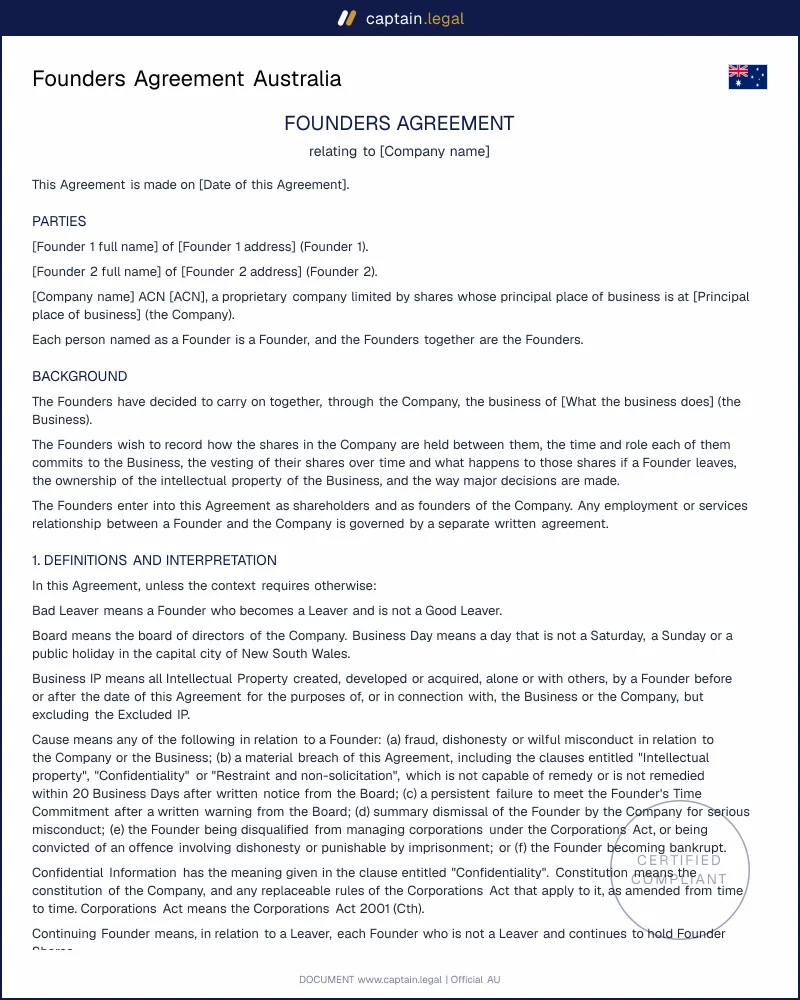
Founders Agreement Australia (vesting, leavers and IP for a Pty Ltd)

Founders agreement for 2 to 4 co-founders of an Australian Pty Ltd, registered or about to be: shares and roles, vesting with a cliff, good and bad leaver rules, IP assigned to the company, Reserved Matters, transfers, drag-along and tag-along, confidentiality and restraint. Word and PDF.
4.6/5— 15 reviewsAustralian law 2026Instant download
Share

A founders agreement is the contract co-founders of an Australian startup sign to settle who owns what, who does what and what happens to the shares when someone walks away. This template is built for two to four founders of a proprietary company limited by shares, whether the Pty Ltd is already registered with ASIC or about to be. It covers the share split, vesting with a cliff, good and bad leaver rules, the assignment of intellectual property to the company and the decisions that need the founders' sign-off.

Compliant

2026 Legislation

50,000+ clients

trust us

Affordable

From $4.90 / doc

Secure payment

Instant download

Founders Agreement Australia (vesting, leavers and IP for a Pty Ltd)

Secure payment

Fill in the template

What is a founders agreement?

In Australian practice, a founders agreement is a private contract between the people who start a company together, usually signed before outside money arrives. It sits beside the company's constitution and does a job the constitution cannot do on its own: it ties each founder's shares to their continued work in the business. The core mechanism is reverse vesting. Each founder holds all their shares from day one, votes them and receives dividends on them, but the shares "vest" over a period, typically 48 months with a 12-month cliff. If a founder leaves early, the unvested portion can be called back by the founders who stay, or by the company, at a low price. That is the difference between a team that survives a departure and a cap table frozen by a co-founder who stopped turning up in month five.

People often confuse this document with a shareholders agreement for an Australian Pty Ltd, which governs an established company with several investors, board seats and funding rounds and rarely says anything about time commitment or code written in a garage. A founders agreement is narrower and earlier. Many startups sign one at incorporation and replace it with a full shareholders deed at the seed round, when investors bring their own term sheet.

When do you need this document?

The classic moment is incorporation day. Two or three people have worked on a product for a few months, they register the Pty Ltd, and the shares are split on a handshake. That is when the agreement costs the least to sign, because nobody has left yet and the vesting conversation is still hypothetical. The second trigger is a new co-founder joining an existing company: the incoming person wants equity, the original founders want proof of commitment, and a cliff answers both.

Fundraising is the third. Angel investors and accelerators routinely ask whether the founders' shares vest and whether the company owns its IP, and an unsigned team can lose weeks in due diligence. A fourth case is the part-time founder who keeps a day job for the first year; the template records each founder's time commitment separately. One edge case comes up often: a founder who wrote the prototype before the company existed owns that code personally until it is assigned in writing, so the template lists it as contributed IP. If a founder is also paid as an employee, that relationship needs its own written agreement, such as an Australian employment contract compliant with the Fair Work Act.

Key clauses included in our template

The opening clauses identify the company (registered with its ACN, or still to be registered), describe the business in a line that later frames the IP assignment and the restraint, and list each founder with their role, time commitment and number of ordinary shares in Schedule 1. Vesting follows, with your own vesting period, cliff and monthly or quarterly instalments, and a choice between no acceleration, single trigger acceleration on a sale and double trigger acceleration if a founder is let go within 12 months after a sale.

  • Departures are where most disputes start, so the leaver clause defines a Good Leaver (death, incapacity, termination without cause, and resignation with notice if you choose) and a Bad Leaver.
  • Unvested shares can always be called back at the lower of the issue price and fair market value; for a Bad Leaver, you decide whether vested shares are kept, sold at fair market value or sold at the lower figure.
  • An independent valuer acting as an expert fixes fair market value when the departing founder and the board disagree.
  • Intellectual property created for the business passes to the company, future work included, with a moral rights consent drafted to the standard of s 195AWA.

Governance clauses give each engaged founder a board seat and list twelve Reserved Matters, from issuing shares to winding up, that need the approval of all founders or of founders holding 75% of the founder shares. Transfers are locked by a right of first refusal, with drag-along at 75% and tag-along when a buyer would take control. Confidentiality, an optional cascading restraint, warranties, a deadlock procedure, mediation and a Deed of Accession complete the document.

How to fill out this founders agreement

You start by telling the form whether the company is already registered. If it is, you enter its name and ACN and the company signs alongside the founders; if not, the wording switches so the founders sign now and the company joins through the Deed of Accession within 10 business days after registration. Next come the business description, the date and the number of founders, which opens one identity screen and one role screen per person: full name, address, email for notices, title, responsibilities, time commitment and share count.

The questionnaire then moves to the issue price and an optional employee share pool. The vesting screen asks for the vesting commencement date, which can be earlier than the signing date if the founders have already been working together, and for the vesting period and cliff in months. Leaver rules, acceleration and the notice period come next, followed by the approval threshold for Reserved Matters, any existing IP a founder contributes, the restraint and the governing State or Territory. The preview updates with each answer, so the founders can read the clauses together before generating the Word and PDF files.

Common mistakes to avoid

The most expensive mistake is signing nothing. Founders who split shares equally with no vesting discover, usually in year two, that the co-founder who left after six months still owns a third of the company and can block a funding round. The second is leaving IP with the person who created it: a pitch deck that promises a proprietary platform means little if the source code was never assigned in writing. Third, teams copy a US template that refers to Delaware law and to a board vote that "repurchases" shares, a mechanism that ignores the buy-back rules in Part 2J.1. A buy-back done without the resolution required by s 257D can be challenged later.

Paperwork after signing is the other blind spot. Every later transfer of leaver shares must be entered in the member register and notified to ASIC within 28 days under ss 178A and 178D; teams that forget the lodgement end up with a register that does not match the cap table. Founders also set restraints that are far too wide, such as five years across the world, which courts will not enforce, and the template steps down automatically to shorter periods and smaller areas. When the time comes to buy out a co-founder's vested shares, use a proper share sale agreement for a Pty Ltd rather than an email exchange.

Key takeaways

VESTING AND LEAVERS

Shares are earned over time, not on day one

Each founder's shares vest over a period you choose, usually 48 months with a 12-month cliff, then monthly or quarterly. A founder who leaves can be required to sell back the unvested shares at the lower of the issue price and fair market value, offered first to the founders who stay, and keeps the vested ones. A Bad Leaver, for example one dismissed for fraud, can also lose vested shares, on the terms you select.

COPYRIGHT ACT 1968

The code and the brand belong to the company

An assignment of copyright has no effect unless it is in writing and signed by the assignor (section 196(3)), and a patent assignment must be signed by both sides (Patents Act, section 14). The agreement assigns all IP created for the business, including future work, lists any existing IP a founder contributes, and records a moral rights consent in the specific form section 195AWA requires, so the company can edit and adapt the work.

CORPORATIONS ACT 2001

Registered now or later, the company is covered

If the Pty Ltd already exists, it signs the agreement. If not, the founders sign now and the company ratifies after registration by signing the Deed of Accession, as section 131 allows. Share issues must be notified to ASIC within 28 days (section 254X), and a buy-back of a leaver's shares follows Part 2J.1, including the special resolution of section 257D on which the leaver cannot vote in favour.

Frequently Asked Questions

It becomes a binding contract once each founder signs it, and the company is bound when it signs too, either directly or through the Deed of Accession after registration. Australian law does not require it to be witnessed or lodged anywhere, but the template provides a witness line for each founder because evidence of signature matters if a dispute reaches court. Two points deserve attention. The constitution must permit the transfers and buy-backs the agreement describes, which is why the founders promise to amend it if needed. And the restraint is enforced only to the extent a court finds it reasonable.

Yes, and the form supports that scenario. The founders sign first, the company is registered with each founder named as a member and director in the application, and the founder shares are taken to be issued on registration under s 120 of the Corporations Act. Within 10 business days, the new company signs the Deed of Accession in Schedule 2, which ratifies the agreement under s 131 and accepts the IP assignment. Until then, each founder holds the business IP for the benefit of the company. Founders still choosing a structure can browse the business and startup templates for Australian companies first.

None of their shares has vested, so all of them are Leaver Shares. The board, without the departing founder voting, can serve a Leaver Notice within three months, and the shares are offered to the remaining founders in proportion to their holdings, or to someone the board nominates, such as a replacement founder. The price is the lower of the issue price and fair market value, which for shares issued at a nominal price usually means the founder recovers what they paid. Any shares not taken up within 20 business days can be bought back by the company under Part 2J.1.

Both formats are generated at the end of the questionnaire. The PDF is ready to print or send for electronic signature, and the agreement expressly allows signing in counterparts and exchanging signed copies electronically. The Word version lets your lawyer or accountant add a bespoke clause before signing, for example a milestone for a part-time founder or an investor's consent right. If you edit the text, keep the defined terms consistent, especially Leaver, Vested Shares and Fair Market Value, because several clauses rely on them working together.

Most teams complete the questionnaire in 20 to 30 minutes once they have agreed the share split and the vesting terms; that conversation, not the form, usually takes the longest. After signing, the timeline depends on the company's status. A registered company has 28 days to notify ASIC of any new share issue, and a company still to be registered must sign the Deed of Accession within 10 business days after registration. If you also need a contractor agreement for a founder, the full catalogue of Australian legal templates lets you prepare it in the same week.

A constitution is strongly advisable. The replaceable rules of the Corporations Act apply if you have none, but they were not written for vesting, leaver buy-backs or Reserved Matters, and the agreement asks the founders to make the constitution consistent with it. A full shareholders agreement becomes useful later, typically when outside investors take a stake and want board rights, information rights and anti-dilution protection. At that point, investors normally ask the founders to replace the founders agreement with a new deed, often keeping the vesting schedule in place.

4.6/5

15 verified reviews · Australian law 2026

Founders Agreement Australia (vesting, leavers and IP for a Pty Ltd)
  • Immediate access to the document
  • PDF + Word download
  • Compliant with 2026 legislation
  • Reviewed by lawyers
Fill in the template
Secure payment
Updated on November 20, 2026

You might also like

Service Agreement Template Australia
Privacy Policy Template Australia