Non-Profit

Donation Receipts Donors Can Claim | DGR Template AU

Gift receipts drafted to s 30-228 ITAA 1997 and ATO guidance: DGR name, ABN, gift statement and date. Covers event contributions and property gifts.
4.8/5— 22 reviews50 000+ downloadsInstant download
Share

A donation receipt template lets an Australian deductible gift recipient issue DGR compliant tax-deductible gift receipts in a consistent, audit-ready format. Each receipt names the organisation or gift fund, shows its ABN, states that the payment is a gift, and records the amount and the date received: the details donors need at tax time, and the first ones the ATO looks at when it reviews an endorsed charity. Treasurers of incorporated associations and finance officers at companies limited by guarantee use it all year. It also covers deductible contributions at fundraising events and auctions, where one careless sentence can turn a valid deduction into a disallowed one.

Compliant

2026 Legislation

50,000+ clients

trust us

Affordable

From $4.90 / doc

Secure payment

Instant download

Donation Receipts Donors Can Claim | DGR Template AU

Secure payment

Fill in the template

What is a donation receipt template?

A donation receipt is the written acknowledgment a DGR gives a donor as evidence of a gift of money or property. It is not a tax invoice, it is not a contract, and the law does not oblige a DGR to issue one. Once the organisation chooses to, however, the content is prescribed by s 30-228 of the Income Tax Assessment Act 1997 (Cth), and the ATO checks receipt wording when it reviews whether a DGR remains entitled to endorsement. A donation receipt template fixes those elements so that every receipt carries the same mandatory wording in the same order.

Two related documents are often mistaken for it. A thank-you letter may describe the project a gift funded, but without the prescribed details it does not serve as a receipt for tax purposes. A tax invoice belongs to a taxable supply, whereas a payment made by way of gift to a non-profit body is not consideration under s 9-15(3)(b) of the A New Tax System (Goods and Services Tax) Act 1999 (Cth). The receipt also differs from a deed of gift for transferring significant property, which the donor signs to pass ownership of land, shares or other valuable assets.

When do you need this document?

Most organisations reach for a template at the end of the financial year. Donors ask for receipts before lodging their returns, and the treasurer discovers that the online platform, the bank deposits and the cash tin have each produced different paperwork. A standard donation receipt brings those channels under one format. The second trigger is DGR endorsement itself, since a newly endorsed charity needs a compliant receipt from its first gift and its gift fund rules usually say so. Auditors asking for sample receipts provide the third.

Disaster appeals create pressure of another kind. After floods or bushfires, gifts arrive in volume from first-time donors, and the ATO recommends stating DGR status in appeal material and receipts. Gala dinners and auctions are where the template earns its place, as the receipt must describe a contribution and the deductible amount depends on what the donor received in return.

Edge cases come up regularly. An auxiliary or local committee collecting for a DGR must receipt in the name and ABN of the endorsed entity, never its own. A business paying for logo placement or advertising is a sponsor, not a donor, and needs a tax invoice. Issuing a gift receipt for a sponsorship deal misdescribes the transaction.

Key clauses included in our template

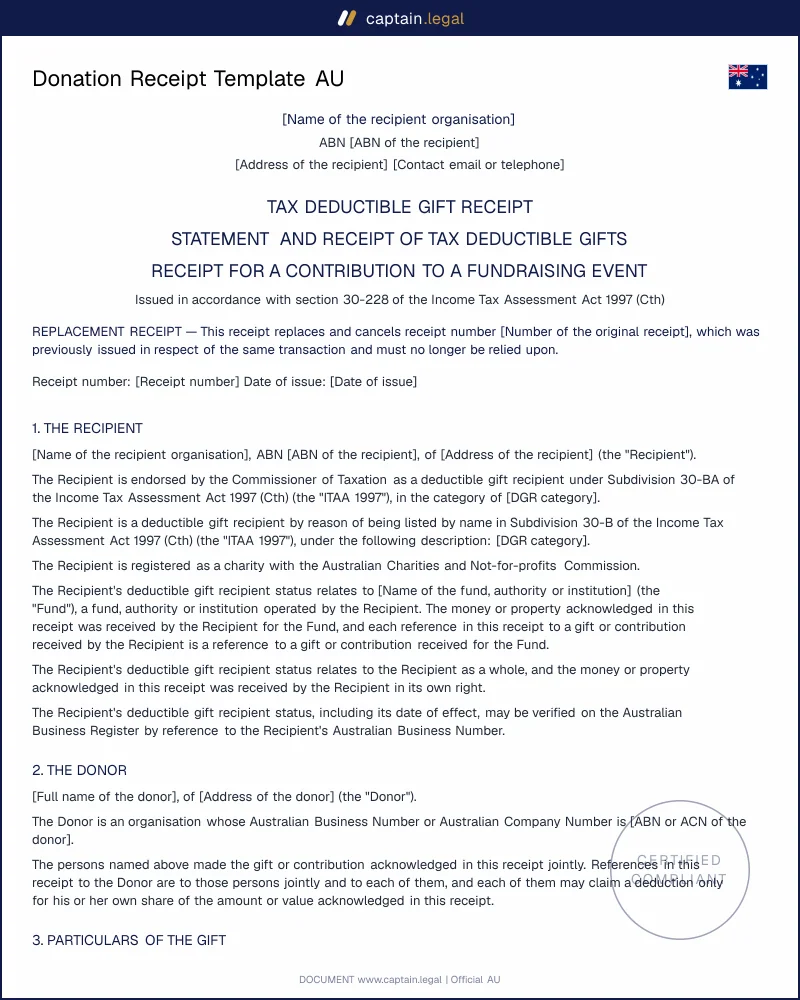
Our donation receipt template opens with the identity block that s 30-228 requires: the full legal name of the DGR, or of the gift fund where only a fund is endorsed, the ABN and a short statement of DGR status. A unique receipt number follows, issued in sequence so that a cancelled or reissued receipt leaves an audit trail rather than a gap. Donor details come next.

The body carries the substance. A dedicated line states in plain words that the payment is a gift and that the donor received no material benefit, while the amount appears in figures and in words to deter alteration. The date the gift was received sits apart from the date of issue, which matters on 30 June when a transfer straddles two income years. Gifts of property switch the form to a description field, with room to record how the value was set and whether an ATO valuation applies, because a receipt that repeats the donor's own estimate is a familiar audit flag.

For events and auctions, the template swaps in a contribution statement and calculates the deductible portion by subtracting the GST-inclusive market value of the benefit, provided the transaction passes the minor benefit test in the contribution items of the s 30-15 table. The closing section covers payment method, authorised signatory and an optional annual summary for regular givers. A short collection notice explains how donor information is handled, and charities taking gifts online should pair it with a Privacy Act 1988 compliant privacy policy.

State and territory considerations

Receipt rules are federal and identical across the country, but the fundraising that generates gifts is licensed state by state. In New South Wales, the Charitable Fundraising Act 1991 (NSW) requires an authority to fundraise from NSW Fair Trading before a public appeal begins. ACNC-registered charities are automatically eligible but must still obtain the authority, and holders follow the national fundraising principles on ethical conduct and transparency. Organisations outside the ACNC system face a fit and proper assessment and lodge financial returns directly with the regulator.

Charities raising money in Victoria deal with Consumer Affairs Victoria under the Fundraising Act 1998 (Vic). For an ACNC charity, registration with the Commission largely replaces registration as a fundraiser, provided it notifies the regulator of its intention to fundraise. Bodies outside the ACNC register in the ordinary way, and ACNC charities apply the national principles.

Since 1 May 2023, fundraisers in Queensland have worked under a simplified Collections Act 1966 (Qld) regime. An ACNC-registered charity is deemed registered once it notifies the Office of Fair Trading, while other organisations still apply under the Act. Skipping that notification means collecting without authority, and the regulator can act against the appeal even though the donor's deduction turns solely on federal law.

Western Australia remains the outlier. The Charitable Collections Act 1946 (WA) still requires a licence for charitable collections, ACNC charities included, until amendments deeming registered charities licensed on notice to the Commissioner for Consumer Protection take effect. Confirm the commencement status before launching a WA appeal on the assumption that ACNC registration is enough. South Australia and the ACT generally treat ACNC registration as sufficient, Tasmania still requires its own approval under the Collections for Charities Act 2001 (Tas), and the Northern Territory has no dedicated fundraising statute.

How to fill out this donation receipt template

You begin by choosing the receipt type: a single gift, a contribution at an event or auction, or an annual summary for a regular donor. The questionnaire then asks for the DGR details exactly as they appear on the Australian Business Register, including whether the endorsement covers the whole organisation or only a named gift fund. From there you enter the donor, the amount, the date received and the payment method. The wording adjusts as you go, replacing the gift statement with a contribution statement and opening the benefit value fields where needed.

Property gifts take a slightly longer path, with fields for a description of the item and the basis of its value. Once complete, the donation receipt downloads in Word for editing or PDF for sending, and the numbering field continues the sequence your accounts already use. The other Australian non-profit and charity templates follow the same logic, so the receipt sits comfortably beside constitutions, minutes and policies.

Common mistakes to avoid

The error seen most often is a receipt missing the words that make it a receipt for a gift. A platform confirmation email showing the amount and the charity's logo looks complete, yet without the gift statement and the ABN it falls short of s 30-228. A close second is receipting the full price of a gala ticket or a raffle ticket as a donation: raffle tickets are never deductible, and event tickets qualify only as contributions that pass the minor benefit test.

Property gifts cause quieter trouble. Recording whatever value the donor suggests, with no description and no note on how the figure was reached, invites a challenge to the deduction. Dates are another trap: the receipt must show the date the gift was received, not the day in July when the cheque was finally banked, or the donor claims in the wrong income year. Gaps and duplicates in receipt numbers then undermine the reconciliation an auditor depends on. Sound cash handling prevents most of these errors upstream, and a financial controls and complaints policy pack for NFPs gives the committee a written process.

Key takeaways

RECEIPT CONTENT

The receipt wording is prescribed

Under s 30-228 of the Income Tax Assessment Act 1997 (Cth), a DGR gift receipt must name the fund, authority or institution, show the DGR's ABN where it has one, and state that it is for a gift. For deductible contributions, it must say contribution. The ATO also expects the date and, for property, a description.

GIFT STATUS

A gift cannot buy a benefit

A tax-deductible gift is a voluntary transfer of money or property made out of benevolence, with no material benefit returning to the donor, as described in TR 2005/13. The receipt is not a tax invoice and not a contract. At fundraising dinners, auctions or events, careless wording can make a deduction harder to claim.

ENDORSEMENT

DGR status must be current

A receipt cannot rescue a gift made after DGR endorsement has been revoked or an ABN has been cancelled. Most non-government DGRs must also be registered charities with the ACNC. Keep the receipt trail audit-ready: registered charities must retain financial records for seven years under s 55-5 of the Australian Charities and Not-for-profits Commission Act 2012 (Cth).

Frequently Asked Questions

A receipt generated from a template is valid if it contains what s 30-228 of the Income Tax Assessment Act 1997 (Cth) requires: the name of the DGR or its gift fund, the DGR's ABN where it has one, and a statement that the receipt is for a gift. The ATO also looks for the date and, for property, a description. Validity turns on that content and on the issuer holding DGR endorsement on the day the gift is received, not on its design.

Nothing in the tax law forces a DGR to issue receipts; the rules only govern content once a receipt exists. Donors still need written evidence for most claims, and while the ATO accepts bank statements, payroll giving statements and similar records in many cases, a proper receipt saves time for everyone. Most charities therefore receipt every gift automatically and send regular donors an annual summary in July.

Only an endorsed DGR, or an entity listed by name in Division 30, can receive tax-deductible gifts. A community group without endorsement can still thank donors and acknowledge payments, but it must not describe them as deductible. Doing so misleads the donor and can draw the attention of the ATO and state regulators. Check the organisation's status on ABN Lookup before printing receipts, since endorsement can be revoked and a cancelled ABN ends it.

The completed receipt downloads as an editable Word file and as a PDF. Word suits organisations merging the layout into their own letterhead or mail merge, while PDF is safer for emailing donors because the content cannot be altered in transit. If you need other governance or tax paperwork at the same time, the complete catalogue of Australian legal templates lists every document available.

The law sets no deadline, but timing still matters. Donors need the receipt before they lodge their return, and individuals preparing their own return are generally due by 31 October after the financial year closes on 30 June. Good practice is to receipt online gifts immediately, cash and cheques within a few days of banking, and to send annual summaries early in July.

A gala dinner ticket is not a gift, because the donor receives a meal and entertainment. It can still be a deductible contribution if it passes the statutory minor benefit test, which caps the value of the benefit relative to the price paid. The receipt then names the DGR, shows its ABN and states that it covers a contribution, and the deductible portion equals the ticket price less the GST-inclusive market value of the benefit.

4.8/5

22 verified reviews · 50 000+ downloads

Donation Receipts Donors Can Claim | DGR Template AU
  • Immediate access to the document
  • PDF + Word download
  • Compliant with 2026 legislation
  • Reviewed by lawyers
Fill in the template
Secure payment
Updated on October 15, 2026

You might also like

Volunteer Agreement Template
Grant-Ready Policy Pack for NFPs