Personal

Need a Sworn Affidavit? Court-Ready Template for Australia

General affidavit drafted to the Oaths Acts: NSW s 34 identity certificate, remote witnessing in Vic and Qld, a jurat valid in your state. Word and PDF.
4.6/5— 17 reviews50 000+ downloadsInstant download
Share

A general affidavit is a written statement of facts that the deponent swears or affirms to be true before an authorised witness, who then completes the jurat at the foot of the document. Courts and tribunals rely on it whenever a fact has to be proved on paper. This template is built for self-represented parties, executors, company directors and family members who need a sworn statement that looks the way a registry expects: a proper heading, numbered paragraphs in the first person, annexure references and a jurat matched to the state or territory where you sign.

Compliant

2026 Legislation

50,000+ clients

trust us

Affordable

From $4.90 / doc

Secure payment

Instant download

Need a Sworn Affidavit? Court-Ready Template for Australia

Secure payment

Fill in the template

What is a general affidavit?

An affidavit is evidence. Once sworn and filed, a general affidavit usually stands in place of the deponent's evidence in chief, so the other side can cross-examine on every paragraph. The word "general" means the template is not tied to one prescribed form, such as a probate affidavit or a family law financial statement. It gives you the standard skeleton every Australian jurisdiction recognises, which you then adapt to your matter.

The document most often confused with it is the statutory declaration. Both are witnessed and both expose the maker to criminal liability, yet they do different jobs. A statutory declaration serves mostly administrative purposes and is generally not the vehicle for evidence in court, while an affidavit is sworn or affirmed for legal proceedings and governed by court rules on form, filing and service. If an insurer or a government agency asks you to confirm a fact, a statutory declaration template for Commonwealth and state purposes is usually the right tool. When a registrar, a judge or a tribunal member will read the document, you need a general affidavit.

When do you need this document?

Interlocutory applications are the classic trigger: setting aside a default judgment, extending time, obtaining substituted service or adjourning a hearing almost always requires one. Affidavits of service come next: without sworn proof of where, when and how documents were delivered, the court cannot be satisfied the other side had notice.

Estates and family matters produce a steady flow as well. Executors swear to the deceased's assets or to the search for a later will, and parties in property proceedings file affidavits alongside a financial disclosure statement for family law matters, although the Federal Circuit and Family Court prescribes its own form for many applications. An affidavit intended for use overseas is a different exercise: it is usually sworn before a notary public and then authenticated by an apostille from the Department of Foreign Affairs and Trade.

One edge case catches small companies every year. A creditor serving a statutory demand for a debt that is not a judgment debt must attach an affidavit verifying the debt under s 459E(3) of the Corporations Act 2001, and a defective verifying affidavit can be enough to have the whole demand set aside under s 459J where the defect causes substantial injustice. Directors facing a debt dispute often need it alongside the corporate legal documents for Australian businesses they already use.

Key clauses included in our template

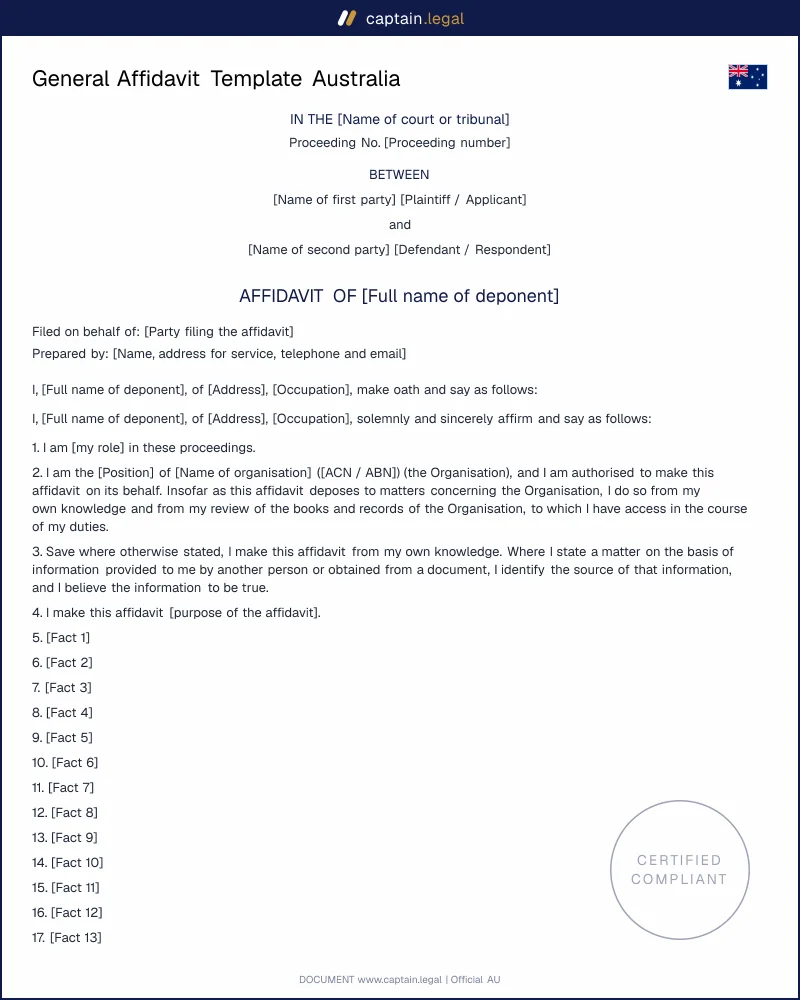
The document opens with the formal frame a registry checks first. The heading carries the court or tribunal, the proceeding number, the parties and the title "Affidavit of [full name]", followed by the date of swearing. The deponent block then sets out the opening words: "I, [name], of [address], [occupation], say on oath" or "affirm".

Inside the general affidavit, the body uses numbered paragraphs, each limited to one topic and arranged chronologically, because that is how judges cross-reference evidence. The template prompts you to separate what you saw or did yourself from what someone told you, naming the source whenever you rely on information and belief. Documents are attached as annexures marked A, B, C, or as exhibits with a certificate where the court requires it, and each page carries signature lines for deponent and witness where the rules call for them, as they do in NSW. If your records show different versions of your name, an identity paragraph deals with it, although a change of name usage declaration is often accepted on its own when that is the only point to prove.

At the foot of the document, the jurat records the place, the date, the choice between oath and affirmation, and the witness's name, qualification and signature. The NSW identity certificate or the audio visual link statements required in Victoria and Queensland are inserted automatically, and a reading clause covers deponents who are blind or need an interpreter, mirroring ss 13 and 14 of the Oaths, Affidavits and Statutory Declarations Act 2005 (WA).

State and territory considerations

New South Wales has the most prescriptive identity regime in the country. Section 26 of the Oaths Act 1900 lists who may take affidavits, including justices of the peace and Australian legal practitioners, and s 34 requires the witness to see the deponent's face, confirm identity through twelve months' acquaintance or an approved identification document, and sign a certificate saying so. Remote witnessing is permanent, since Part 2B of the Electronic Transactions Act 2000 (NSW) allows audio visual link witnessing, provided the witness endorses the document accordingly.

Across the Murray, the Oaths and Affirmations Act 2018 (Vic) takes a different route. Section 19 sets out a long list of authorised affidavit takers, from honorary justices to registered patent attorneys, and prescribes the exact wording of the oath. Victoria permanently allows electronic signing and audio visual link witnessing, but the jurat must then say so and confirm the taker used a scanned or electronic copy rather than the original.

Deponents in Queensland sign under the Oaths Act 1867, where s 13B governs the jurat and s 16A lists who may witness. Part 6A permits electronic affidavits and swearing over audio visual link, but only a special witness can do the remote version, a category that includes Australian legal practitioners. Under s 13E, a lawyer acting as special witness must name their law practice, and the Supreme, District and Magistrates Courts use Form 46 under r 431.

Western Australia remains the most traditional jurisdiction. Section 9 of the Oaths, Affidavits and Statutory Declarations Act 2005 (WA) requires swearing in the presence of an authorised witness. The pandemic-era remote arrangements were temporary and WA has no permanent equivalent, so plan for an in-person appointment if you sign in WA. South Australia sits at the other end, having made remote witnessing of affidavits permanent under the Oaths Regulations 2021 (SA).

How to fill out this general affidavit

You start with two questions that drive everything else: where will you sign, and where will the affidavit be used? Those answers set the jurat and identity certificate. The form then asks for the court, the proceeding number and the parties exactly as they appear on documents already filed, so the registry can match the affidavit to its file.

The facts come next, through guided paragraphs that ask what happened, when, and how you know it. Each document you mention joins an annexure list that letters itself and inserts the matching reference in the text.

You then download the finished general affidavit, print it and take it unsigned to your witness, together with photo identification and every annexure. If you also need a will or a power of attorney witnessed, the personal legal documents for Australians in the same category can usually be signed at that same appointment.

Common mistakes to avoid

The error we see most often is procedural. Never sign the affidavit before you are in front of the witness, because the oath and the signature must happen in the witness's presence, physical or by permitted audio visual link. The second mistake is writing submissions instead of evidence. Phrases such as "the respondent clearly lied" belong in argument, and a judge may strike them out, sometimes with costs.

Annexures cause most of the remaining trouble. Deponents attach documents without marking them, or forget that the witness must sign each annexure certificate. Mixing up jurisdictions is another frequent slip: the witness must be authorised under the law of the place where you sign, while the layout must satisfy the court receiving the document, so a Queenslander filing in Sydney needs a Queensland witness and a NSW heading. Finally, do not alter an affidavit after it has been sworn. Corrections made before swearing must be initialled by deponent and witness, and anything discovered later calls for a supplementary affidavit.

Key takeaways

Evidence

An affidavit is court evidence

A general affidavit is not a casual statement. Once sworn or affirmed and filed, it can stand as the deponent's evidence in chief, and the other side may cross-examine on every paragraph. Use it when a registrar, judge or tribunal member needs facts proved on paper, not when an insurer or agency simply asks for a statutory declaration.

Signing rules

Match the jurat to the signing place

There is no single national affidavit statute, so the jurat and witnessing steps depend on where the affidavit is made. In NSW, s 34 of the Oaths Act 1900 requires the witness to see the deponent's face, confirm identity through 12 months' knowledge or ID, and certify those steps. Victoria and Queensland also allow remote witnessing in specified circumstances.

Liability

False facts can lead to prison

The body of the affidavit still has to comply with evidence law: hearsay and opinion may be excluded unless an exception applies, and information and belief generally needs its source identified in interlocutory matters under Evidence Act s 75. Knowingly false evidence is perjury, with penalties reaching 10 years in NSW, 14 years in Queensland and 15 years in Victoria.

Frequently Asked Questions

A properly sworn general affidavit is admissible evidence, which the court treats as your testimony on oath. Its weight depends on three things: correct witnessing under the oaths legislation of the place where you sign, compliance with the receiving court's form rules, and contents limited to admissible facts. The template handles the first two. The third depends on you, because no template can make an opinion or a rumour admissible.

Justices of the peace and Australian legal practitioners are the usual choices, but a justice's authority is limited to the state or territory of appointment, so a Victorian JP cannot witness an affidavit you sign in Brisbane. Beyond them, the list varies: Victoria's s 19 names dozens of categories, Queensland distinguishes ordinary from special witnesses, and Western Australia relies on s 9 of its 2005 Act. Pharmacists and teachers are often authorised for statutory declarations but not always for affidavits, so check first.

An honest mistake should be corrected promptly by a supplementary affidavit that identifies the paragraph and states the correct position. A deliberate falsehood is perjury, carrying up to 10 years' imprisonment in NSW under s 327 of the Crimes Act 1900 and 14 years in Queensland under s 123 of the Criminal Code. A court that catches one false paragraph tends to discount the rest of your evidence.

In NSW, Victoria, Queensland and South Australia, you can, provided the witness follows that jurisdiction's remote procedure and records it in the jurat. Queensland limits remote witnessing to special witnesses, usually lawyers. In Western Australia an in-person appointment remains the safe course, and in Tasmania, the ACT and the Northern Territory you should confirm the position with your witness first. The template adds the correct audio visual link wording once you select remote witnessing.

Court orders set the timetable in most matters, and those dates prevail. Where no direction exists, practice requires affidavit material to be served a reasonable time before the hearing so the other side can respond, and late material may need the court's leave or lead to an adjournment at your cost. An affidavit does not expire once sworn, but one sworn months earlier may need a supplementary affidavit to bring the facts up to date.

Both formats come with every order. The editable Word file lets you adjust paragraphs, add annexures or match a registry's preferred layout, while the PDF gives a clean print for the swearing appointment. Courts with electronic filing generally take the signed version as a scanned PDF, so keep the original with your records. You can browse the full catalogue of Australian legal templates if your matter calls for other documents.

The choice is yours, with identical legal effect. Every Australian oaths statute treats an affirmation as equivalent to an oath, so a deponent who prefers not to swear on a religious text simply affirms. Tell the witness which you prefer before the appointment starts, because the wording of the oath and the affirmation differs and the witness administers whichever you choose. The template prints the matching wording in both the opening paragraph and the jurat.

4.6/5

17 verified reviews · 50 000+ downloads

Need a Sworn Affidavit? Court-Ready Template for Australia
  • Immediate access to the document
  • PDF + Word download
  • Compliant with 2026 legislation
  • Reviewed by lawyers
Fill in the template
Secure payment
Updated on October 16, 2026

You might also like

Letter of Wishes Template Australia
Advance Care Directive Australia