Personal

Letter of Wishes & Funeral Instructions | Cremations Act

Non-binding letter of wishes drafted around state dispensing powers and cremation laws (s 7 Cremations Act Qld, s 9 SA). Word and PDF, for every state.
4.6/5— 21 reviews50 000+ downloadsInstant download
Share

A letter of wishes and funeral instructions is a signed, non-binding document that sits beside your will and tells your executor what you would like done about your funeral, your personal belongings and your online accounts. It covers what a will handles badly, from the hymn at the service to which nephew gets the fishing rods. Executors, adult children and blended families rely on it in the first week after a death, when decisions are made fast and tempers run short. Our template is drafted for Australian succession law in every state and territory, with wording that keeps the letter persuasive without the risk of it being read as a second will.

Compliant

2026 Legislation

50,000+ clients

trust us

Affordable

From $4.90 / doc

Secure payment

Instant download

Letter of Wishes & Funeral Instructions | Cremations Act

Secure payment

Fill in the template

What is a letter of wishes?

In Australian practice, a letter of wishes is a private, signed statement addressed to your executor (and sometimes to the trustee of a testamentary trust) explaining how you would like discretions exercised after your death. It does not dispose of property. That job belongs to your Australian will drafted to state succession law, signed before two witnesses. The letter guides the decisions the will leaves open: how personal items are shared among the residuary beneficiaries, how a trustee should weigh the needs of a child with a disability, what kind of funeral you want. Because it is not executed as a will, you can rewrite it whenever life changes.

Lawyers distinguish three documents that people often merge. A codicil amends the will and must meet the same execution formalities. A memorandum incorporated by reference becomes part of the will, but only if it existed when the will was signed and the will identifies it precisely, which rarely happens. A letter of wishes is the third category: it binds no one, and it should say so on its face. Funeral instructions share that status, because Australian law gives the executor, not the deceased, the final word on disposal of the body.

When do you need this document?

Most people prepare a letter of wishes at the same sitting as their will, and that is the right moment. A will leaving "my personal chattels to my children equally" is clean on paper and a source of friction in practice, because three children cannot each take the same engagement ring. The letter of wishes is also the natural home for funeral wishes, including whether a prepaid funeral plan already exists and where the paperwork is filed.

Blended families are the second big trigger. When a spouse and children from an earlier relationship are all grieving, silence about the service, the eulogy or the resting place of the ashes is exactly the gap that ends up before a Supreme Court judge. Business owners have a separate reason. The letter can tell your executor which relative understands the company and who the accountant is, but it cannot override pre-emptive rights in a shareholders agreement for a Pty Ltd company, so the two documents must be read together.

Two edge cases deserve a mention. Anyone on the Australian Organ Donor Register should record that decision, because the family will still be asked to confirm it at the hospital. And people holding digital assets, from cryptocurrency wallets to a monetised YouTube channel, need a letter of wishes that explains where access information lives without writing passwords into a document that may be photocopied.

Key clauses included in our template

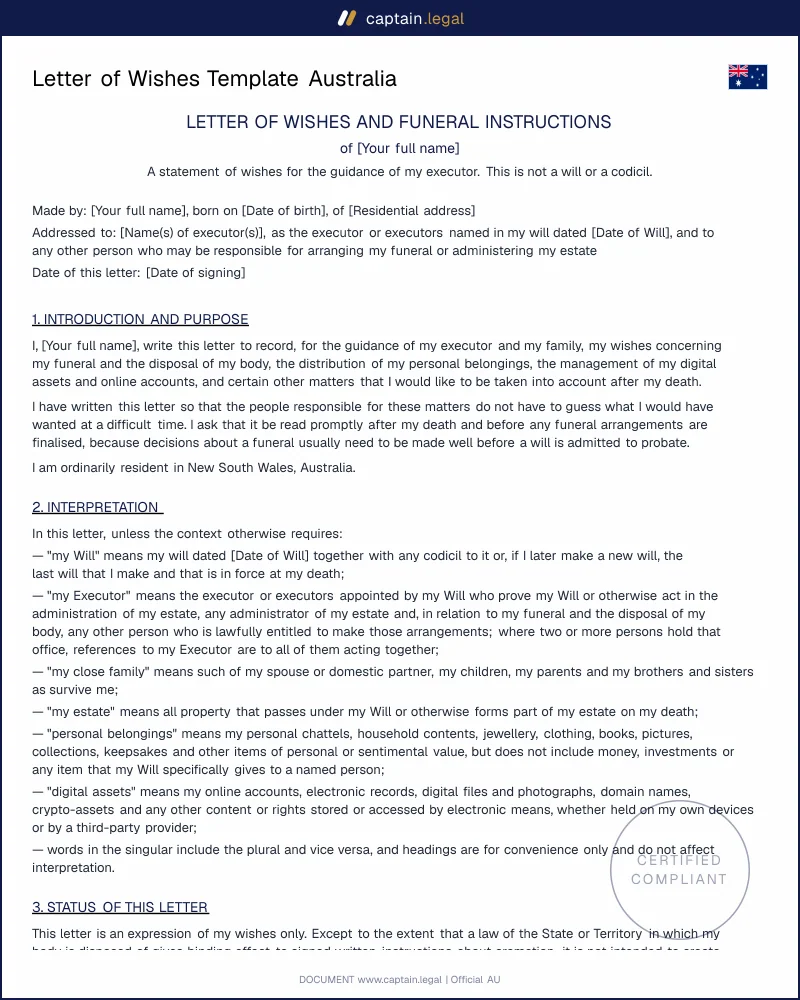
The template opens with an identification block and a statement of non-binding intent, confirming that the letter accompanies a will of a stated date, expresses wishes only and yields to the will on any inconsistency. That paragraph is the main defence against a dispensing power application, so it sits on page one.

  • Your funeral section records burial or cremation as a signed statement, then the service, the funeral director, music, readings and speakers.
  • Body donation gets its own paragraph, since university programs usually require registration in advance and acceptance within hours of death.
  • For personal items, the schedule names each object and its intended recipient, plus a fallback for anything unlisted (for example, rotating choice among the residuary beneficiaries).
  • Digital accounts are handled platform by platform: close, memorialise or download, and where access details are kept, never the passwords themselves.
  • Pets, unfinished projects and personal messages close the letter, with a note of where original documents and insurance policies are stored.

An optional passage speaks to the trustee of any testamentary trust about distributing income and capital. Superannuation is listed but deliberately not dealt with: a death benefit is paid by the fund trustee, and the document that directs it is a valid binding death benefit nomination under the SIS Regulations. Your letter of wishes simply points the executor to it.

State and territory considerations

In New South Wales, the practical test sits with the medical referee who issues the cremation permit under the Public Health Regulation 2022 (NSW). The referee must be satisfied that the deceased left no written objection to cremation. A signed letter stating "I do not wish to be cremated" therefore stops a cremation outright. NSW has also led the work on digital assets: the NSW Law Reform Commission's Report 147 recommended a statutory access scheme, later taken up as a national project by the Meeting of Attorneys-General. Until legislation arrives, executors depend on each platform's terms.

Victoria works differently. Apart from a narrow rule for disposals ordered by a magistrate or coroner under the Cemeteries and Crematoria Act 2003 (Vic), no general statute gives effect to a wish to be cremated. The executor's common law discretion governs. The tone of the letter therefore matters more in Melbourne than in Brisbane, because the document has to persuade when it cannot compel.

A cremation wish gets its strongest protection in Queensland. Under s 7 Cremations Act 2003 (Qld), a personal representative who knows the deceased left signed instructions to be cremated must carry them out. The objection procedure in s 8, which otherwise lets close relatives block a cremation, does not apply where those instructions exist. An unsigned note on a phone will not trigger the rule. The signature is everything.

Executors in Western Australia face a duty rather than a pure discretion. The Cremation Act 1929 (WA) requires the administrator to use all reasonable endeavours to carry out a written wish to be cremated. It also makes it unlawful to cremate someone who left instructions against it. In remote areas, naming an acceptable alternative to a distant crematorium spares the family a hard call.

South Australia sits closer to Queensland, with one twist. Section 9 of the Burial and Cremation Act 2013 (SA) lets a parent or child object to a cremation. A spouse or partner cannot object unless they are also the personal representative. The objection fails where the deceased directed cremation by will or another signed and witnessed document, hence the optional witness line in our template.

How to fill out this letter of wishes

You start by choosing your state or territory, because the form adjusts the cremation wording and the witness option to local rules. The questionnaire then asks for the date of your current will and the name of your executor, so the letter of wishes refers to the right document and reaches the right person. Most users finish the practical funeral questions quickly and spend longer on readings, music and speakers.

The personal items schedule works best if you walk through the house first. Describe each object so a stranger could identify it: "my grandmother's gold watch engraved M.K." leaves no room for argument, while "my jewellery" leaves plenty. For digital accounts, list the platform, the linked email address and what you want done, then say where access details are stored.

Once the draft is generated, you sign and date it. Keep the original with your will, give your executor a copy, and review both whenever you update your other personal legal documents for Australian estates, such as a power of attorney or an advance care directive.

Common mistakes to avoid

The most damaging mistake is writing a letter of wishes as if it were a will. A phrase such as "I give my car to Tom" invites a dispensing power application, and a letter that postdates the will may be argued to revoke part of it. Use the language of wishes and requests, and let the will do the giving. Hiding the letter is nearly as bad. Families regularly find it in a drawer after the cremation. Funeral decisions are made within days of death, long before probate is granted, so your executor needs to know where the letter is today.

Contradiction causes the next set of problems. A letter leaving a painting to a niece while the will gives "all my artworks" to a son forces the executor to choose between the legal gift and the moral one, and the son can insist on the will. Writing passwords into the letter is another frequent error: the document will be copied, and logging into someone else's account without authority can breach platform terms and, in some cases, Part 10.7 of the Criminal Code Act 1995 (Cth). Finally, many letters are never updated, though a separation or a new grandchild can make an old one actively unhelpful.

Key takeaways

Practical wishes

It guides what your will leaves open

A letter of wishes sits beside your will as a signed, private note to your executor. It can cover funeral preferences, personal belongings, online accounts and trustee discretions, without disposing of property. That makes it useful in the first week after death, when family decisions are made quickly and small items can cause real conflict.

Funeral control

Your executor still has the final say

Australian law treats funeral directions as guidance, not a binding command. Under cases such as Williams v Williams and Smith v Tamworth City Council, the executor has the right and duty to arrange disposal of the body. Cremation is the main exception: state laws, including s 7 of the Queensland Cremations Act 2003 and s 9 in South Australia, can give signed wishes stronger force.

Probate risk

Loose wording can trigger a will dispute

A badly drafted letter can be argued into probate if it reads like a gift of property. State dispensing powers, such as s 8 Succession Act 2006 (NSW), s 9 Wills Act 1997 (Vic) and s 18 Succession Act 1981 (Qld), let courts admit informal documents as wills. The letter should say it has no testamentary intention and that the will prevails.

Frequently Asked Questions

No court will enforce it as an instruction, and that is by design. Your executor is not legally required to follow it, although a trustee exercising a discretion may properly take it into account. Two exceptions matter. Signed cremation instructions carry statutory force in Queensland, Western Australia and South Australia, and New South Wales will not allow a cremation against a written objection. In NSW family provision claims, the letter is also admissible evidence of your reasons. Otherwise it persuades rather than compels.

Generally not. The letter is not a will, so the two-witness rule in state succession legislation does not apply, and unnecessary witnesses can make the document look like a will to a probate registrar. South Australia is the exception: a direction to be cremated defeats a relative's objection there only if it sits in a will or another signed and witnessed document. If cremation matters to you and you live in SA, use the witness line. Elsewhere, your dated signature is enough.

Yes. The letter is generated as an editable Word file and a print-ready PDF. Most people sign the PDF and keep the Word version for edits, since a letter of wishes usually changes several times while the will stays put. You can update one section and sign a fresh copy the same day. If you are building a full estate plan, the complete catalogue of Australian legal templates covers the documents most people sign alongside it.

Faster than most people expect. A funeral is typically held within one to two weeks of death, and the executor's right to arrange it exists from the moment of death, not from the grant of probate, which can take months. Funeral directors ask about burial or cremation at the very first meeting. Reasonable funeral costs are paid from the estate, and most banks will settle a funeral invoice from the deceased's account before probate. For body donation the window is hours, so give your executor a copy now.

The executor decides. If the executor and close relatives cannot agree, any of them can apply to the Supreme Court of the relevant state, and these applications are heard urgently, sometimes within a day. Judges start from the executor's right to dispose of the body, then weigh your expressed wishes, the family's views and any cultural or spiritual obligations, which carry particular weight for Aboriginal and Torres Strait Islander families. A clear, signed letter shifts that balance in your favour.

Carefully, if at all. Throughout Australia, divorce generally revokes gifts and appointments in favour of a former spouse under the will, but separation alone does not, and the letter cannot fix a will that still names an estranged partner as executor. Update the will first and use the letter only to explain your reasons. Where the relationship has ended, the property side is usually settled through our family law agreements and separation templates.

4.6/5

21 verified reviews · 50 000+ downloads

Letter of Wishes & Funeral Instructions | Cremations Act
  • Immediate access to the document
  • PDF + Word download
  • Compliant with 2026 legislation
  • Reviewed by lawyers
Fill in the template
Secure payment
Updated on October 16, 2026

You might also like

Revocation of Power of Attorney Template
General Power of Attorney AU