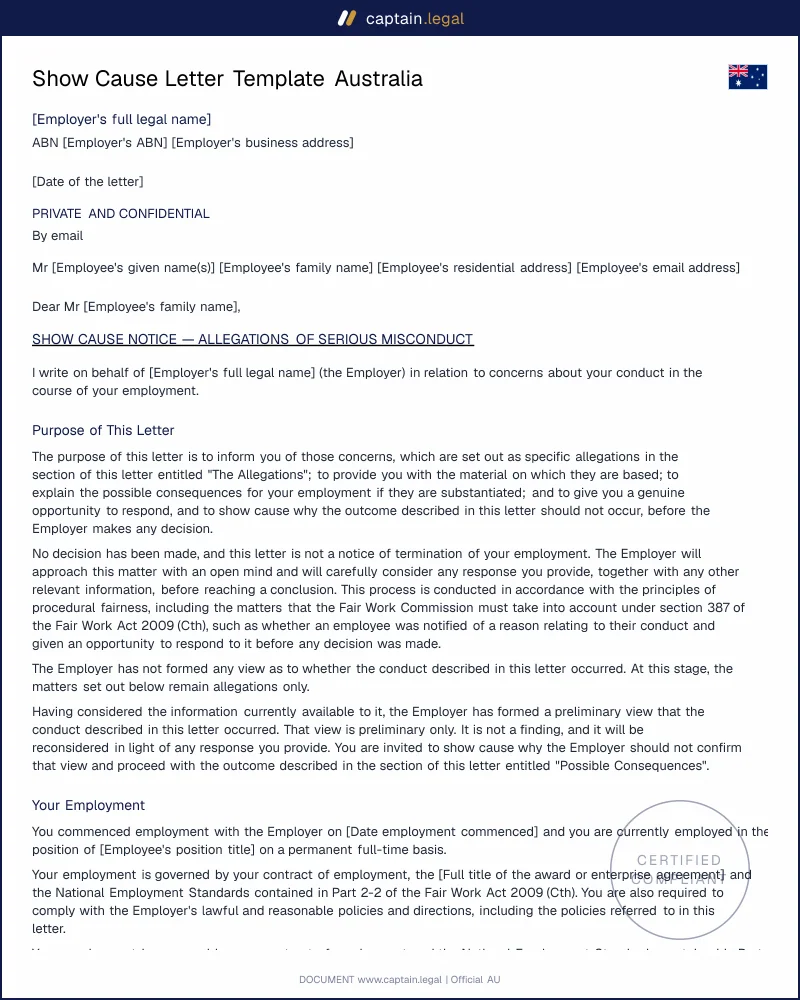
National system employers cover most of the country. The Fair Work Act reaches incorporated businesses everywhere and, through state referrals of power, nearly all private employers outside Western Australia. Businesses with fewer than 15 employees can rely on the Small Business Fair Dismissal Code, which permits summary dismissal where the employer believes on reasonable grounds that the conduct was serious enough. Under Pinawin v Domingo [2012] FWAFB 1359, the Commission asks whether that belief was genuinely held and reasonably formed, and a show cause process is the clearest evidence that it was.
Western Australia is the main exception. Sole traders, unincorporated partnerships and some trusts remain in the state system under the Industrial Relations Act 1979 (WA), as does the WA public sector. The test under s.29 is whether the dismissal was harsh, oppressive or unfair, there is no minimum employment period, and the claim window is 28 days after the dismissal. Employees outside an award or agreement earning above the prescribed amount in s.29AA are excluded. With no equivalent of the Small Business Code, the show cause letter carries the whole procedural burden.
New South Wales public sector agencies operate under the Government Sector Employment Act 2013 (NSW) and the Industrial Relations Act 1996 (NSW), which also covers local councils. Misconduct action under s.69 of the GSE Act must follow the procedural requirements of the GSE Rules 2014, and unfair dismissal applications go to the Industrial Relations Commission of New South Wales within 21 days.
Queensland state and local government employers sit under the Industrial Relations Act 2016 (Qld), with reinstatement applications heard by the Queensland Industrial Relations Commission within 21 days. Public service discipline follows the Public Sector Act 2022 (Qld) and the Discipline directive, which uses a formal show cause notice at both the allegation stage and the proposed penalty stage.