Employment

Employee Stopped Showing Up? Abandonment Letter Template AU

Drafted to s.386 and s.387 Fair Work Act 2009 and the Bienias Full Bench ruling. Welfare, final notice and termination letters for NSW, Vic, Qld and WA.
4.9/5— 18 reviews50 000+ downloadsInstant download
Share

An abandonment of employment letter is the written record an Australian employer sends when an employee stops attending work without explanation and cannot be reached. It asks the employee to make contact, sets a firm date to respond, and states what will happen if they stay silent. Our template is built for small business owners, HR managers and practice managers who need to deal with an unexplained absence under the Fair Work Act 2009 (Cth) without turning a no-show into an unfair dismissal claim. It covers the first welfare contact, the final request to explain the absence and the confirmation that employment has ended, so every step of the unexplained absence process is documented in a form the Fair Work Commission will recognise.

Compliant

2026 Legislation

50,000+ clients

trust us

Affordable

From $4.90 / doc

Secure payment

Instant download

Employee Stopped Showing Up? Abandonment Letter Template AU

Secure payment

Fill in the template

What is an abandonment of employment letter?

The Fair Work Act does not define abandonment. The Commission describes it as a situation where an employee ceases to attend work without proper excuse or explanation and, by doing so, shows an unwillingness or inability to perform the contract. In contract terms, that conduct is a form of repudiation. The employer can accept the repudiation and end the relationship, but nothing happens until it does. The abandonment of employment letter is how that step is taken and proved.

The document is often confused with two others. A resignation acceptance responds to an employee who has clearly said they are leaving; abandonment involves no such statement, which is why the employer carries more risk. A termination letter for misconduct follows an investigation into known conduct, while an abandonment letter starts from the opposite position: the employer does not know why the employee is absent and has to find out before deciding anything. A well-drafted letter therefore reads first as a genuine attempt to make contact, and only in its final stage as notice that employment is ending.

When do you need this document?

The classic trigger for an abandonment of employment letter is an employee who simply stops turning up, with calls going to voicemail and messages left unanswered. A second common scenario is the failure to return after approved leave: an employee goes overseas on annual leave, the return date passes, and nobody hears from them. Here the letter fixes the agreed return date on the record. It also helps when an absence starts with a single message ("not feeling well, will call later") and then goes quiet. A reason was given, so the employer cannot treat it as abandonment straight away, but it can require evidence and set a reasonable deadline.

Three edge cases deserve care. If the absent worker was engaged under an independent contractor agreement for Australian businesses, the analysis is about breach of a commercial contract, although s.15AA lets the Commission look past the label to the real substance of the relationship. A casual employee with no firm advance commitment who stops accepting shifts raises different questions, and the letter should be adapted rather than sent as standard. And where the employee may be experiencing family and domestic violence, the ten days of paid leave under s.106A mean a silent absence can have a protected cause the employer does not yet know about.

Key clauses included in our template

  • The employee identification and absence record sets out the employee's full name, position, last day of attendance and every rostered day missed since. Precise dates matter because the Commission will compare them against the employer's own rosters and call logs.
  • The summary of contact attempts lists each phone call, text, email and letter with its date and method. This is the core evidence that the employer made reasonable efforts before drawing any conclusion.
  • The welfare statement expresses genuine concern for the employee's wellbeing and invites them to make contact. It answers any later suggestion that the outcome was decided in advance.
  • The request for an explanation and supporting evidence asks the employee to explain the absence and, where relevant, provide a medical certificate or statutory declaration. The wording tracks regulation 3.01 so a legitimate illness or injury claim surfaces early.
  • The response deadline gives a specific calendar date and time, with a reasonable allowance for delivery. Vague phrases such as "as soon as possible" have no place in the final letter.
  • The statement of consequences explains that if no response is received, the employer will treat the conduct as a repudiation and end the employment. This is the opportunity to respond that s.387(c) looks for.
  • The confirmation of termination records the effective date, the reason and the final pay position. Where a standard dismissal is the better route, our termination letter pack drafted to s.117 and s.119 of the Fair Work Act takes over.

State and territory considerations

New South Wales private sector employers are in the national system, but state law still shapes the outcome. If the absent employee has a compensable workplace injury, s.248 of the Workers Compensation Act 1987 (NSW) makes it an offence to dismiss them because they are not fit for employment within six months of becoming unfit, and a dismissed injured worker can apply for reinstatement within two years. Long service leave matters too. Under s.4(2)(a)(iii) of the Long Service Leave Act 1955 (NSW), pro rata leave after five years is lost only where the employer terminates for serious and wilful misconduct, so the way the letter characterises the conduct has a direct financial effect.

Victoria referred its industrial relations powers to the Commonwealth, so almost every private employer applies the Fair Work Act directly. The main state overlay is the Workplace Injury Rehabilitation and Compensation Act 2013 (Vic), which requires employers to provide suitable or pre-injury employment for up to 52 weeks of a worker's incapacity, to the extent reasonable. An injured worker's silence is therefore not a safe basis for abandonment. Under the Long Service Leave Act 2018 (Vic), pro rata leave is payable after seven years whatever the reason for termination.

Queensland private employers are also in the national system. The key risk is s.232B of the Workers' Compensation and Rehabilitation Act 2003 (Qld), which makes it an offence to dismiss a worker within 12 months of injury solely or mainly because they are not fit for their position. Long service leave is governed by the Industrial Relations Act 2016 (Qld), where pro rata leave between seven and ten years is generally not payable if the employer ends employment because of the employee's conduct, which is how most abandonment cases are framed.

Western Australia needs separate treatment. Sole traders, partnerships and other employers that are not constitutional corporations sit in the state system under the Industrial Relations Act 1979 (WA). Their employees bring unfair dismissal claims to the Western Australian Industrial Relations Commission within 28 days rather than 21, and the template adjusts the tribunal reference accordingly.

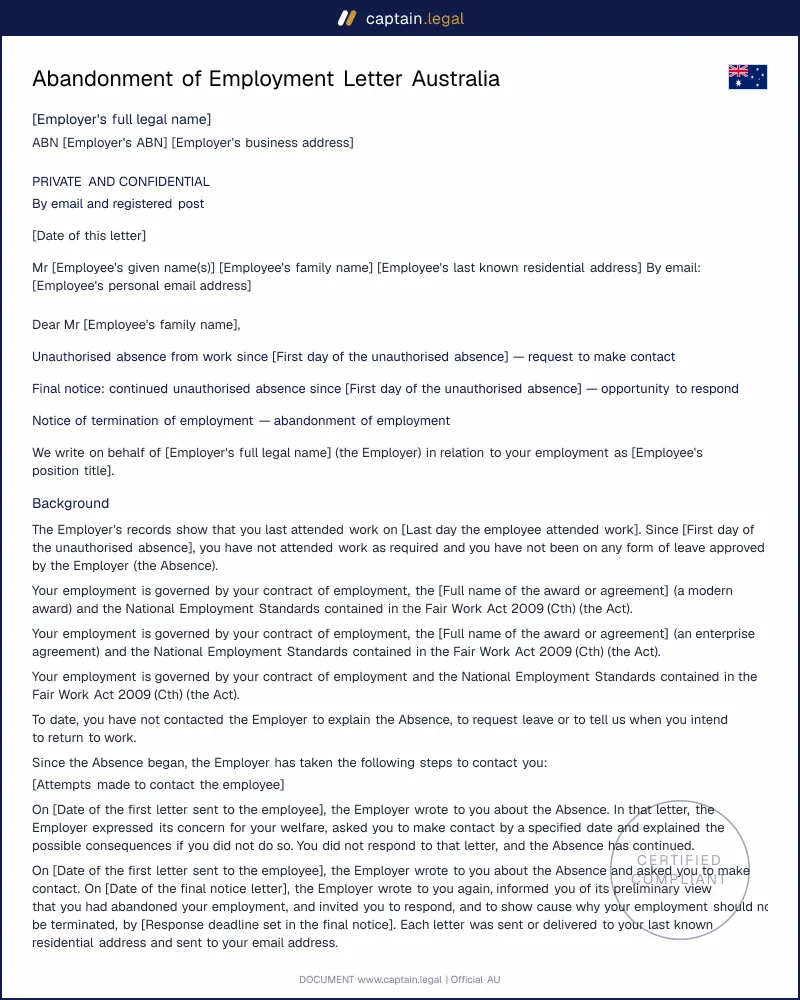
How to fill out this abandonment of employment letter

You start by selecting the state or territory where the employee works and confirming whether your business is a company or an unincorporated employer, which matters most in Western Australia. The form then asks for the employee's details, position, employment type and the date they last attended work. From there, you record each contact attempt with its date and channel.

Next, you choose the stage you are at, and you can return to the same answers as the matter progresses. The welfare letter is open in tone; the final letter sets the response deadline and states the consequences; the confirmation letter records the end of employment. If the absence follows approved leave, you enter the agreed return date and the wording adjusts.

Finally, you set the deadline and the delivery method. Registered Post to the last known address, combined with email to the employee's personal address, is the safest combination. If the employee responds with a performance or conduct issue rather than a valid explanation, a written warning and performance improvement plan is usually the better next step than termination.

Common mistakes to avoid

The most frequent mistake is treating silence as a resignation. Employers send a letter saying "you are taken to have resigned", then argue at the Commission that there was no dismissal. That argument succeeds only where the repudiation was unmistakable and the employer's contact efforts were thorough, which is rarely the case when the letter went out after three days. The second mistake is moving too fast. A termination letter sent before the employee has had a genuine chance to respond is the single biggest cause of lost abandonment cases. The third is relying on one channel. A single unanswered call is not "all reasonable attempts", and the Commission will ask whether the employer also emailed, wrote, tried the emergency contact on file or, in serious cases, requested a police welfare check.

The fourth mistake is backdating. Letters that set the termination date as the last day the employee attended create notice, final pay and continuity problems, and they suggest the decision came before the process. The effective date should be the date the employer actually decides to end employment, after the response deadline has passed. The last mistake is forgetting the money. Accrued annual leave must be paid out under s.90(2), most modern awards require final pay within seven days of termination, and notice under s.117 is still owed unless s.123(1)(b) applies because the conduct genuinely amounts to serious misconduct.

Key takeaways

LEGAL TEST

Abandonment is not automatic termination

Under Bienias v Iplex Pipelines, an unexplained absence does not end employment by itself, even where an award or contract once suggested a deemed termination. The employer must take a positive step to accept the repudiation and end the relationship. Safer drafting treats that step as a potential dismissal under section 386 of the Fair Work Act 2009.

PROCESS

Contact first, decide only after silence

The letter should start as a welfare contact, not a punishment. It asks the employee to respond by a firm date, records reasonable attempts to reach them, then gives a final chance to explain the absence. That paper trail matters under section 387, because the Fair Work Commission looks for notice of the reason and a fair opportunity to respond.

ILLNESS RISK

Protected absence can change everything

Section 352 of the Fair Work Act 2009 prohibits dismissal because of a temporary absence for illness or injury. Regulation 3.01 protects an employee who provides a medical certificate or statutory declaration within 24 hours, or within a longer reasonable period. Ending employment too quickly can shift the dispute into a general protections claim under section 365.

Frequently Asked Questions

The letter is the document that ends the employment and proves how that happened. Employment does not end automatically through absence; under Bienias v Iplex Pipelines [2017] FWCFB 38, the employer must act, and the letter is that act. A properly sequenced set of letters, showing reasonable contact attempts, a clear deadline and a stated consequence, is strong evidence that the employee had a fair opportunity to respond under s.387. It will not prevent an application to the Commission, but it puts the employer in a far better position to defend one.

There is no fixed number. Modern awards no longer contain abandonment clauses, and the Fair Work Act sets no minimum period. Many employers start the process after three consecutive working days without contact, reflecting the old award practice, but that is a trigger for the first letter rather than a conclusion. The Commission looks at the length of the absence, the employee's history, the contact attempts made and whether any explanation was given.

A period of three to seven days from the expected delivery date of the final letter is common, and longer is appropriate where it goes by post or the employee may be overseas. A deadline that ends before the letter could reasonably arrive is no opportunity at all. State a specific date and time rather than a number of days, and keep proof of delivery. A reply that arrives after the deadline but before termination is confirmed should still be considered on its merits.

You receive the completed letters in Word and PDF. The Word version lets you add further contact attempts or change the deadline before sending, and the PDF gives you a clean copy to post, email and keep on the personnel file. The welfare letter, final notice and termination confirmation are separate documents, so each can be dated and sent on its own. The full range of Australian legal document templates works the same way.

Yes, if the termination is found to be a dismissal under s.386. An eligible employee must apply within 21 days under s.394(2), after completing the minimum employment period of six months, or 12 months for a small business with fewer than 15 employees, and earning under the high income threshold unless an award or agreement covers them. A small business that treats prolonged, unexplained absence as serious misconduct and follows the Small Business Fair Dismissal Code is in a stronger position. A general protections claim under s.365, also within 21 days, remains possible if the absence was linked to illness, injury or another workplace right.

Final pay is always owed, including wages to the termination date and accrued annual leave under s.90(2). Notice under s.117 is payable unless s.123(1)(b) applies because the absence amounted to serious misconduct, meaning wilful or deliberate conduct inconsistent with continuing the contract under regulation 1.07. A long, unexplained absence after repeated contact attempts will often meet that standard; a short one usually will not. Withholding final pay to encourage contact is a breach in its own right. The Australian employment templates collection includes an exit pack covering final pay.

4.9/5

18 verified reviews · 50 000+ downloads

Employee Stopped Showing Up? Abandonment Letter Template AU
  • Immediate access to the document
  • PDF + Word download
  • Compliant with 2026 legislation
  • Reviewed by lawyers
Fill in the template
Secure payment
Updated on October 15, 2026

You might also like

Probation Outcome Letter Australia
Fixed-Term Employment Contract AU