New South Wales private sector employers sit in the national system, so the Fair Work rules above apply. The NSW public sector and local government follow the Industrial Relations Act 1996 (NSW). Under section 83 and clause 6 of the Industrial Relations (General) Regulation 2020, an employee on probation cannot claim unfair dismissal if the probation was determined in advance and is three months or less, or longer but reasonable. Public servants may face up to twelve months under rule 5 of the Government Sector Employment (General) Rules 2014, a maximum the Industrial Relations Commission accepted in Simon v Industrial Relations Secretary [2025] NSWIRComm 1027.
Queensland private employers are also national system employers, while state and local government employees fall under the Industrial Relations Act 2016 (Qld). Section 315 sets a statutory probationary period of three months unless the parties agree in writing on a shorter period or none at all. During that period an unfair dismissal claim is unavailable, though general protections claims remain open. The Queensland Industrial Relations Commission treated a six month probation as a reasonable extension in Ncube v Cairns Regional Council [2022] QIRC 75.
Western Australia needs separate treatment. Sole traders, partnerships and some trusts remain in the state system under the Industrial Relations Act 1979 (WA), which has no minimum employment period at all. A state system employee can claim unfair dismissal from the first week of employment. Section 23A requires the Western Australian Industrial Relations Commission to consider whether the employee was on probation and employed for less than three months. Claims must reach the Commission within 28 days, and the unlawful termination provisions of the Fair Work Act still apply.
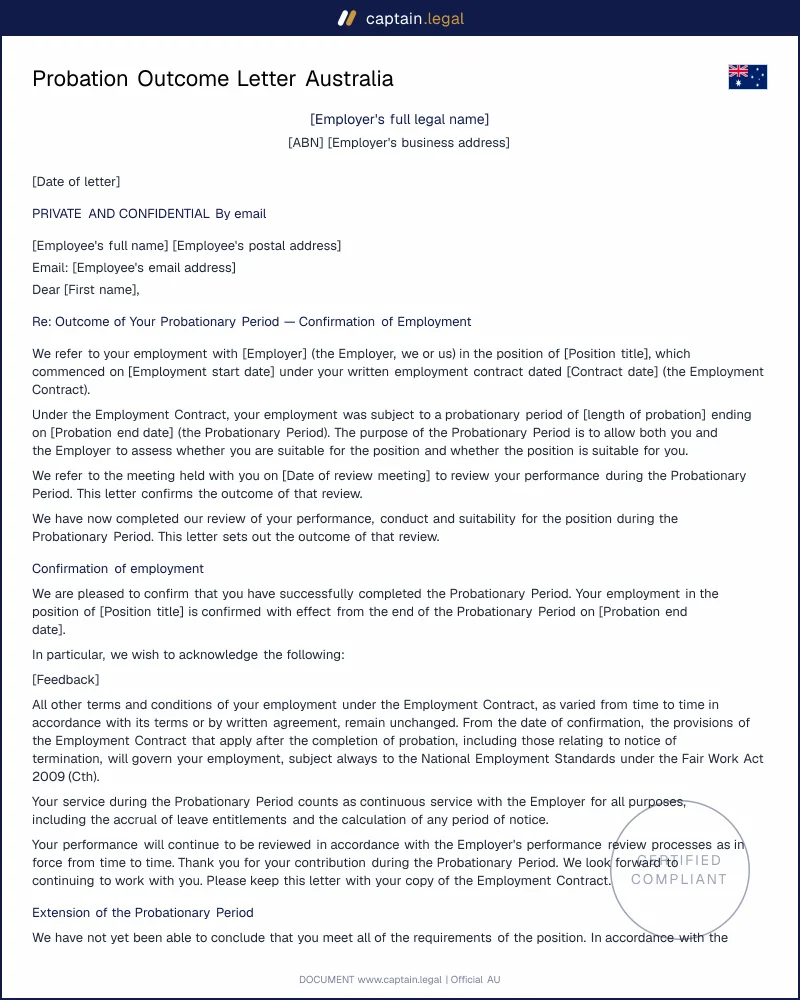
Victoria referred its industrial relations powers to the Commonwealth, so private employers and most public sector employers apply the Fair Work rules directly. The added layer is the Equal Opportunity Act 2010 (Vic), which prohibits discrimination in dismissal under section 18 and opens a complaint pathway through the Victorian Equal Opportunity and Human Rights Commission. A probation outcome letter ending employment in Victoria should therefore rest on documented performance facts only.
South Australia and Tasmania keep state systems for their own public sectors, under the Fair Work Act 1994 (SA) and the Industrial Relations Act 1984 (Tas), while private employers there follow the Commonwealth rules. In the ACT and the Northern Territory, every employer is a national system employer.