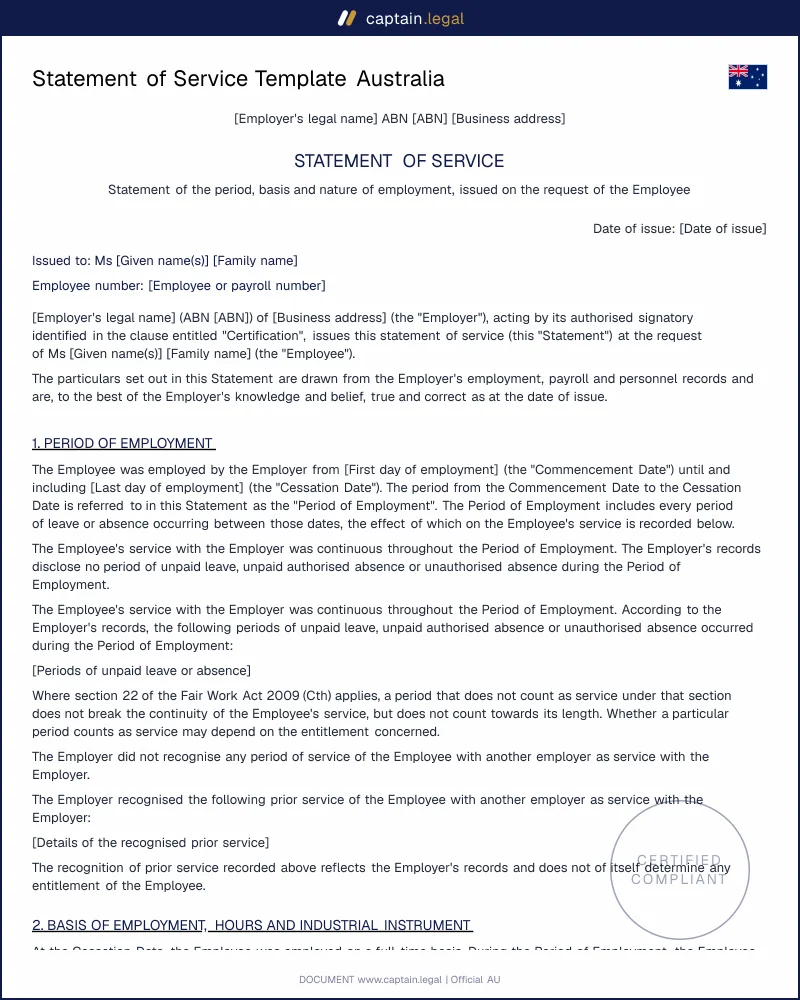
The statement of service matters most at state level because long service leave is still governed by state and territory legislation, preserved under s 113 of the Fair Work Act. Continuity of service often turns on the dates in your letter, and South Australia, Tasmania, the ACT and the Northern Territory each have their own Long Service Leave Act with different thresholds.
New South Wales applies the Long Service Leave Act 1955 (NSW): two months after ten years, and a pro rata payment after five years where the employer ends the employment other than for serious and wilful misconduct, or the employee resigns because of illness, incapacity or domestic or other pressing necessity. That trigger is why NSW employees sometimes ask for the reason for leaving to be stated. Construction workers accrue under the portable scheme in the Building and Construction Industry Long Service Payments Act 1986 (NSW).
Victoria has the most generous regime. Under the Long Service Leave Act 2018 (Vic), leave is available after seven years, continuity survives a resignation or dismissal followed by re-employment within 12 weeks, and s 11 carries service across a transfer of business or assets. Employers cannot refuse a request for long service leave records. Community services, contract cleaning and security workers sit under the Long Service Benefits Portability Act 2018 (Vic).
Queensland sets the entitlement in s 95 of the Industrial Relations Act 2016 (Qld) at 8.6667 weeks after ten years, with pro rata access after seven years in defined circumstances. State and local government employees remain in the Queensland system under their own certified agreements, and QLeave administers portable schemes for building and construction, contract cleaning and community services.
Western Australia needs separate treatment. Sole traders, partnerships and unincorporated trusts sit outside the national system and fall under the Industrial Relations Act 1979 (WA) and the Minimum Conditions of Employment Act 1993 (WA). Amendments to the Long Service Leave Act 1958 (WA) that commenced on 20 June 2022 confirmed coverage of casual and seasonal employees and expanded record-keeping duties, with 8.667 weeks due after ten years and pro rata after seven. A resignation followed by later re-employment does not preserve continuity in WA, so precise dates matter.